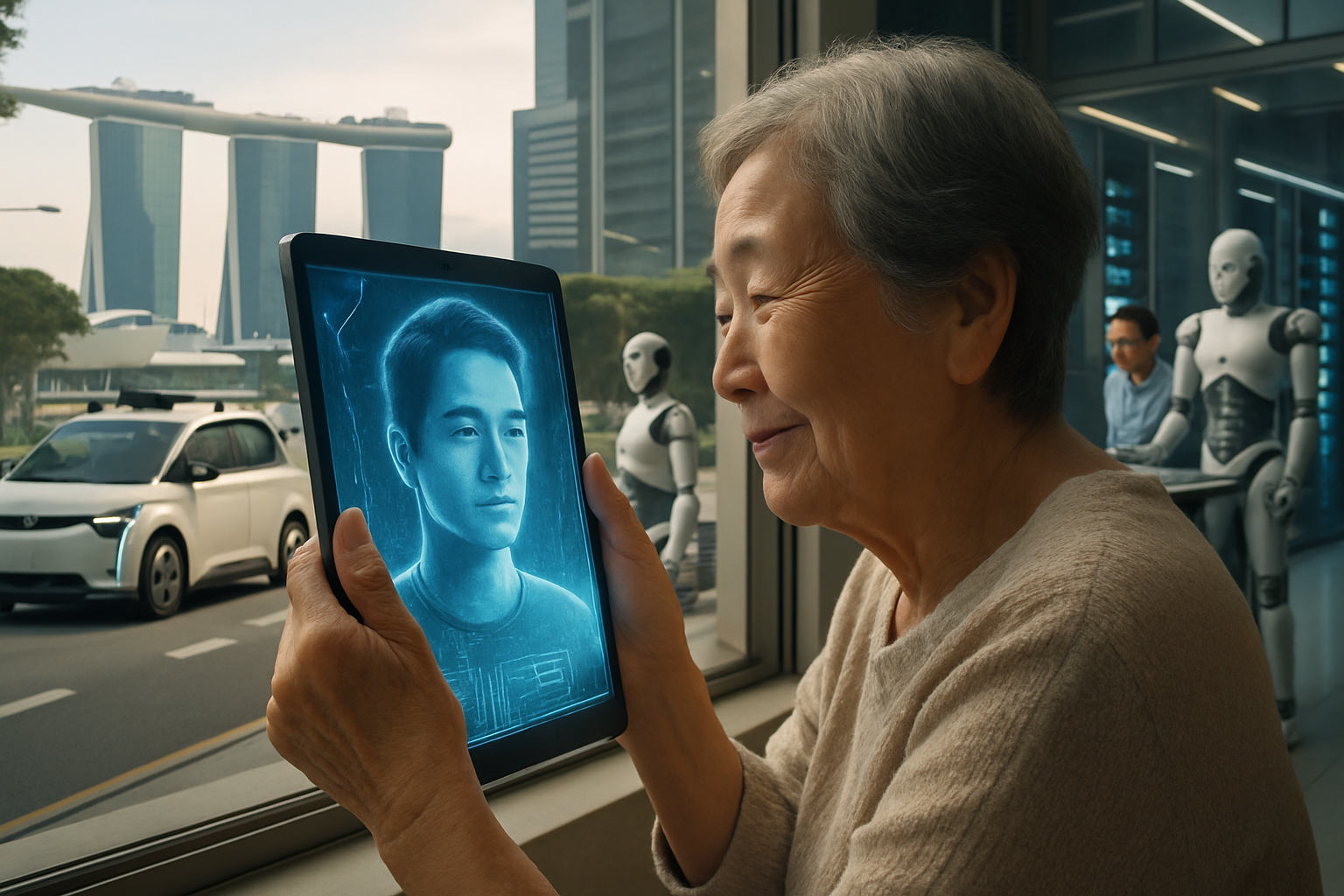
April 2026 marks a watershed moment in artificial intelligence development as revolutionary applications emerge across continents, from digital avatars comforting bereaved families in China to autonomous vehicles navigating Singapore's streets, while global cybersecurity threats raise urgent questions about the technology's rapid integration into essential infrastructure.
Digital Resurrection: AI Clones Provide Comfort in Grief
In a development that blurs the lines between technology and human emotion, a Chinese family has pioneered the use of artificial intelligence to create a digital version of their deceased son to comfort his elderly mother. After the man was tragically killed in a road accident last year, his family hired an AI technology team led by Zhang Zewei in Jiangsu province to develop a digital avatar capable of engaging in natural conversations.
The AI creation can chat with his octogenarian mother online, helping her cope with the reality of losing her only child. The system utilizes advanced natural language processing and personality modeling to maintain the conversational patterns and emotional connections that defined their relationship.
"This represents a fundamental shift in how we might address grief and loss in the digital age, though it raises profound questions about the nature of memory, attachment, and healing."
— Dr. Emily Chen, Digital Psychology Research Institute
The incident, exposed by team leader Zhang Zewei and reported by Litchi News, highlights the growing intersection between artificial intelligence and deeply personal human experiences. The family, residing in Shandong province, represents an early adopter of what experts predict could become a significant application of AI technology in emotional and psychological support.
Singapore Leads Autonomous Vehicle Revolution
Simultaneously, Singapore is positioning itself at the forefront of autonomous vehicle deployment with groundbreaking robotaxi operations. In the quiet streets of northern Singapore, left-hand drive vehicles from China are being tested with safety officers trained to keep their hands off the wheel unless emergencies arise.
The program represents a strategic partnership between Singapore and Chinese autonomous vehicle leaders, mirroring successful deployments already operating in Beijing, Shenzhen, San Francisco, and Los Angeles. Singapore's systematic approach includes comprehensive safety protocols and regulatory frameworks designed to ensure public trust while advancing technological capabilities.
The initiative reflects Singapore's broader AI education strategy, including plans to train 10,000 students in physical AI systems over the next five years. Education Minister Desmond Lee has emphasized the importance of preparing students for a future where autonomous machines operate using "common sense" reasoning in real-world environments, building on Singapore's successful WonderBot 2.0 conversational AI heritage education system.
Global Cybersecurity Crisis Threatens AI Infrastructure
As AI systems become increasingly integrated into critical infrastructure, cybersecurity concerns are reaching alarming levels. The gaming industry has experienced significant breaches, with Rockstar Games, developer of the Grand Theft Auto series, revealing exposure to data breaches that demonstrate the vulnerability of major technology companies.
The breach, first reported by Egyptian media outlet Sada El-Balad, illustrates a pattern of escalating cyber threats targeting companies with valuable digital assets. Hackers issued ultimatums demanding payment to prevent data leaks, a tactic becoming increasingly common as AI-enhanced criminal networks exploit vulnerabilities in corporate systems.
European law enforcement reports document criminal organizations using AI as "elite hackers" for automated vulnerability detection and sophisticated attack coordination. This development coincides with Spain's implementation of the world's first criminal executive liability framework for technology platforms, creating personal legal risks for executives who fail to maintain adequate security measures.
Educational AI: Balancing Innovation with Human Development
The educational sector continues to grapple with AI integration challenges and opportunities. Singapore's approach to training 10,000 students in physical AI systems represents part of the global "2026 Educational Technology Renaissance" - a coordinated international movement toward thoughtful digital tool integration while preserving traditional educational values.
Success models include Malaysia's world-first AI-integrated Islamic school achieving 97.82% teacher placement rates while combining artificial intelligence with traditional religious and academic learning. Canada's responsible AI teaching assistants maintain critical thinking standards while providing personalized educational support. These examples demonstrate that effective AI implementation enhances rather than replaces fundamental human relationships in education.
However, challenges persist. Dr. Frank Bäumer's research documents a "productivity paradox" where AI implementation often creates additional workload rather than the promised efficiency gains, as students and educators must perform their original responsibilities while also supervising and correcting AI outputs.
Infrastructure Crisis Drives Innovation
The global semiconductor crisis continues to create challenges and opportunities for AI development. Memory chip prices have surged sixfold, affecting major manufacturers Samsung, SK Hynix, and Micron, with shortages expected to persist until 2027 when new fabrication facilities come online.
Paradoxically, these constraints are spurring innovation in memory-efficient algorithms and sustainable deployment strategies that could democratize AI access by reducing computational requirements. The World Bank projects that AI water demand could reach 4.2-6.6 billion cubic meters annually by 2027 for data center cooling alone - equivalent to four to six times Denmark's total water consumption.
Despite these challenges, massive corporate investments continue. Alphabet has committed $185 billion to AI infrastructure in 2026, representing the largest single-year corporate technology investment in history. Amazon's development plans exceed $1 trillion over the coming decade, demonstrating industry confidence in AI's transition from experimental to essential infrastructure.
International Governance and Regulation
The rapid advancement of AI technology has prompted unprecedented international cooperation on governance frameworks. The United Nations has established an Independent Scientific Panel comprising 40 global experts under Secretary-General António Guterres - the first fully independent international AI assessment body.
France has conducted AI company cybercrime raids while the European Union threatens billion-dollar penalties under the Digital Services Act for violations. This coordinated regulatory response represents the most sophisticated global technology governance effort since internet commercialization, aimed at preventing "jurisdictional shopping" where companies exploit regulatory differences between nations.
Human-Centered AI: The Path Forward
The most successful AI implementations consistently demonstrate human-centered approaches that amplify rather than replace human capabilities. Singapore's heritage education programs, Malaysia's religious-academic integration, and Canada's critical thinking preservation all share common characteristics: sustained human development commitment, comprehensive stakeholder engagement, and cultural sensitivity in implementation.
As Microsoft's Mustafa Suleyman predicts that AI could replace the majority of office workers within two years and lawyers and auditors within 18 months, regional variations in response are emerging. Indian IT giants like Infosys, Wipro, and HCL are implementing comprehensive worker transition programs rather than mass layoffs, demonstrating alternative approaches to workforce transformation.
The Civilizational Choice Point
Industry experts characterize April 2026 as a "civilizational choice point" - a critical juncture determining whether AI serves human flourishing through democratic governance or becomes a surveillance and control tool beyond democratic accountability. The decisions made in this period will establish decades-long patterns for human-AI relationships across all sectors of society.
The convergence of breakthrough applications like digital bereavement support, autonomous vehicle deployment, and educational AI integration with serious challenges including cybersecurity threats and infrastructure constraints requires unprecedented coordination between governments, technology companies, educational institutions, and civil society organizations.
Success depends on resolving infrastructure constraints while maintaining innovation momentum, developing sustainable business models that prioritize human welfare alongside technological advancement, and fostering international cooperation that balances national competitiveness with global stability.
As these diverse developments demonstrate, the window for proactive adaptation is narrowing rapidly. The most promising path forward involves sophisticated human-AI collaboration that amplifies human capabilities while preserving the creativity, cultural understanding, and ethical reasoning that define human potential. Whether AI serves humanity's highest aspirations or becomes a source of division and displacement will depend on the wisdom and coordination of choices made in this critical period.