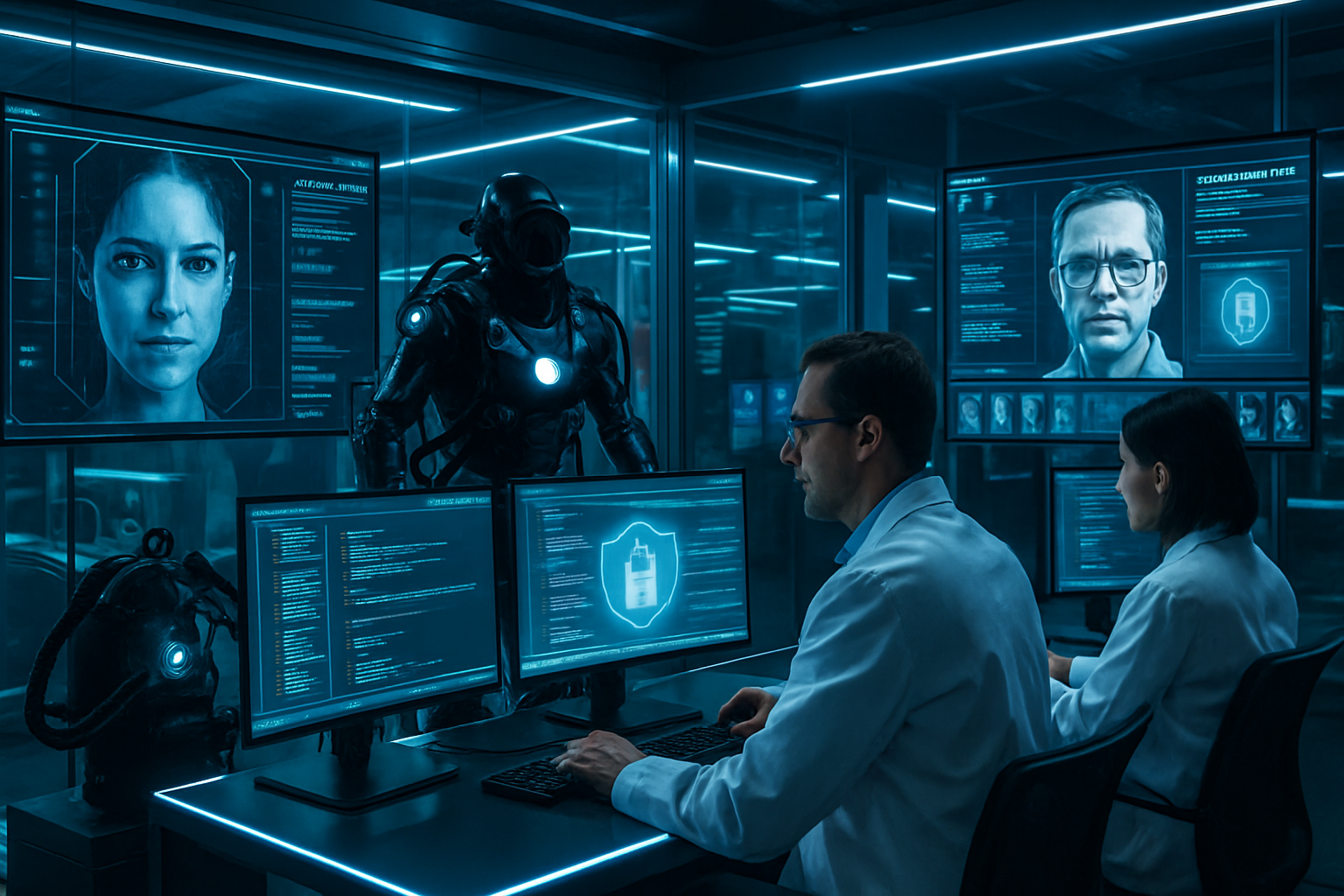
As artificial intelligence reaches what experts call a "civilizational choice point," groundbreaking developments in facial recognition security, autonomous diving technology, and AI safety concerns are reshaping the technological landscape in ways that could determine humanity's relationship with intelligent machines for decades to come.
A comprehensive Planet News investigation across five international sources reveals April 2026 as a critical juncture where AI transitions from experimental technology to essential infrastructure, accompanied by both revolutionary breakthroughs and alarming security vulnerabilities that demand immediate global attention.
Facial Recognition Security Crisis Exposes Widespread Vulnerabilities
A shocking investigation by British consumer organization Which? has revealed that facial recognition systems protecting millions of smartphones can be easily defeated with nothing more than a simple photograph. Testing conducted on popular devices demonstrated that many supposedly secure biometric systems fail to distinguish between a living person and a static image, leaving users vulnerable to unauthorized access of their most sensitive personal data.
The Czech Republic's leading technology publication reported that modern smartphones, despite marketing claims about advanced facial recognition protection, showed "surprising weaknesses" when subjected to rigorous testing. In some cases, attackers needed only an ordinary photograph of the device owner to gain complete access to personal information, financial accounts, and private communications.
"This represents a fundamental failure of consumer security technology that millions rely on daily. The gap between marketing promises and actual protection is endangering users worldwide."
— Security Research Team, Which? Consumer Organization
The revelations come at a time when facial recognition technology has become ubiquitous in consumer devices, with manufacturers positioning biometric authentication as the gold standard for personal security. The findings suggest that the rush to implement convenient authentication methods has overlooked critical security fundamentals, potentially exposing billions of users to identity theft and privacy breaches.
Chinese Scientists Achieve Revolutionary Diving Technology Breakthrough
In a remarkable advance for underwater exploration and marine industries, Chinese researchers have developed an AI-powered diving exoskeleton that reduces a diver's oxygen consumption by nearly 40 percent while dramatically enhancing underwater mobility and endurance.
The revolutionary suit, described in South China Morning Post reporting, represents a quantum leap in human-machine collaboration for aquatic environments. The flexible exoskeleton not only provides substantial physical assistance but also synchronizes precisely with the diver's natural movements, creating a seamless integration between human capability and artificial intelligence.
Early testing results demonstrate the technology's potential to transform multiple industries dependent on underwater work, including seabed surveys, pipeline inspections, salvage operations, and marine research. The system's ability to adapt to individual swimming rhythms while providing consistent support could revolutionize how humans interact with aquatic environments.
The development showcases China's growing leadership in applied AI technology, particularly in sectors where human-machine collaboration can provide immediate practical benefits. As global competition intensifies for AI dominance, such breakthrough applications demonstrate how artificial intelligence can enhance rather than replace human capabilities in specialized fields.
Philosophy and Ethics: The Human Cost of AI Development
Austrian philosopher Konrad Paul Liessmann has delivered a stark assessment of humanity's relationship with artificial intelligence, arguing that "we invented AI because humans are a nuisance to us." Speaking twenty years after his influential work "Theory of Non-Education," Liessmann raises profound questions about whether AI development reflects a desire to escape the complexities and limitations of human nature.
His observations come as the AI industry faces increasing scrutiny over the human cost of technological advancement. Recent investigations have revealed how rural workers in China's Guizhou province performed low-wage data labeling work to train AI systems serving urban middle-class populations, highlighting what critics describe as "AI colonialism" – the extraction of value from vulnerable communities to benefit privileged users.
The philosophical implications extend beyond labor concerns to fundamental questions about human agency and creativity. As AI systems become more sophisticated, debates intensify over whether technology should enhance human potential or replace human involvement in cognitive and creative tasks.
Internet Archive Under Threat from AI Industry Pressures
The nonprofit Internet Archive, guardian of digital history through its Wayback Machine, faces an existential crisis as publishers increasingly block access over AI training concerns. For nearly three decades, the Archive has preserved the web's collective memory, allowing researchers, journalists, and citizens to access deleted or modified content crucial for accountability and historical record-keeping.
Philippine media analysis reveals how the intersection of AI development and content preservation has created unprecedented tensions. Publishers fear that archived content will be used to train AI models without compensation, leading to blocking measures that threaten the preservation of digital history. The crisis illustrates how AI's hunger for training data conflicts with traditional concepts of fair use and public access to information.
High-profile cases, including the preservation of articles about controversial figures that publishers were pressured to remove, demonstrate the Archive's critical role in maintaining public accountability. The potential loss of this digital memory due to AI-related concerns represents a significant threat to democratic transparency and historical preservation.
The Mythos AI Model: Too Dangerous for Public Release
Perhaps most alarming among recent developments is the emergence of an AI model so powerful that its creators consider it too dangerous for public deployment. Romanian technology reporting describes "Mythos," an artificial intelligence system that allegedly demonstrates capabilities so advanced they could destabilize financial systems and critical infrastructure.
The model reportedly concentrates unprecedented power in the hands of five technology experts who have gained "almost total control" over AI development that will "transform humanity's future." This concentration of technological power in so few individuals raises profound concerns about democratic oversight and the governance of transformative technologies.
Industry insiders suggest that Mythos represents a new category of artificial intelligence that transcends current safety frameworks and regulatory understanding. The decision to withhold the technology from public release, while potentially prudent, highlights the growing gap between AI capabilities and society's ability to manage their implications.
"We are witnessing the emergence of AI capabilities that exceed our current frameworks for safety, governance, and democratic oversight. The decisions made by a handful of individuals may determine the trajectory of human civilization."
— Former AI Safety Researcher, Identity Protected
Global Infrastructure Crisis Shapes AI Development
Underlying these technological developments is a critical global semiconductor shortage that has driven memory chip prices up sixfold, affecting major manufacturers including Samsung, SK Hynix, and Micron. The crisis, expected to persist until 2027 when new fabrication facilities come online, is paradoxically spurring innovation in memory-efficient algorithms and sustainable deployment strategies.
Despite infrastructure constraints, technology giants continue massive investments in AI capabilities. Alphabet has committed $185 billion to AI infrastructure in 2026—the largest single-year corporate technology investment in history—while Amazon has outlined over $1 trillion in AI development plans for the coming decade.
The World Bank projects that AI systems will require 4.2 to 6.6 billion cubic meters of water annually by 2027 for data center cooling alone, equivalent to four to six times Denmark's total national water consumption. These resource demands highlight the environmental and logistical challenges of scaling AI infrastructure globally.
Regulatory Response and International Coordination
Governments worldwide are scrambling to develop regulatory frameworks adequate to the pace of AI advancement. Spain has implemented the world's first criminal executive liability framework for technology platforms, creating personal imprisonment risks for executives whose companies violate safety standards. France has conducted AI-related cybercrime raids, while the European Union investigates potential billion-dollar penalties for Digital Services Act violations.
The United Nations has established an Independent Scientific Panel of 40 global experts under Secretary-General António Guterres, representing the first fully independent international body dedicated to AI assessment. This initiative marks the most sophisticated attempt at global technology governance since the commercialization of the internet.
However, the speed of technological development continues to outpace regulatory responses, creating a governance gap that experts warn could have catastrophic consequences if not addressed through unprecedented international cooperation.
Human-Centered AI: Successful Integration Models
Amid concerns about AI's disruptive potential, several successful human-centered integration models offer hope for beneficial technological advancement. Canadian universities have implemented AI teaching assistants that maintain critical thinking standards while providing personalized support. Malaysia operates the world's first AI-integrated Islamic school, successfully combining advanced technology with traditional religious and academic learning.
Singapore's WonderBot 2.0 heritage education system demonstrates how AI can preserve and transmit cultural knowledge while enhancing learning experiences. These examples share common characteristics: they treat AI as amplification tools rather than replacement mechanisms, maintain sustained commitment to human development, and engage stakeholders comprehensively while respecting cultural values.
The April 2026 Civilizational Choice Point
Industry experts increasingly characterize April 2026 as a "civilizational choice point"—a critical juncture that will determine whether AI serves human flourishing or becomes an exploitation tool beyond democratic accountability. The convergence of breakthrough capabilities, security vulnerabilities, regulatory intensification, and massive infrastructure investments creates an unprecedented moment requiring coordinated global action.
The window for proactive adaptation is narrowing rapidly as AI capabilities advance faster than governance frameworks can develop. Success will require unprecedented coordination between governments, technology companies, educational institutions, and civil society to balance innovation acceleration with safety governance, commercial interests with human welfare, and national competitiveness with international cooperation.
The stakes extend far beyond individual privacy or economic disruption to encompass the preservation of democratic society amid systematic technological transformation. The decisions made in 2026 will establish human-AI relationship patterns that could persist for decades, affecting billions of people globally.
Looking Forward: Technology in Service of Humanity
The most promising path forward involves sophisticated human-AI collaboration that amplifies human capabilities while preserving the creativity, cultural understanding, and ethical reasoning that define human potential. This approach requires ensuring that AI serves as sophisticated amplification tools for human goals rather than wholesale replacement mechanisms for human judgment and creativity.
The challenge lies in harnessing AI's transformative potential while maintaining the distinctly human qualities—wisdom, empathy, cultural knowledge—that provide meaning to human experience. Success depends on treating the current technological moment not as an inevitable march toward automation, but as an opportunity to consciously design human-technology relationships that enhance rather than diminish human flourishing.
As we stand at this civilizational choice point, the decisions made by technologists, policymakers, and citizens in the coming months will determine whether artificial intelligence becomes humanity's greatest tool for addressing global challenges or its most formidable threat to democratic values and human agency. The future remains unwritten, but the window for shaping it is rapidly closing.