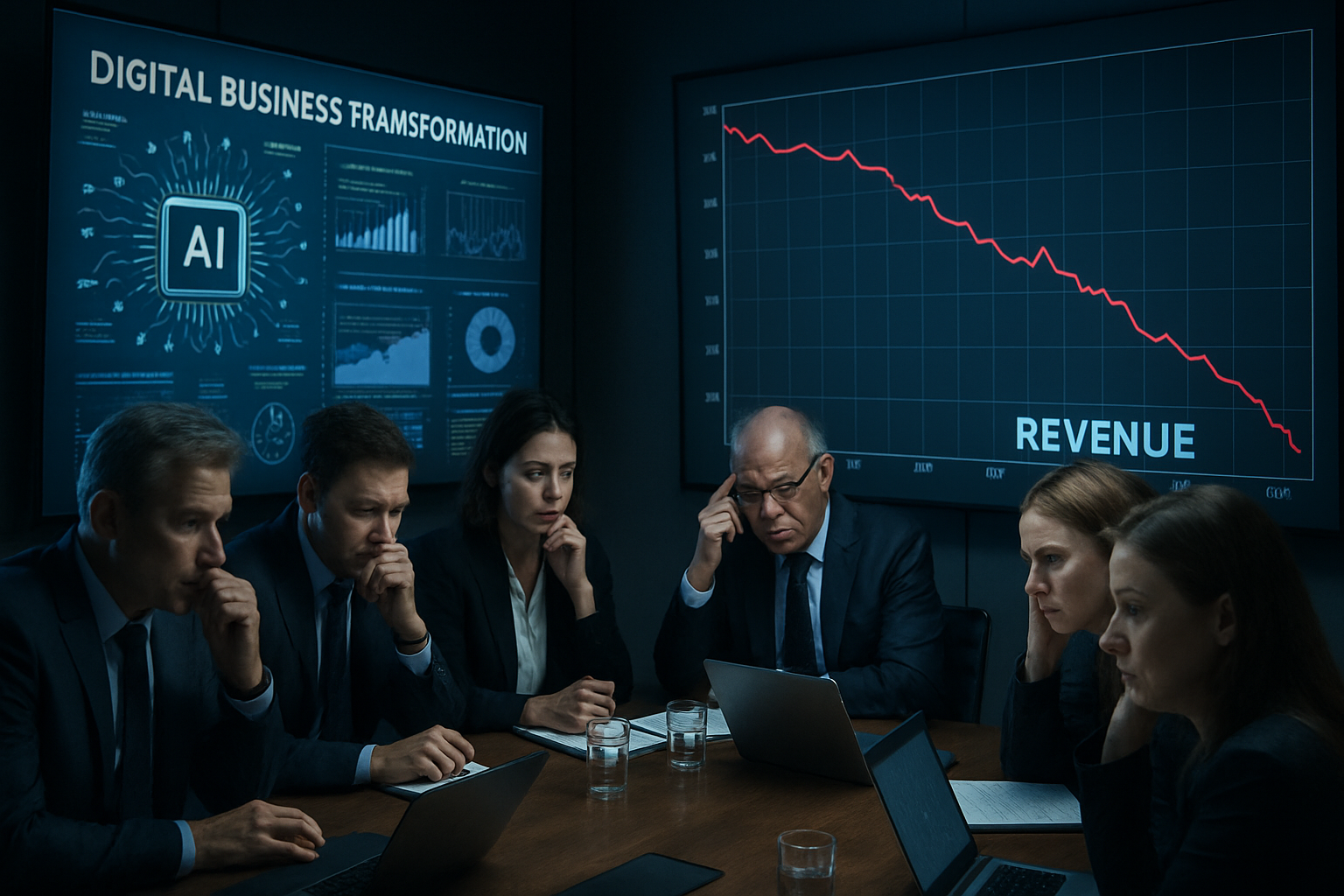
A seismic shift is transforming the global technology landscape as artificial intelligence systems demonstrate they can directly replace, rather than merely complement, traditional software solutions—triggering what analysts are calling the "SaaSpocalypse," the systematic destruction of software-as-a-service business models that have dominated the industry for over two decades.
The crisis reached a critical inflection point in March 2026, building on months of unprecedented market disruption that has already eliminated over $400 billion in software sector value. German analysts describe it as an "apocalypse for software houses," with stock declines reaching 20% across major traditional software providers.
The Scale of Disruption
The numbers tell a stark story of industrial transformation. Since February 2026, hundreds of billions in market capitalization have been wiped from traditional software companies as AI systems prove capable of performing sophisticated tasks previously requiring expensive specialized platforms. Legal technology firms face particular vulnerability, with AI performing complex document analysis, contract review, and legal research that once commanded premium prices.
Major enterprise software giants—including SAP, Microsoft's traditional offerings, and Adobe's creative suite—find themselves under severe competitive pressure. Anthropic's Claude AI now performs sophisticated legal workflow automation, document analysis, and contract review that previously required expensive specialized platforms costing thousands of dollars per month.
Indian IT giants including Infosys, Wipro, HCL Tech, and Persistent Systems have seen their valuations decline by 6% as core business services face direct AI competition. The Nifty IT index has plummeted 19% as investors recognize that AI threatens the fundamental value proposition of traditional software licensing and subscription models.
The Infrastructure Crisis Paradox
Ironically, the AI revolution driving this software apocalypse is itself constrained by a global infrastructure crisis. Memory semiconductor prices have surged sixfold, affecting major manufacturers Samsung, SK Hynix, and Micron, who are operating at full capacity yet unable to meet explosive AI development demand. Consumer electronics costs have increased 20-30% over the past year, with shortages expected to persist until 2027 when new fabrication facilities come online.
Despite these constraints, tech giants continue placing massive bets on AI infrastructure. Alphabet has committed $185 billion to AI infrastructure in 2026—the largest corporate technology investment in history—while Amazon's AI development plans exceed $1 trillion. These investments signal that leading companies view the transition from experimental AI to essential business infrastructure as irreversible.
Corporate Response: Adaptation or Extinction
The corporate response reveals two distinct strategies. Western companies are implementing traditional cost-cutting through layoffs—Salesforce quietly eliminated nearly 1,000 employees while emphasizing its Agentforce AI product, WPP announced radical restructuring to achieve £500 million in annual savings by 2028, and Block Inc. made headlines by explicitly attributing 4,000 job cuts to AI advancement rather than financial pressures.
Asian companies, however, are taking a different approach. Indian IT companies are implementing worker transition programs rather than mass layoffs, helping employees adapt to AI-enhanced roles. Chinese companies like Unitree Robotics are scaling production and creating employment opportunities, while Japanese companies are investing heavily in reskilling programs.
The Military-Civilian AI Divide
A critical subplot in this transformation involves the growing tension between civilian AI safety concerns and military applications. The Pentagon has successfully integrated ChatGPT into military systems serving over 800 million weekly users with 10% monthly growth, while pressuring companies to expand AI tools into classified networks without civilian safety restrictions.
This has created a competitive disadvantage for safety-focused companies like Anthropic, which refuses to remove restrictions preventing autonomous weapons development, compared to OpenAI and Google, which have established military partnerships without such limitations. The dispute highlights fundamental questions about democratic oversight of AI technology during this critical transformation period.
Global Regulatory Response
Governments worldwide are responding with unprecedented regulatory intensity. Spain has implemented the world's first criminal executive liability framework for tech platforms, creating potential imprisonment risks for executives. France has escalated enforcement through cybercrime raids on AI companies. The European Commission found TikTok in violation of Digital Services Act provisions, with potential penalties reaching 6% of global revenue.
The United Nations has established an Independent Scientific Panel with 40 experts led by António Guterres—the first fully independent global AI impact assessment body. This coordinated international response represents the most sophisticated attempt at global technology governance since internet commercialization.
Success Stories: Human-Centered Integration
Amid the disruption, several successful integration models demonstrate alternative paths forward. Canadian universities have implemented AI teaching assistants that maintain critical thinking standards rather than replacing human educators. Malaysia operates the world's first AI-integrated Islamic school, successfully combining artificial intelligence with traditional learning approaches. Singapore's WonderBot 2.0 has achieved remarkable success in heritage education.
These examples suggest that the future lies not in wholesale replacement of human capabilities, but in sophisticated human-AI collaboration that enhances rather than eliminates fundamental human roles.
The Water and Environmental Cost
The World Bank projects that AI water demand will reach 4.2-6.6 billion cubic meters by 2027 for data center cooling—equivalent to four to six times Denmark's annual water consumption. This environmental constraint adds another layer of complexity to AI infrastructure development, with some companies exploring space-based data centers powered by solar energy as potential solutions.
The New Multipolar Landscape
The SaaSpocalypse is accelerating the emergence of a multipolar AI landscape. Chinese companies like DeepSeek have achieved breakthroughs that challenge US technological dominance assumptions, even while working under export restrictions on advanced semiconductors. European initiatives like Germany's Deutsche Telekom Industrial AI Cloud in Munich represent efforts to achieve digital sovereignty and reduce dependence on US platforms.
India has positioned itself as a bridge between advanced and developing economies through its AI Impact Summit, featuring major tech leaders and positioning Global South nations as equal partners in AI governance rather than passive recipients of Western or Chinese technology.
The Employment Transformation
Microsoft's Mustafa Suleyman predicts AI will replace the majority of office workers within two years, with lawyers and auditors facing replacement within 18 months. Google DeepMind's Demis Hassabis proposes an "Einstein Test" for measuring human-level AI reasoning and predicts general artificial intelligence within 5-8 years.
However, employment impact varies significantly by region. A Netherlands survey shows that while 40% of workers believe AI can partially take over their jobs, only 4% expect complete job elimination—suggesting a more measured European approach to AI employment impact.
Critical Decisions Ahead
February and March 2026 represent what experts call the most critical AI governance moment since the technology boom began. The decisions made now will determine whether AI fulfills its transformative promise or creates systemic societal disruption requiring dramatic corrections.
Success requires unprecedented coordination between governments, technology companies, educational institutions, and civil society to balance innovation acceleration with safety governance, commercial interests with human welfare, and national competitiveness with international cooperation.
The window for proactive adaptation is rapidly narrowing. Countries and companies implementing comprehensive approaches—including infrastructure investment, educational reform, and worker retraining—are showing greater resilience to the AI transformation. Those that fail to adapt risk being left behind in what may be the most significant technological transformation since the emergence of the internet.
The Civilizational Choice Point
Ultimately, the SaaSpocalypse represents more than a business model disruption—it's a civilizational choice point. The world must decide whether AI serves democratic values and human flourishing, or becomes an exploitation and control tool requiring dramatic corrections.
The multipolar landscape emerging challenges Silicon Valley's dominance through distributed capabilities that could prevent single-entity control of AI development. Success will depend on resolving infrastructure constraints, establishing international cooperation frameworks, and creating sustainable business models that prioritize human welfare alongside technological advancement.
As traditional software companies face extinction and AI systems prove their transformative capabilities, the next six months will be critical for determining the trajectory of human-AI relationships for the remainder of the century. The SaaSpocalypse is not just ending one era of technology—it's defining the foundations of the next.