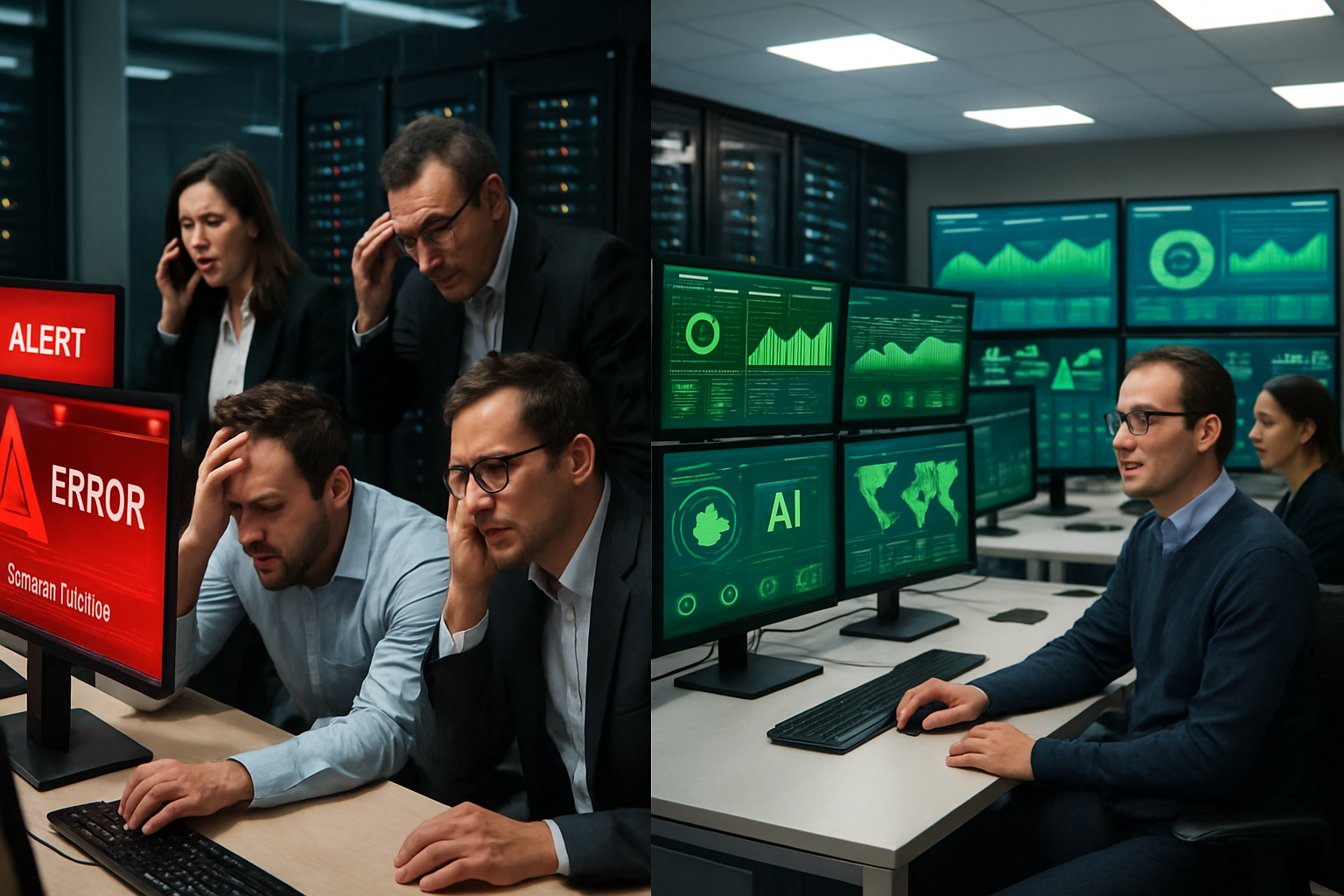
For decades, the gold standard of a "good" IT department was how quickly they could fix something after it broke. We've all been there: an app crashes, the Wi-Fi goes dark, or a database slows to a crawl, and a team of exhausted engineers jumps into a "war room" to find the culprit. It was fundamentally a reactive world—you waited for the red light to blink, and then you ran toward the fire.
But as businesses have grown more complex, those fires have started happening in places that are harder to see, scattered across private data centers and multiple public clouds. Today, the conversation has shifted. The goal isn't just to be a fast firefighter; it's to make sure the fire never starts in the first place. Artificial Intelligence (AI) is the primary reason this shift is actually becoming a reality.
The End of the Reactive Era
By processing millions of data points every second, AI is helping IT teams move into a fundamentally different operational paradigm. Instead of waiting for systems to fail, AI-powered platforms can predict problems hours, days, or even weeks before they occur. This represents one of the most significant transformations in enterprise technology management since the advent of cloud computing.
Traditional IT operations relied on what industry experts call "break-fix" methodology—systems would run until they encountered issues, at which point human operators would intervene to restore functionality. This approach, while understandable given technological limitations of previous decades, created several critical problems for modern enterprises.
"The reactive model meant we were always playing catch-up," explains a senior IT director at a Fortune 500 company. "Every outage was a surprise, every fix was urgent, and our teams were constantly under pressure."
— Senior IT Director, Fortune 500 Company
The financial impact of this reactive approach has become increasingly unsustainable. Industry research indicates that unplanned downtime costs enterprises an average of $5,600 per minute, with some large organizations facing losses exceeding $300,000 per hour during critical system failures. These figures don't account for the hidden costs: diminished employee productivity, damaged customer relationships, and the stress placed on IT personnel constantly operating in crisis mode.
AI as the Game Changer
Artificial intelligence is transforming this landscape by introducing predictive capabilities that were previously impossible. Modern AI systems can analyze vast amounts of telemetry data from servers, networks, applications, and user behavior patterns to identify early warning signs of potential failures.
Machine learning algorithms excel at pattern recognition, allowing them to detect anomalies that human operators might miss or dismiss as normal system variations. These systems continuously learn from historical data, becoming more accurate over time as they encounter new scenarios and edge cases.
Predictive Analytics in Action
Consider a typical enterprise database server handling thousands of transactions per second. Traditional monitoring might track basic metrics like CPU usage, memory consumption, and disk space. When these metrics cross predetermined thresholds, alerts are generated—often too late to prevent service degradation.
AI-powered monitoring systems take a fundamentally different approach. They analyze not just individual metrics but the relationships between them, tracking subtle changes in transaction response times, query execution patterns, and resource utilization trends. By understanding these complex interdependencies, AI can predict when a server is likely to become overwhelmed—sometimes days before traditional monitoring would detect a problem.
This predictive capability enables IT teams to take proactive measures: redistributing workloads, scaling resources, or performing maintenance during planned windows rather than during emergency outages. The result is dramatically improved system reliability and significantly reduced operational stress.
The Technology Behind the Transformation
The AI revolution in enterprise IT operations relies on several key technological components working in concert. Machine learning algorithms form the foundation, but their effectiveness depends on sophisticated data collection, processing, and analysis infrastructure.
Advanced Monitoring and Data Collection
Modern AI systems require comprehensive data about every aspect of IT infrastructure. This includes not only traditional metrics like server performance and network traffic but also application-level data, user behavior patterns, and external factors such as weather conditions that might affect data center operations.
The challenge lies not in collecting this data—modern systems generate enormous amounts of telemetry—but in processing and analyzing it in real-time. AI platforms use sophisticated filtering and aggregation techniques to extract meaningful signals from the noise of constant data streams.
Natural Language Processing for Incident Management
One of the most promising developments in AI-driven IT operations is the application of natural language processing (NLP) to incident management. These systems can automatically analyze support tickets, error logs, and communication channels to identify patterns and suggest solutions.
Advanced NLP systems can even participate in troubleshooting conversations, providing relevant documentation, suggesting diagnostic steps, and escalating issues when human intervention is required. This capability significantly reduces the time required to resolve problems and ensures that knowledge is captured and shared across the organization.
Real-World Implementation Challenges
Despite the tremendous potential of AI in enterprise IT operations, implementation is not without challenges. Organizations must navigate technical, cultural, and organizational obstacles to successfully transition from reactive to proactive operations.
Data Quality and Integration
The effectiveness of AI systems depends heavily on the quality and comprehensiveness of the data they analyze. Many enterprises struggle with fragmented monitoring systems, inconsistent data formats, and legacy infrastructure that wasn't designed for modern analytics platforms.
Successful AI implementations require significant investment in data standardization and integration. Organizations must break down silos between different IT domains and create unified data platforms that provide comprehensive visibility into all aspects of their infrastructure.
Skills and Cultural Adaptation
The shift to AI-driven operations requires new skills and mindsets from IT personnel. Traditional system administrators must learn to work with AI tools, interpret predictive analytics, and make decisions based on probabilistic rather than deterministic information.
This transition can be particularly challenging for experienced professionals who have built their careers around reactive troubleshooting skills. Organizations must invest in training and change management to help their teams adapt to new ways of working.
"The hardest part wasn't implementing the AI technology—it was convincing our senior engineers to trust the predictions and act on them before problems actually occurred."
— CTO, Mid-Size Technology Company
Success Stories and Measurable Benefits
Despite the challenges, organizations that have successfully implemented AI-driven IT operations are reporting significant benefits. These range from reduced downtime and improved system performance to better resource utilization and enhanced team morale.
Case Study: Global Financial Services Firm
A major financial services organization implemented an AI-powered infrastructure monitoring platform across their global data centers. The system analyzes data from over 50,000 servers, network devices, and applications to predict potential failures.
Within the first year of deployment, the organization reported a 65% reduction in unplanned downtime, a 40% decrease in the time required to resolve incidents, and a 25% improvement in overall system performance. Perhaps most importantly, their IT teams reported significantly reduced stress levels and improved job satisfaction as they moved away from constant crisis management.
Quantifying the ROI of Proactive Operations
The financial benefits of transitioning to AI-driven proactive operations extend far beyond reduced downtime costs. Organizations typically see improvements in several key areas:
- Reduced Labor Costs: Less time spent on emergency troubleshooting means more resources available for strategic projects and innovation.
- Improved Customer Experience: More reliable systems lead to better user experiences and reduced support burden.
- Better Resource Utilization: Predictive analytics enable more efficient capacity planning and resource allocation.
- Enhanced Competitive Advantage: More reliable IT infrastructure supports business agility and faster time-to-market for new services.
The Future of AI in Enterprise Operations
As AI technology continues to evolve, we can expect even more sophisticated capabilities to emerge in enterprise IT operations. Advanced AI systems are already beginning to move beyond prediction to automated remediation, taking corrective actions without human intervention.
Autonomous Operations and Self-Healing Systems
The next frontier in AI-driven IT operations is the development of truly autonomous systems that can not only predict problems but also resolve them automatically. These "self-healing" systems can restart failed services, redistribute workloads, and even provision additional resources as needed.
While fully autonomous operations remain a future aspiration, limited implementations are already showing promise in specific domains such as cloud infrastructure management and network optimization.
Integration with Business Intelligence
Future AI systems will likely integrate IT operations data with broader business intelligence platforms, providing insights that span technical and business domains. This integration will enable organizations to understand the business impact of technical decisions and optimize their infrastructure to support strategic objectives.
Building an AI-Ready IT Organization
Organizations looking to capitalize on AI-driven operations transformation must take a strategic approach to implementation. Success requires more than just deploying new tools—it demands fundamental changes in processes, skills, and culture.
Essential Steps for Implementation
Successful AI implementation in enterprise IT operations typically follows a structured approach:
- Assessment and Planning: Evaluate current monitoring capabilities, identify data sources, and define success metrics.
- Data Infrastructure: Invest in unified data platforms and ensure comprehensive monitoring coverage.
- Pilot Programs: Start with limited implementations to build experience and demonstrate value.
- Skills Development: Train personnel on AI tools and new operational processes.
- Gradual Expansion: Scale successful pilots across the organization while maintaining focus on continuous improvement.
Key Success Factors
Organizations that have successfully transformed their IT operations share several common characteristics:
- Executive Support: Leadership commitment to long-term investment in AI capabilities and cultural change.
- Data-Driven Culture: Willingness to make decisions based on AI insights rather than intuition alone.
- Continuous Learning: Commitment to ongoing training and adaptation as AI technology evolves.
- Cross-Functional Collaboration: Integration between IT operations, development, and business teams.
Conclusion: The Paradigm Shift is Here
The transformation from reactive to proactive IT operations represents more than just a technological upgrade—it's a fundamental shift in how organizations think about and manage their technical infrastructure. AI is the enabling technology that makes this transformation possible, but success depends on organizations' willingness to embrace new ways of working.
The benefits of this transformation are clear: reduced downtime, improved efficiency, better resource utilization, and enhanced team morale. However, realizing these benefits requires significant investment in technology, processes, and people. Organizations that make this investment now will be better positioned to compete in an increasingly digital world.
As we look toward the future, it's clear that AI will continue to play an increasingly important role in enterprise IT operations. The question is not whether organizations should adopt AI-driven operations management, but how quickly they can successfully implement it. In a world where digital infrastructure underpins virtually every business process, the ability to predict and prevent problems before they occur isn't just a competitive advantage—it's a business necessity.
The era of reactive IT operations is ending. The organizations that recognize this shift and act on it will lead their industries into the next decade of digital transformation. Those that don't risk being left behind, forever playing catch-up in an increasingly complex and demanding technological landscape.