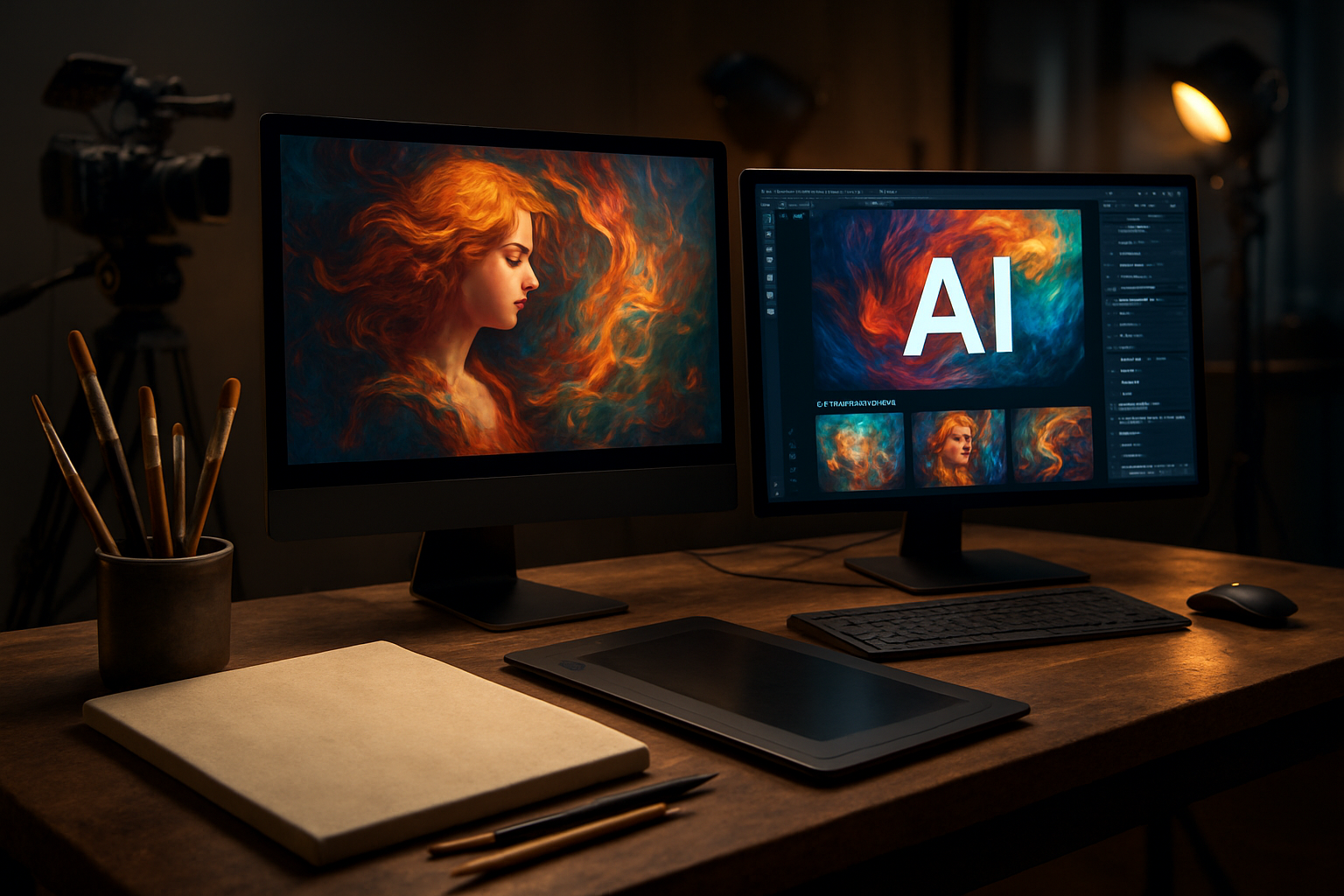
As artificial intelligence transforms creative industries across the globe, a complex debate emerges over the balance between technological innovation and human authenticity, with major developments from Hollywood film schools to European digital art exhibitions illustrating both the promise and perils of AI-enhanced creativity.
The creative landscape of 2026 finds itself at an unprecedented crossroads where traditional artistic expression meets cutting-edge artificial intelligence, creating opportunities for innovation while simultaneously challenging fundamental assumptions about creativity, authorship, and authenticity in the arts.
Hollywood Embraces AI-Powered Filmmaking
The entertainment industry's relationship with AI has shifted dramatically from skepticism to strategic adoption. Curious Refuge, launched in May 2023, has emerged as a training ground for Hollywood workers racing to adapt to the industry's rapid technological transformation. The online school teaching AI-powered filmmaking has become particularly crucial for visual effects veterans like Michael Eng, who discovered gaps in his resume requiring machine learning experience.
"I kind of just embraced it," Eng explained of diving into AI tools after being sidelined during last year's production slowdown. "I jumped in." His experience reflects a broader industry trend where professionals are proactively acquiring AI skills rather than waiting for traditional training programs.
The AI film academy has gained recognition for providing practical training in generative technology that is reshaping production workflows, creating new career paths even as some industry professionals express concerns about job displacement. This educational transformation represents a microcosm of the broader creative industry's adaptation to AI integration.
Digital Art Celebrates Innovation and Heritage
European cultural institutions are demonstrating sophisticated approaches to integrating AI with traditional artistic expression. Belgium's Atomium is celebrating the 20th anniversary of its major renovation with a year-long program focusing specifically on digital art and public events, indicating how established cultural landmarks are embracing technological innovation while honoring their heritage.
The celebration represents more than mere technological novelty—it signals a mature understanding of how digital art can enhance rather than replace traditional cultural programming. The Atomium's approach suggests that successful AI integration in creative industries requires thoughtful curation that respects historical significance while exploring new artistic possibilities.
"The focus is on digital art, public events and will include a birthday gift for visitors celebrating their birthday on 18 February 2006."
— Atomium Anniversary Program
Journalism Grapples with AI-Generated Content
The challenges of AI in creative industries extend beyond entertainment and art into journalism and media production. German public broadcaster ZDF's recent recall of a New York correspondent following the screening of AI-generated images during a news report on ICE immigration raids demonstrates the critical importance of maintaining editorial integrity in an era of sophisticated artificial intelligence.
This incident highlights broader questions about the appropriate use of AI-generated content in professional media contexts. While AI tools offer unprecedented capabilities for content creation, their deployment raises fundamental questions about transparency, accuracy, and the responsibility of media organizations to clearly distinguish between human-created and artificially generated material.
The ZDF case serves as a cautionary tale for creative industries more broadly, illustrating how the power of AI-generated content must be balanced against professional standards and public trust.
The Authenticity Debate Intensifies
The integration of AI into creative industries has sparked intense debate about the nature of authenticity and creative expression. While Hollywood professionals are embracing AI as a tool for enhanced storytelling and production efficiency, critics point to concerns about the potential loss of human creativity and authentic artistic vision.
The emergence of AI film schools and digital art exhibitions represents one side of this debate—viewing AI as a powerful tool that can enhance human creativity rather than replace it. Proponents argue that AI enables artists and filmmakers to explore new creative territories while maintaining human oversight and creative direction.
However, incidents like the ZDF controversy demonstrate the risks associated with AI-generated content when proper editorial controls and transparency measures are not in place. The creative industries must navigate between harnessing AI's capabilities while maintaining the authenticity and integrity that audiences expect.
Educational Innovation Leads the Way
The success of institutions like Curious Refuge suggests that education may be the key to successful AI integration in creative industries. By providing comprehensive training that helps professionals understand both the capabilities and limitations of AI tools, educational programs can help the creative workforce adapt to technological change while maintaining professional standards.
This educational approach aligns with successful AI integration models documented across various sectors, including Malaysia's AI-integrated Islamic schools and Canadian universities implementing AI teaching assistants while maintaining critical thinking standards. These examples demonstrate that effective AI adoption requires human-centered approaches that enhance rather than replace fundamental skills and relationships.
Global Cultural Renaissance and AI
The current period has been characterized as a "2026 Cultural Renaissance," with unprecedented international cultural programming that successfully integrates traditional artistic expression with digital innovation. From Azerbaijan's cultural diplomacy through art exhibitions to Rwanda's creative industry development, nations are demonstrating how AI and digital tools can amplify cultural authenticity rather than threaten it.
This global cultural renaissance provides important lessons for creative industries grappling with AI integration. Success appears to depend on thoughtful implementation that respects cultural traditions while embracing technological possibilities, creating meaningful cross-cultural dialogues that enhance rather than diminish artistic expression.
Industry Challenges and Opportunities
The creative industries face several challenges as they integrate AI technologies. Infrastructure constraints, including the ongoing global memory crisis affecting semiconductor production, create practical limitations on AI implementation. Additionally, regulatory frameworks are still developing to address issues of intellectual property, transparency, and professional standards in AI-generated content.
Despite these challenges, the opportunities for innovation are substantial. AI tools can democratize content creation, enable new forms of artistic expression, and enhance production efficiency. The key lies in developing frameworks that harness these benefits while maintaining the human creativity, cultural authenticity, and professional integrity that define quality creative work.
Looking Forward: Human-AI Collaboration
The future of creative industries appears to lie not in AI replacement of human creativity, but in sophisticated collaboration between human artists and artificial intelligence tools. Successful examples from Hollywood film schools to European cultural institutions demonstrate that the most effective approaches treat AI as a powerful instrument that amplifies human creativity rather than substituting for it.
This collaborative model requires ongoing education, clear professional standards, and thoughtful implementation that prioritizes transparency and authenticity. As the creative industries continue to evolve, the challenge will be maintaining the uniquely human elements of creativity—imagination, cultural understanding, emotional depth, and authentic expression—while leveraging AI's capabilities to explore new artistic frontiers.
The transformation currently underway in creative industries represents a pivotal moment in the intersection of technology and human expression. Success will depend on the industry's ability to navigate this transition thoughtfully, ensuring that artificial intelligence serves to enhance rather than diminish the profound human capacity for creative expression that lies at the heart of all meaningful art.