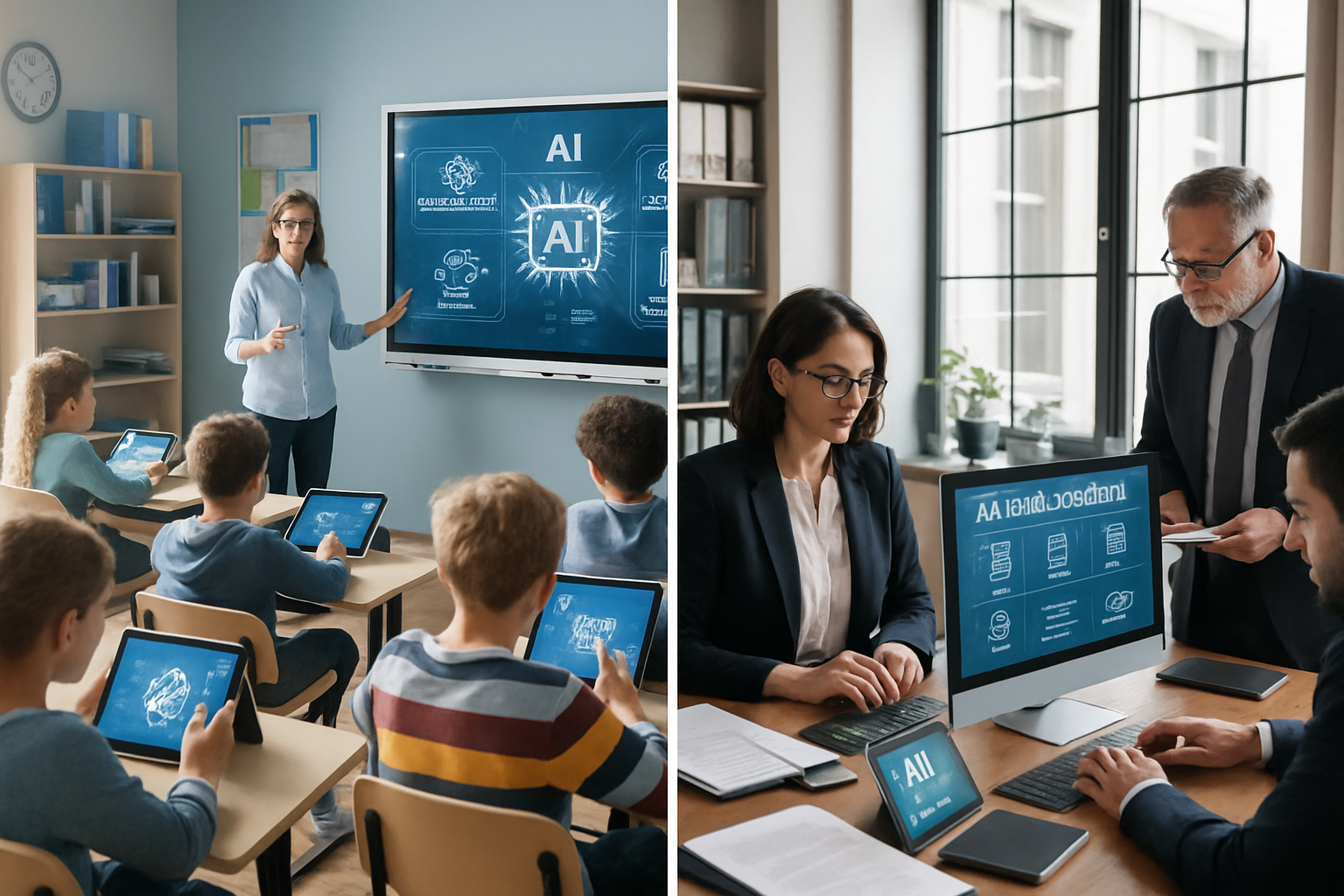
Artificial intelligence is fundamentally reshaping two of society's most traditional sectors, as 25 German AI startups revolutionize the multi-billion euro legal market while Italian universities report that 70% of students now use AI tools daily, marking a historic transformation in how education and legal services operate.
The convergence represents a critical inflection point in the "2026 Educational Technology Renaissance," a coordinated global phenomenon characterized by thoughtful digital integration with traditional professional values rather than wholesale technological replacement.
German Legal Market Disruption Accelerates
Germany's legal technology sector is experiencing unprecedented transformation as 25 AI-powered startups target the country's multi-billion-euro tax advisory and auditing market with sophisticated automation solutions. These companies are developing AI systems capable of performing complex calculations, regulatory compliance monitoring, and financial advisory services that traditionally required extensive human expertise.
The disruption comes at a critical time for the German legal sector, which faces significant workforce shortages and increasing regulatory complexity. International platforms and entrepreneurs are introducing efficiency solutions that address these challenges while potentially displacing traditional software-as-a-service models.
"The legal profession is perfectly suited for artificial intelligence implementation across research, contract analysis, and practice management systems."
— FAZ.NET Legal Technology Report
This development aligns with global predictions by Microsoft's Mustafa Suleyman, who forecasts AI replacing the majority of office workers within two years, with lawyers and auditors particularly vulnerable within 18 months. The German legal market transformation represents a microcosm of broader professional service disruption occurring worldwide.
Italian Universities Pioneer Student AI Integration
At Italy's prestigious Luiss University, Rector Paolo Boccardelli has documented a remarkable shift in student behavior, revealing that 70% of students now use artificial intelligence tools on a daily basis. This represents a fundamental change from experimental curiosity to essential academic infrastructure integration.
The Google-Luiss partnership exemplifies systematic institutional AI adoption, bringing artificial intelligence directly into lecture halls across disciplines from jurisprudence to statistics. The collaboration demonstrates how universities are adapting to student-driven technological adoption while maintaining academic integrity and educational excellence.
Usage patterns vary significantly across subjects and geographic regions, with students employing AI for research assistance, writing support, data analysis, and complex problem-solving. However, research by German expert Dr. Frank Bäumer reveals a concerning "productivity paradox" where AI implementation often creates more work rather than reducing it, as students must perform original responsibilities plus supervising and correcting AI outputs.
Global Educational Technology Renaissance
The German-Italian developments occur within a broader international transformation. Malaysia operates the world's first AI-integrated Islamic school, combining artificial intelligence with traditional religious and academic learning. Singapore's WonderBot 2.0 has achieved remarkable success in conversational AI for heritage education, while Canadian universities have implemented AI teaching assistants that maintain critical thinking standards.

The Philippines has developed a particularly sophisticated approach through the Department of Education's partnership with the National Artificial Intelligence Center for Research and Innovation (NAICRI). Education Secretary Sonny Angara emphasizes preparing Filipino students for an AI-integrated future while ensuring "safe, fair, and responsible" usage through comprehensive governance frameworks.
Estonia continues to position itself as a global model for thoughtful AI integration in education, with international delegations visiting local classrooms to observe balanced approaches that preserve human educational elements while leveraging computational advantages.
Infrastructure Challenges and Opportunities
The rapid AI adoption faces significant infrastructure constraints. A global memory semiconductor crisis has driven chip prices up sixfold, affecting major manufacturers Samsung, SK Hynix, and Micron. These shortages are expected to persist until 2027 when new fabrication facilities come online.
Paradoxically, these constraints are spurring innovation in memory-efficient algorithms, hybrid processing approaches, and cloud-based solutions that maximize AI capabilities while minimizing hardware requirements. Educational institutions and legal firms are developing more sustainable technology integration strategies that emphasize efficiency over brute-force computational approaches.
Regulatory Framework Evolution
European governments are implementing sophisticated regulatory responses to rapid AI development. Spain has introduced the world's first criminal executive liability framework for technology platforms, while France has conducted cybercrime raids on AI companies. The United Nations has established an Independent Scientific Panel with 40 experts under António Guterres, representing the first fully independent global AI assessment body.
These regulatory developments create both challenges and opportunities for educational institutions and legal firms integrating AI systems. Organizations must navigate complex compliance requirements while leveraging technological advantages that enhance rather than replace human capabilities.
Employment Transformation Models
The transformation reveals stark regional differences in approaching AI-driven employment changes. While Western markets often experience layoffs followed by AI-focused hiring, Asian companies are implementing comprehensive worker transition programs. Indian IT giants like Infosys, Wipro, and HCL Technologies are successfully adapting through employee retraining rather than mass layoffs.
Legal technology appears particularly vulnerable to AI replacement, with sophisticated systems now capable of document analysis, contract review, and legal research that previously required expensive specialized software and human expertise. However, successful integration models emphasize human-AI collaboration rather than wholesale replacement.
Human-Centered AI Success Stories
The most promising AI implementations emphasize enhancement rather than replacement of human capabilities. In education, successful programs treat AI as amplification tools serving pedagogical goals rather than ends in themselves. Clear educational objectives, comprehensive teacher training, and cultural sensitivity emerge as critical success factors.
"Artificial intelligence can no longer be ignored in education, but responsible implementation requires preserving the irreplaceable human elements that define authentic learning."
— Estonian President Alar Karis
Similarly, in legal services, the most effective AI deployments support lawyers in research and analysis while preserving the critical thinking, ethical reasoning, and client relationships that define professional legal practice.
Economic Implications and Future Trajectory
The "SaaSpocalypse" has eliminated hundreds of billions in traditional software market capitalization as AI systems demonstrate direct replacement capabilities for conventional solutions. This represents a fundamental shift from software-as-a-service to AI-based alternatives that offer more sophisticated, responsive, and cost-effective solutions.
Prevention-first educational approaches demonstrate superior economic outcomes through reduced crisis intervention costs, improved workforce productivity, and enhanced international competitiveness. Countries implementing comprehensive AI integration programs report enhanced community resilience and reduced long-term social service demands.
Critical Decisions Ahead
March 2026 represents a critical inflection point in determining whether AI fulfills its transformative promise or creates systemic societal disruption requiring dramatic corrections. Success depends on unprecedented coordination between governments, technology companies, educational institutions, and civil society organizations.
The challenge involves achieving technological wisdom over mere technological dominance, ensuring AI serves human flourishing while preserving creativity, empathy, and wisdom that define human potential. The German legal transformation and Italian educational integration provide valuable templates for balanced approaches that leverage AI capabilities while maintaining professional integrity and educational excellence.
As artificial intelligence transitions from experimental technology to essential infrastructure, the decisions made in 2026 will determine whether this transformation enhances human capabilities or creates new forms of inequality and social disruption. The evidence from Germany and Italy suggests that thoughtful, culturally sensitive implementation can harness AI's potential while preserving the irreplaceable human elements that define authentic education and ethical legal practice.