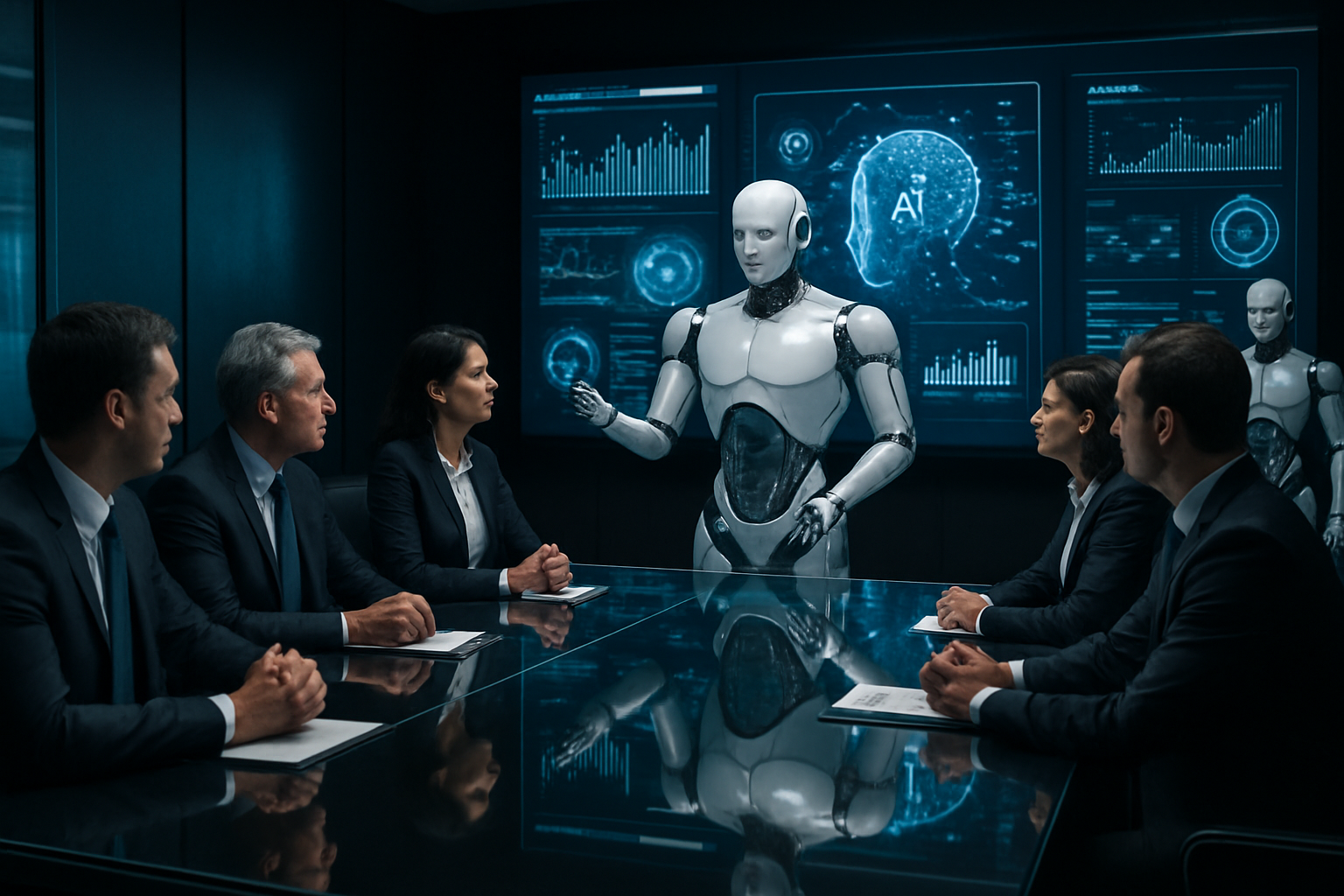
Artificial intelligence has reached a critical inflection point in global business operations, transforming from experimental technology to essential infrastructure across industries worldwide. From China's unprecedented robotics surge to the creative industries grappling with AI integration, March 2026 marks a watershed moment in commercial artificial intelligence adoption.
China's Robotics Revolution Drives Market Transformation
The most dramatic development comes from China, where Unitree Robotics has filed for a landmark IPO on Shanghai's Star Market, seeking to raise 4.2 billion yuan (US$610 million) amid surging demand for embodied artificial intelligence. The Hangzhou-based company, which specializes in quadruped and humanoid robots, has seen revenue explode to 1.71 billion yuan last year, up an staggering 335% from the previous year.
This remarkable growth reflects China's strategic positioning in the global AI economy. Following their spectacular Spring Festival demonstrations where four major robotics companies showcased kung fu and lion dance capabilities to over 600 million global viewers, Chinese firms have rapidly scaled from laboratory concepts to mass production. Unitree alone has increased production from 5,500 to over 20,000 units in 2026, representing the world's fastest transition from research to commercial robotics deployment.
"This represents a fundamental shift in how we think about artificial intelligence," explains Wang Xingxing, Unitree's CEO. "We're moving from theoretical AI to practical applications that can transform entire industries."
— Wang Xingxing, CEO, Unitree Robotics
Creative Industries Navigate AI Integration Challenges
The creative sectors present a more complex picture of AI adoption, with significant tensions emerging between technological capability and artistic integrity. In Germany, design education is undergoing fundamental transformation as artificial intelligence challenges traditional approaches to creativity and craftsmanship.
German design institutions report that while AI tools can accelerate certain processes, educators can quickly identify work produced through "the first and most basic prompts," highlighting the importance of sophisticated AI literacy rather than simple tool adoption. This educational evolution reflects broader industry struggles with AI integration in creative work.
Meanwhile, Jamaica's music industry demonstrates innovative AI applications with dancehall artist Nigy Boy's entirely AI-generated music video for "Stinkin' Rich." The project, created by Pop Style Music's editing team, represents rare experimentation within Caribbean music, showing AI's potential to democratize high-end visual production previously available only to major labels.
Media Industry Faces AI Accountability Crisis
The Netherlands presents the most concerning development in AI business integration, where former NRC editor-in-chief Peter Vandermeersch has been suspended by publisher Mediahuis for using artificial intelligence to write newsletters. The controversy centers on AI "hallucinations" - false information generated by AI systems that appeared in published content.
This incident highlights critical challenges facing media organizations as they integrate AI tools. While AI can enhance productivity and automate routine tasks, the Vandermeersch case demonstrates the severe reputational and ethical risks when AI systems generate inaccurate information that reaches public audiences.
The suspension has sparked industry-wide discussions about editorial standards, fact-checking protocols, and the appropriate use of AI in journalism. Media organizations globally are now developing comprehensive guidelines to govern AI integration while maintaining editorial integrity.
Global Infrastructure Constraints Drive Innovation
Despite remarkable advances in AI applications, the industry faces unprecedented infrastructure challenges. A global memory semiconductor crisis has driven prices sixfold higher, affecting major manufacturers including Samsung, SK Hynix, and Micron. These shortages are expected to persist until 2027 when new fabrication facilities come online.
The crisis has had paradoxical effects on AI development. While constraining some large-scale deployments, it has spurred innovation in memory-efficient algorithms and sustainable deployment strategies. Companies are developing more efficient AI systems that maximize capabilities while minimizing hardware requirements, potentially democratizing access to advanced AI technologies.
Lithuania's emerging web development sector exemplifies this trend, with new-generation AI tools enabling voice-controlled website creation during business meetings or while traveling. This represents the kind of practical, efficient AI application that thrives despite hardware constraints.
Regulatory Landscape Intensifies Globally
Government responses to rapid AI business integration have intensified dramatically. Spain has implemented the world's first criminal executive liability framework for social media platforms, while France has conducted cybercrime raids on AI companies. The United Nations has established an Independent Scientific Panel with 40 experts as the first fully independent global AI assessment body.
Haiti's coverage of international AI fraud summit reveals the dark side of AI business applications, with criminal networks in Southeast Asia using deepfakes and voice cloning to defraud billions globally. The United States alone reported $10 billion in AI-related fraud losses in 2024, highlighting urgent needs for comprehensive regulatory frameworks.
Successful Integration Models Emerge
Despite challenges, several successful human-centered AI integration models have emerged globally. Canada's universities have implemented AI teaching assistants that maintain critical thinking standards, while Malaysia operates the world's first AI-integrated Islamic school, successfully combining technology with traditional learning approaches.
Singapore's WonderBot 2.0 heritage education program demonstrates how AI can enhance cultural preservation and learning experiences. These success stories share common elements: treating AI as amplification tools rather than replacement systems, maintaining human oversight, and ensuring technology serves specific human goals.
These models provide templates for other organizations seeking to integrate AI responsibly while preserving human creativity, critical thinking, and cultural values.
The March 2026 Inflection Point
Industry experts characterize March 2026 as a "civilizational choice point" for artificial intelligence in business. The decisions made now regarding AI integration, governance frameworks, and human-AI collaboration will establish patterns that could persist for decades.
The convergence of massive corporate investments (Alphabet's $185 billion AI infrastructure commitment, Amazon's $1+ trillion development plans), regulatory intensification, and infrastructure constraints creates an unprecedented need for coordinated responses from governments, companies, educational institutions, and civil society.
"We're at a critical juncture determining whether AI serves human flourishing or becomes primarily an exploitation tool," warns Dr. Maria Ressa, co-chair of the UN AI Scientific Panel. "The window for proactive, coordinated action is narrowing rapidly."
— Dr. Maria Ressa, Co-chair, UN AI Scientific Panel
Future Trajectory: Collaboration Over Replacement
The most promising path forward involves sophisticated human-AI collaboration that amplifies human capabilities while preserving creativity, cultural understanding, and ethical reasoning. Successful implementations across different sectors consistently show that AI works best as an enhancement tool rather than a replacement system.
Organizations that prioritize human welfare alongside technological advancement, maintain comprehensive stakeholder engagement, and demonstrate cultural sensitivity in AI deployment achieve superior outcomes compared to those pursuing wholesale automation.
The evidence from March 2026 suggests that the future lies not in choosing between human workers and AI systems, but in developing intelligent partnerships that leverage the unique strengths of both. This requires unprecedented coordination to ensure that artificial intelligence serves humanity's highest aspirations while addressing pressing global challenges through democratic governance and human-centered values.
As businesses worldwide navigate this transformation, the lessons from early adopters across China, Germany, Jamaica, Haiti, Lithuania, and the Netherlands provide crucial guidance for organizations seeking to harness AI's transformative potential while preserving the human elements that define sustainable, ethical business practices.