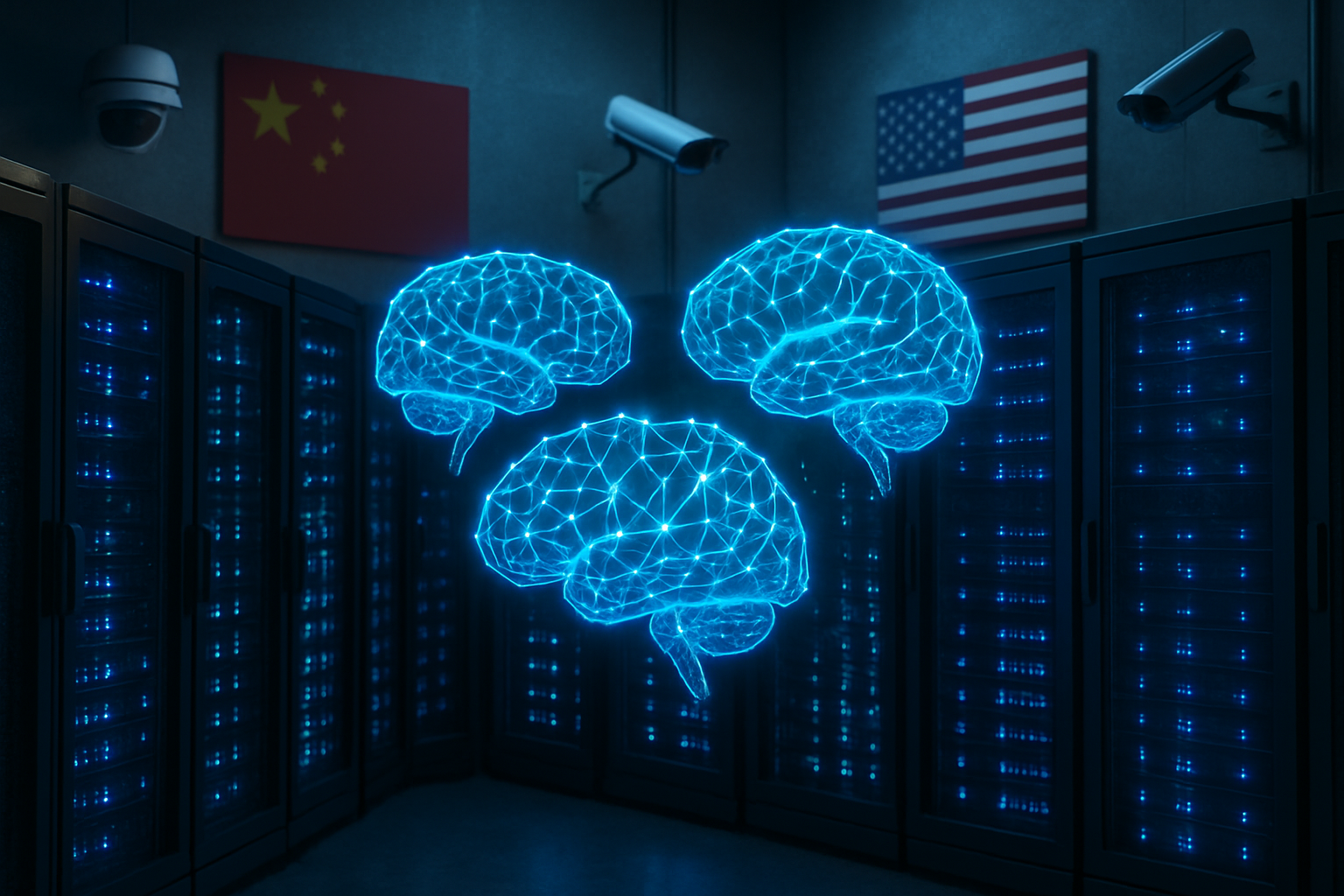
The artificial intelligence landscape is experiencing unprecedented transformation as AI systems evolve from experimental tools to essential business infrastructure, with new developments in workplace monitoring, massive cloud computing deals, and military applications defining the technology's trajectory for the remainder of this decade.
Multiple breakthrough developments across Austria, Venezuela, and Singapore this week signal that April 2026 represents what experts are calling a "civilizational choice point" - a critical juncture determining whether AI serves human flourishing or becomes a surveillance and control mechanism.
AI Workplace Monitoring Revolution
Austrian research institutions are pioneering the next generation of AI-powered employee wellness monitoring systems that represent a fundamental shift in workplace surveillance. These AI systems now actively track employee mood, speech patterns, and mobile device data to monitor worker mental health and productivity in real-time.
The technology builds on existing workplace AI applications but goes significantly further by analyzing voice stress indicators, smartphone usage patterns, and comprehensive behavioral data to assess employee wellbeing. Companies deploying these systems argue they provide valuable mental health support and early intervention capabilities for stressed workers.
However, privacy advocates warn that such comprehensive monitoring creates unprecedented surveillance capabilities that employees may not fully understand. The systems can detect emotional states, predict productivity fluctuations, and identify potential workplace conflicts before they manifest - raising fundamental questions about worker autonomy and digital privacy rights.
Meta's Massive Cloud Infrastructure Investment
Meta Platforms has signed a groundbreaking $21 billion cloud computing deal with CoreWeave, marking one of the largest AI infrastructure partnerships in corporate history. The five-year agreement positions Meta to dramatically expand its artificial intelligence capabilities amid intensifying competition from Google, Microsoft, and OpenAI.
The partnership emerges during a global semiconductor crisis that has driven memory chip prices up sixfold, affecting major manufacturers Samsung, SK Hynix, and Micron. These supply chain constraints are expected to persist until 2027 when new fabrication facilities come online, making strategic cloud partnerships increasingly valuable.
"This infrastructure investment represents our commitment to leading the next phase of AI development while managing supply chain constraints effectively."
— Meta spokesperson on the CoreWeave partnership
The deal comes as Meta simultaneously launched its "Muse Spark" AI model, described by CEO Mark Zuckerberg as achieving "superintelligence" capabilities with native multimodal reasoning and agent orchestration features. The model is currently available in the United States and represents Meta's most ambitious AI deployment to date.
Amazon's AI Revenue Milestone
Amazon Web Services achieved a significant milestone as its AI revenue run rate exceeded $15 billion annually, according to CEO announcements this week. This represents explosive growth in enterprise AI adoption as businesses increasingly view artificial intelligence as essential infrastructure rather than experimental technology.
The revenue surge coincides with Amazon's broader $1 trillion AI development plans, demonstrating how cloud computing giants are capitalizing on the transition from experimental AI to essential business infrastructure. World Bank projections suggest AI water demand will reach 4.2-6.6 billion cubic meters by 2027 for data center cooling alone - equivalent to four to six times Denmark's annual water consumption.
Despite infrastructure constraints, major technology companies continue unprecedented investments. Alphabet has committed $185 billion to AI infrastructure in 2026 - the largest single-year corporate technology investment in history - while maintaining expansion plans despite global semiconductor shortages.
Pentagon AI Contract Controversies
The Pentagon's decision to remove Anthropic from approved AI suppliers list has opened opportunities for smaller artificial intelligence companies seeking defense contracts. Anthropic was designated a "supply chain risk" after the company refused to remove safety restrictions on its Claude AI system for military surveillance and autonomous weapons applications.
This controversy highlights the growing divide between AI companies embracing military partnerships and those maintaining ethical restrictions on their technology use. OpenAI has successfully expanded its Pentagon partnership, with ChatGPT now serving over 800 million weekly military users on classified Defense Department networks.
The decision creates precedents for how democratic institutions balance innovation with security concerns during great power competition. Anthropic CEO Dario Amodei has maintained that the company "cannot in good conscience provide unrestricted AI capabilities for surveillance of civilian populations," despite over $200 million in contracts at stake.
Global AI Governance and Brain Research
Austrian institutions are advancing significant breakthroughs in AI-powered brain research through partnerships between FH Kärnten and the Medical University of Vienna. The "Doc.Brain" project, funded by the Austrian Science Fund, is developing new technologies for neuroscience applications that could revolutionize medical diagnosis and treatment.
These developments occur within an intensifying global AI governance framework. The UN has established an Independent Scientific Panel with 40 global experts under Secretary-General António Guterres - the first fully independent international AI assessment body. Spain has implemented the world's first criminal executive liability framework for technology platforms, while France has conducted cybercrime raids on AI companies.
The Semiconductor Crisis and Innovation Response
The ongoing global semiconductor shortage, which has driven memory chip prices up sixfold, is paradoxically spurring innovation in memory-efficient algorithms and sustainable AI deployment strategies. Companies are developing hybrid processing approaches that maximize AI capabilities while minimizing hardware requirements, potentially democratizing access to advanced AI technologies.
This constraint-driven innovation is forcing the industry toward more sustainable approaches. Rather than relying on brute-force computational power, developers are creating sophisticated algorithms that achieve superior results with fewer resources - a development that could prove beneficial for global AI accessibility in the long term.
Successful Human-AI Collaboration Models
Amidst rapid technological advancement, several successful human-AI collaboration models are emerging that emphasize enhancement rather than replacement of human capabilities. Canada's implementation of AI teaching assistants maintains critical thinking standards in universities, while Malaysia operates the world's first AI-integrated Islamic school that combines advanced technology with traditional learning approaches.
Singapore's WonderBot 2.0 heritage education success demonstrates how AI can preserve and enhance cultural knowledge while leveraging computational advantages. These examples share common characteristics: treating AI as sophisticated amplification tools for human goals rather than replacement mechanisms, sustained commitment to human development, comprehensive stakeholder engagement, and cultural sensitivity.
Employment and Market Transformation
The phenomenon experts term "SaaSpocalypse" continues eliminating hundreds of billions in traditional software market capitalization as AI systems demonstrate direct replacement capabilities for conventional solutions. Microsoft's Mustafa Suleyman predicts AI will replace the majority of office workers within two years, with lawyers and auditors following within 18 months.
However, regional variations are emerging in how organizations manage this transition. Indian IT giants like Infosys, Wipro, and HCL are implementing comprehensive worker transition programs rather than mass layoffs, showing alternative approaches to workforce transformation during AI integration.
Critical Choices Ahead
March and April 2026 represent what technology experts increasingly characterize as a "critical inflection point" for artificial intelligence development. The decisions made now regarding AI governance, infrastructure investment, and human-AI relationships will establish patterns that influence technology development for decades to come.
The challenge involves unprecedented coordination between governments, technology companies, educational institutions, and civil society to balance innovation acceleration with safety governance, commercial interests with human welfare, and national competitiveness with international cooperation.
"We are at a civilizational choice point. The decisions we make in 2026 will determine whether AI serves human flourishing and democratic values or becomes a tool for surveillance and control."
— Technology policy expert, UN AI Scientific Panel
The most promising path appears to involve sophisticated human-AI collaboration that amplifies human capabilities while preserving creativity, cultural understanding, and ethical reasoning that define human potential. Success requires treating AI as amplification tools serving human goals rather than wholesale replacement mechanisms.
As the window for coordinated international action narrows, the technology community faces urgent decisions about ensuring AI development serves humanity's highest aspirations through democratic governance and human-centered values during this experimental-to-essential infrastructure transition.