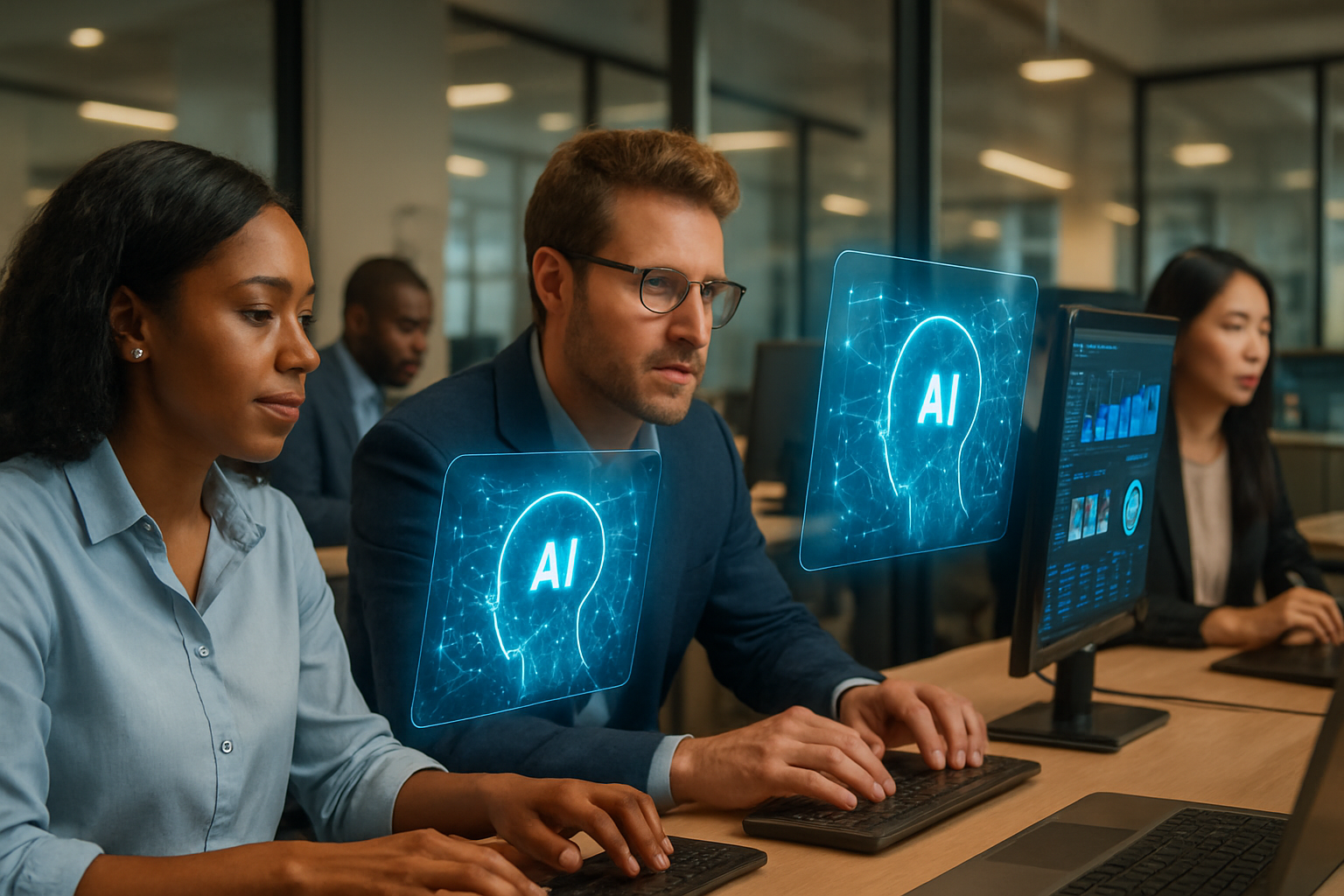
The artificial intelligence revolution has reached a critical inflection point in March 2026, as workplaces across the globe undergo the most significant transformation since the industrial revolution, fundamentally altering how humans and machines collaborate in professional environments.
From educators in the Philippines embracing AI responsiveness to companies in Slovakia deploying digital employees, the integration of artificial intelligence in workplaces is no longer a future possibility but a present reality demanding immediate attention from policymakers, business leaders, and workers worldwide.
The Shift from AI-Defensive to AI-Responsive
In the Philippines, educators are experiencing what industry experts call a paradigmatic shift in their relationship with artificial intelligence. Teachers are being called to "repent" from being AI-defensive and instead embrace AI-responsiveness, according to recent analysis of educational transformation patterns.
This transition represents three distinct attitudes that have emerged globally toward AI integration: the AI-fanatic approach, where organizations adopt technology without question; the AI-defensive stance, viewing technology as a threat; and the emerging AI-responsive model that seeks balance between human capabilities and technological enhancement.
"Responsiveness is trusting that with the intention to learn and to transform, the use of artificial intelligence can find balance"
— Philippines Educational Technology Initiative
The AI-responsive approach has proven most successful in maintaining educational quality while leveraging technological advantages, a model now being studied and replicated across various industries worldwide.
Digital Employees Reshape Corporate Hierarchies
A revolutionary trend is emerging from Slovakia and spreading across North America, where companies are purchasing hardware to activate "digital employees" who subsequently delegate tasks to human workers. This represents a complete inversion of traditional workplace hierarchies, with AI agents now occupying supervisory roles.
In Canada and the United States, this trend is beginning to reshape office dynamics fundamentally. Companies are experimenting with AI agents that can analyze workflow patterns, assign tasks based on efficiency metrics, and even conduct performance evaluations of human employees.
The implications extend far beyond simple automation. These digital supervisors operate on algorithms designed to optimize productivity, potentially creating workplace environments where human emotional needs, creativity, and collaborative problem-solving take secondary importance to measurable efficiency metrics.
The AI Skills Olympics: Preparing the Next Generation
Sweden provides a glimpse into how the next generation is preparing for an AI-integrated future. In Borgholm's city hall, young people from across the country competed in Sweden's AI Olympics, programming artificial intelligence models in what represents a new category of intellectual competition.
These competitions highlight the critical importance of AI literacy among young professionals. Unlike traditional coding competitions that focused on software development, AI Olympics require participants to understand machine learning principles, neural network architectures, and human-AI interaction design.
The Swedish initiative reflects a broader global recognition that AI competency has become as fundamental as traditional literacy. Nations investing in AI education for young people are positioning themselves advantageously for the transformed economy of the late 2020s and beyond.
The Human Element in AI Integration
Despite rapid technological advancement, successful AI workplace integration consistently demonstrates the irreplaceable value of human-centered approaches. Research from multiple countries shows that the most effective AI implementations enhance rather than replace fundamental human capabilities.
Malaysia's world-first AI-integrated Islamic school combines artificial intelligence with traditional religious and academic learning, achieving a remarkable 97.82% teacher placement rate. Singapore's WonderBot 2.0 heritage education program successfully preserves cultural knowledge while leveraging AI capabilities. Canadian universities have implemented AI teaching assistants that maintain critical thinking standards while supporting educational objectives.
These success models share common characteristics: sustained commitment to human development, comprehensive stakeholder engagement, cultural sensitivity, and clear objectives that prioritize human welfare alongside technological advancement.
The Productivity Paradox: When AI Creates More Work
Contrary to industry promises of increased efficiency, German research by Dr. Frank Bäumer has documented what experts call the "productivity paradox" of AI implementation. Many organizations experience "mehr Arbeit und nachlassender Effizienz" (more work and declining efficiency) rather than the promised gains.
Workers frequently report a "double workload" effect, where they must perform their original responsibilities while also supervising and correcting AI outputs. This phenomenon has been observed across multiple industries and represents a critical challenge for organizations rushing to implement AI without proper change management strategies.
The productivity paradox highlights the importance of thoughtful implementation over rapid deployment. Organizations achieving genuine efficiency gains invest heavily in worker training, workflow redesign, and human-AI collaboration frameworks rather than simply adding AI tools to existing processes.
Employment Transformation and the "SaaSpocalypse"
The technology sector is experiencing what analysts call the "SaaSpocalypse" – the systematic elimination of traditional software-as-a-service business models as AI systems demonstrate direct replacement capabilities. Hundreds of billions in market capitalization have been eliminated as conventional software solutions become obsolete.
Microsoft's Mustafa Suleyman has predicted that AI could replace the majority of office workers within two years, with lawyers and auditors particularly vulnerable within 18 months. These predictions are gaining credibility as AI systems demonstrate increasingly sophisticated capabilities in document analysis, legal research, and compliance monitoring.
However, regional variations in response strategies provide different models for managing this transition. While Western companies often implement traditional layoffs followed by AI hiring, Asian companies are pursuing comprehensive worker transition programs, demonstrating that technological displacement need not result in widespread unemployment if properly managed.
Infrastructure Challenges and Global Constraints
The AI workplace revolution faces significant infrastructure constraints that may ultimately determine its pace and success. A global memory semiconductor crisis has driven sixfold price increases affecting major manufacturers like Samsung, SK Hynix, and Micron, creating supply shortages expected to persist until 2027.
These constraints have inadvertently provided time for workforce adaptation that might not otherwise exist in a unconstrained technological rollout. Organizations are forced to implement memory-efficient algorithms and selective deployment strategies rather than comprehensive automation, allowing for more gradual integration.
The World Bank projects that AI systems will require 4.2-6.6 billion cubic meters of water annually by 2027 for data center cooling – equivalent to 4-6 times Denmark's total water withdrawal. These environmental and resource constraints add urgency to developing sustainable AI deployment strategies.
Regulatory Responses and Global Governance
Governments worldwide are intensifying regulatory oversight of AI workplace integration. Spain has implemented the world's first criminal executive liability framework for technology platforms, creating personal legal risks for executives. France has conducted cybercrime raids on AI companies, while the European Commission investigates Digital Services Act violations with potential billion-dollar penalties.
The United Nations has established an Independent Scientific Panel with 40 experts under Secretary-General António Guterres, representing the first fully independent global AI impact assessment body. This coordinated international response reflects growing recognition that AI development pace is outstripping societal adaptation capacity.
Successful Models for Human-AI Collaboration
Despite challenges, numerous examples demonstrate successful human-AI collaboration that enhances rather than diminishes human capabilities. These models share several characteristics:
- Clear pedagogical or organizational objectives that prioritize human development
- Comprehensive training programs for human workers
- Cultural sensitivity and community engagement
- AI systems designed as amplification tools rather than replacement mechanisms
- Regular evaluation and adjustment based on outcomes
Organizations implementing these principles report improved community resilience, enhanced workforce productivity, and better adaptation to technological change while preserving essential human elements of creativity, empathy, and cultural understanding.
The Critical Choice Point of 2026
March 2026 represents what experts describe as a "civilizational choice point" determining whether AI serves democratic values and human flourishing or becomes an exploitation tool requiring dramatic corrections. The decisions made in the coming months will determine the human-AI relationship trajectory for the remainder of the 21st century.
Success requires unprecedented coordination between governments, technology companies, educational institutions, and civil society. The challenge involves balancing innovation acceleration with responsible development, commercial interests with human welfare, and national competitiveness with international cooperation.
The window for proactive adaptation is narrowing rapidly as AI development accelerates. Countries and organizations implementing comprehensive approaches – including infrastructure investment, educational reform, and worker retraining – demonstrate greater resilience and better outcomes for their populations.
Looking Forward: The Future of Work
The evidence from multiple countries suggests that the future lies not in wholesale replacement of human workers but in sophisticated human-AI collaboration that amplifies human capabilities while leveraging computational advantages. The most successful implementations preserve uniquely human elements – imagination, cultural understanding, emotional depth, and authentic relationships – while utilizing AI for data processing, pattern recognition, and routine task automation.
As we navigate this transformation, the key insight emerging from global experience is that technological wisdom must take precedence over technological dominance. AI must serve humanity's highest aspirations while addressing pressing challenges through frameworks that ensure democratic oversight and human welfare protection.
The workplace revolution of 2026 will ultimately be judged not by the sophistication of the technology deployed, but by its contribution to human flourishing, social cohesion, and the preservation of the creativity, empathy, and wisdom that define human potential in an age of artificial intelligence.