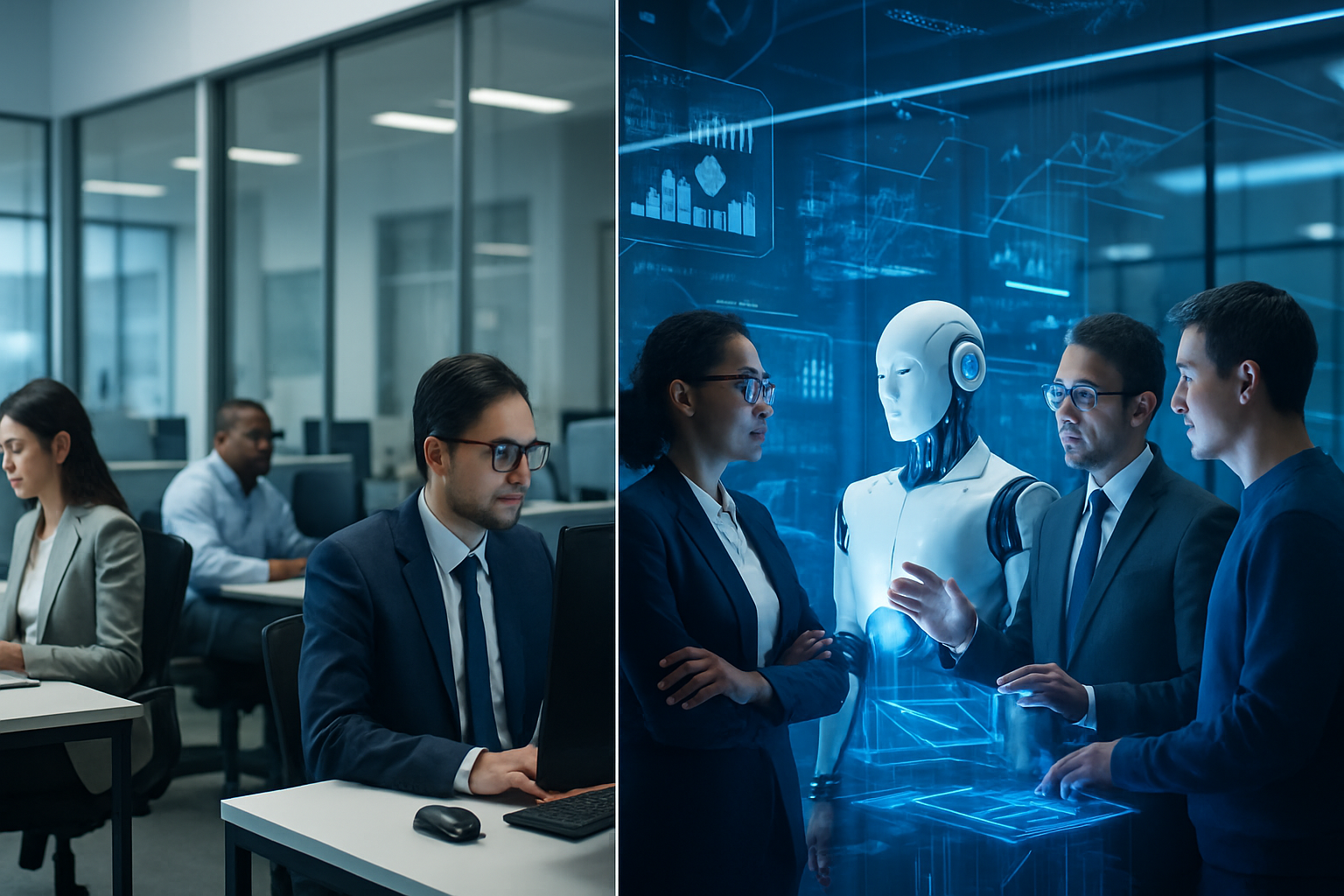
Artificial intelligence's integration into global workplaces is producing a paradoxical reality: rather than the promised efficiency gains, new studies reveal AI implementation often leads to increased workload and diminished productivity, even as industry leaders warn of unprecedented job displacement within the next two years.
Research emerging from Argentina, Germany, and the United States paints a complex picture of AI's workplace impact, challenging assumptions about technology's role in enhancing human productivity while simultaneously validating concerns about mass employment disruption across multiple industries.
The Productivity Paradox Emerges
A groundbreaking US study highlighted by German researchers reveals that artificial intelligence systems, rather than reducing workload, frequently create additional burdens for employees. The research demonstrates that AI can lead to "mehr Arbeit und nachlassender Effizienz" (more work and declining efficiency), contradicting widespread corporate promises of streamlined operations.
Dr. Frank Bäumer's analysis, published through German research institutions, emphasizes that the problem lies not with the technology itself but with human interpretation and implementation. Workers using AI tools often find themselves managing both their original responsibilities and the additional overhead of supervising, correcting, and integrating AI outputs into existing workflows.
This phenomenon, documented across multiple workplace environments, suggests that the current generation of AI tools may be creating a "double workload" effect where employees must simultaneously perform their traditional tasks while also serving as quality control specialists for artificial intelligence systems.
Employment Disruption Warnings Intensify
While productivity gains remain elusive, warnings about AI-driven job displacement have reached unprecedented levels of specificity and urgency. Matt Shumer, a prominent US entrepreneur, has declared that "no office job will be safe within one to two years," representing one of the most aggressive timelines yet predicted for AI-induced employment disruption.
The assessment encompasses a broad spectrum of professional roles, with particular emphasis on knowledge work traditionally considered immune to automation. Legal professionals, auditors, administrative staff, and middle management positions are now being identified as particularly vulnerable to AI replacement in the immediate term.
"The convergence of advanced language models with workplace automation tools has created a perfect storm for white-collar job displacement. What we're witnessing isn't gradual technological adoption—it's a potential employment cliff."
— Industry Analysis, German Technology Research
These predictions align with earlier warnings from Microsoft's Mustafa Suleyman, who suggested that AI could replace the majority of office workers within two years, with lawyers and auditors facing automation within just 18 months. Such timeline compression represents a dramatic acceleration from previous technological transition periods.
Global Employment Landscape at Risk
Research from Oxford Economics, as reported in Argentine media, indicates that approximately 20% of current jobs in the United States face significant automation risk within the next two decades. This assessment, while extending beyond the immediate timeline suggested by some industry figures, still represents one of the most substantial employment disruptions in modern economic history.
The analysis identifies several key vulnerability factors: routine cognitive tasks, predictable decision-making processes, and roles involving data processing or pattern recognition. However, the research also suggests that complete job replacement may be less common than partial automation, where AI handles specific aspects of roles while humans adapt to modified responsibilities.
Argentina's coverage of US employment trends reveals particular concern about the speed of technological adoption. Unlike previous industrial revolutions, which typically allowed decades for workforce adaptation, AI implementation is occurring within compressed timeframes that may not permit adequate retraining or economic adjustment.
The Implementation Challenge
German research institutions have identified a critical disconnect between AI capability and workplace integration success. Studies show that successful AI implementation requires sophisticated change management, comprehensive training programs, and fundamental workflow redesign—investments that many organizations are failing to make.
The research reveals that organizations rushing to deploy AI solutions often experience the "productivity paradox" effect, where initial efficiency gains are quickly overwhelmed by implementation overhead, system maintenance requirements, and employee adaptation challenges.
Sector-Specific Impact Analysis
Different industries are experiencing varying degrees of AI integration success and disruption:
- Legal Services: Document review and contract analysis showing high automation potential, with some firms reporting 60-70% reduction in junior associate work
- Financial Services: Audit processes and compliance checking increasingly automated, threatening traditional career progression paths
- Administrative Support: Scheduling, email management, and basic data entry becoming fully automated in many organizations
- Creative Industries: Content generation and design work facing AI competition, though human oversight remains essential
Infrastructure Constraints Limit Growth
Despite aggressive deployment timelines, AI implementation faces significant technical limitations. A global semiconductor crisis has created sixfold price increases affecting major manufacturers including Samsung, SK Hynix, and Micron, with supply constraints expected to persist until 2027 when new fabrication facilities come online.
These infrastructure challenges are forcing organizations to develop more selective AI deployment strategies, prioritizing highest-impact applications rather than comprehensive automation programs. The constraint may inadvertently provide additional time for workforce adaptation and policy development.
International Policy Response
Governments worldwide are grappling with the speed and scale of AI workplace transformation. The United Nations has established an Independent International Scientific Panel on Artificial Intelligence with 40 global experts, representing the first fully independent global body dedicated to AI impact assessment.
European authorities are implementing increasingly strict oversight measures, with Spain introducing criminal executive liability frameworks for AI deployment and France conducting cybercrime enforcement actions against AI platforms. These regulatory responses reflect growing recognition that current AI development pace may be outstripping societal adaptation capacity.
Success Models Emerge
Despite widespread challenges, some organizations have demonstrated successful AI integration approaches. Canadian universities have implemented AI teaching assistants while maintaining critical thinking standards, showing how technology can enhance rather than replace human capabilities.
Malaysia's introduction of AI-integrated educational programs combines artificial intelligence with traditional learning approaches, providing a template for technology adoption that preserves human development while leveraging AI capabilities. These success stories emphasize the importance of human-centered implementation strategies.
Singapore's WonderBot 2.0 heritage education program demonstrates how AI can enhance cultural preservation and learning engagement when deployed with clear pedagogical objectives and community involvement.
The Path Forward
Research suggests that successful AI workplace integration requires fundamental reconsideration of implementation approaches. Rather than wholesale job replacement, the most effective strategies focus on human-AI collaboration, where artificial intelligence handles routine tasks while humans concentrate on creative problem-solving, relationship management, and strategic decision-making.
This collaborative model demands significant investment in workforce retraining, organizational restructuring, and change management—commitments that many organizations have yet to make. The productivity paradox may persist until companies develop more sophisticated approaches to AI integration that prioritize human development alongside technological deployment.
Industry experts increasingly advocate for "gradual integration" strategies that allow organizations and workers time to adapt, rather than rapid transformation approaches that may create more disruption than benefit.
Economic and Social Implications
The mixed results of AI workplace integration carry profound implications for economic policy and social stability. If productivity gains fail to materialize while job displacement accelerates, societies may face the challenge of technological unemployment without corresponding economic benefits.
This scenario would require unprecedented policy innovation, potentially including universal basic income programs, massive retraining initiatives, and fundamental reconsiderations of work's role in society. The window for proactive policy development may be narrowing as AI deployment accelerates faster than institutional adaptation.
The current moment represents a critical inflection point where decisions about AI implementation approaches will determine whether artificial intelligence becomes a tool for widespread prosperity or a driver of social and economic disruption. Success will depend on balancing technological advancement with human welfare, ensuring that AI serves society rather than simply replacing human contribution to economic activity.