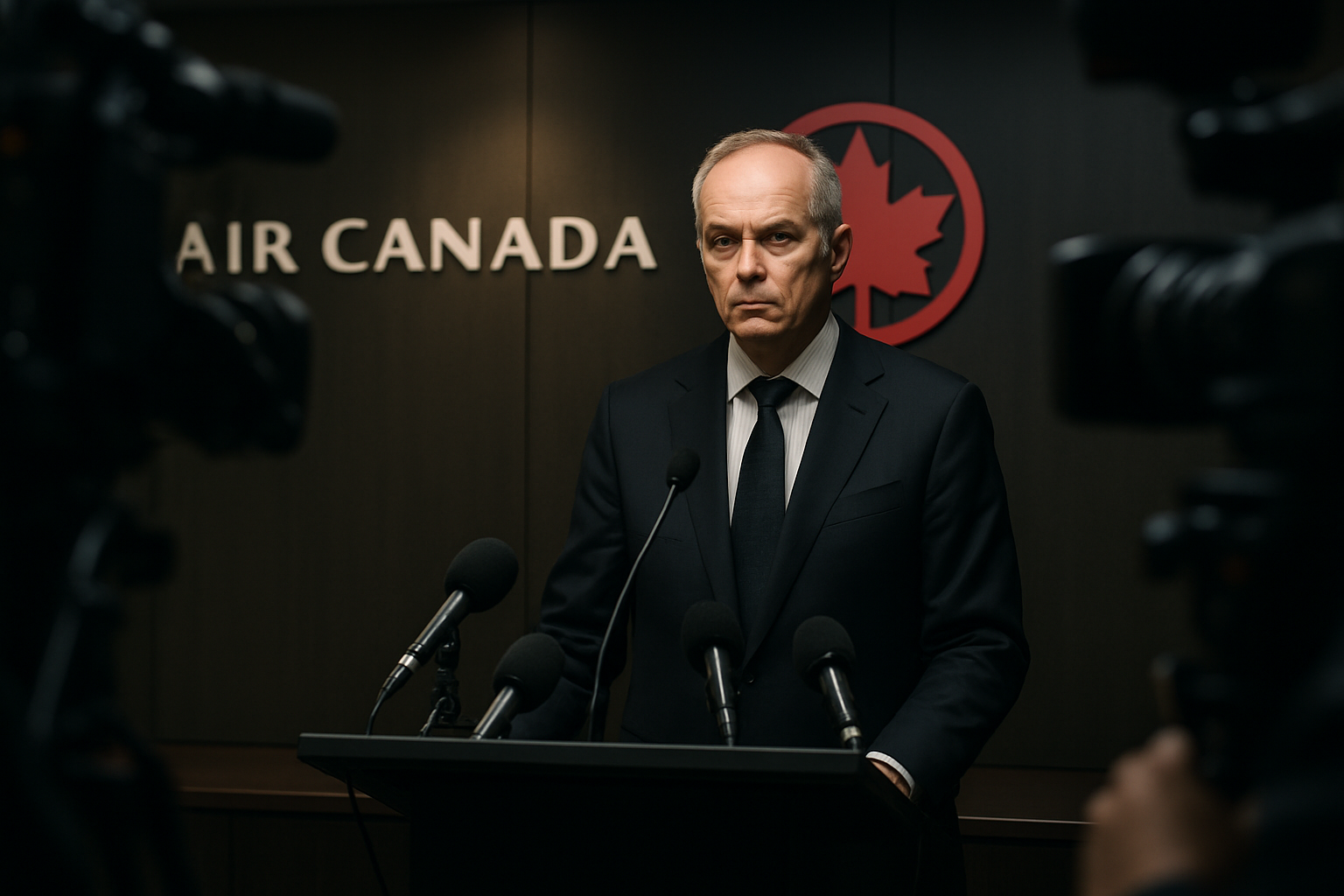
Air Canada CEO Michael Rousseau will retire later this year following mounting pressure over his controversial decision to issue an English-only condolence video after the fatal LaGuardia Airport crash that killed two Air Canada Express pilots, including Quebec pilot Antoine Forest.
The retirement announcement comes just days after the March 22 collision between an Air Canada Express Bombardier CRJ-900 and a Port Authority fire truck during landing operations at LaGuardia Airport. The crash killed both pilots instantly and injured 43 passengers and crew members, sparking one of the most significant aviation safety investigations in recent years.
The Language Controversy That Sparked National Outrage
Rousseau's decision to release his initial condolence message exclusively in English generated immediate backlash across Quebec and francophone communities nationwide. The controversy was particularly acute given that one of the deceased pilots, Antoine Forest, was from Coteau-du-Lac, Quebec, highlighting what critics saw as a fundamental lack of respect for the airline's francophone employees and customers.
"This represents a lack of compassion during our darkest hour," stated Prime Minister Mark Carney in parliamentary remarks that echoed widespread public sentiment.
— Prime Minister Mark Carney
Quebec Premier François Legault went further, publicly demanding Rousseau's resignation and calling the English-only message a demonstration of "complete lack of respect for francophone employees and clients." The controversy generated 84 formal complaints to the Official Languages Commissioner, representing one of the largest single-incident language rights violations in recent Canadian history.
Parliamentary Summons and Political Pressure
The language controversy quickly escalated beyond public criticism to formal political action. The Parliamentary Transport Committee summoned Rousseau to explain his decision, marking a rare instance of direct legislative intervention in corporate communications during a crisis. The summons reflected broader tensions over federal bilingualism obligations, particularly for Crown corporations like Air Canada that operate under enhanced official languages requirements.
The incident occurred amid ongoing national discussions about French language protection in Quebec and federal institutions' bilingual responsibilities. Critics argued that Rousseau's actions represented a systematic failure to understand Canada's linguistic duality, particularly during sensitive crisis communications when empathy and cultural awareness are paramount.
The LaGuardia Crash: A Tragedy Overshadowed
The language controversy unfortunately overshadowed critical discussions about aviation safety following the LaGuardia collision. The March 22 incident involved Air Canada Express Flight 8646, operated by Jazz Aviation, which struck a Port Authority fire truck during routine landing operations. Both pilots were killed instantly when the aircraft's nose section was completely destroyed upon impact.
Among the victims was Antoine Forest, a 30-year-old pilot from Coteau-du-Lac, Quebec, whose death became central to the language controversy. The human tragedy of losing experienced aviation professionals was compounded by the perceived cultural insensitivity of the airline's initial response.
The National Transportation Safety Board (NTSB) investigation revealed serious concerns about air traffic controllers working the midnight shift taking on extra responsibilities in LaGuardia's busy airspace. The probe highlighted coordination vulnerabilities between aircraft operations and ground emergency responses at major airports.
A Pattern of Language Insensitivity
Industry analysts noted that this was not Rousseau's first controversy regarding official languages. Throughout his tenure as CEO, there had been periodic criticism of Air Canada's commitment to bilingual service, though none reached the scale of the LaGuardia response controversy.
The timing proved particularly damaging, as the airline was already facing scrutiny over its handling of the aviation crisis. The crash represented part of a challenging 2026 for global aviation safety, including multiple international incidents and ongoing operational pressures from Middle East conflicts that had cancelled over 18,000 flights worldwide.
Corporate Crisis Communications Under Fire
Crisis communication experts described Rousseau's response as a textbook example of how not to handle sensitive corporate communications during tragedy. The decision to prioritize operational efficiency over cultural sensitivity during such a emotionally charged situation demonstrated what critics called a fundamental misunderstanding of Air Canada's role as a national symbol.
The controversy raised broader questions about crisis communications training for senior executives at federally regulated companies. Industry observers noted that modern crisis management requires sophisticated understanding of cultural, linguistic, and political sensitivities, particularly when dealing with public tragedies.
Impact on Aviation Safety Discussions
Perhaps most troubling for aviation safety advocates was how the language controversy diverted attention from critical safety lessons emerging from the LaGuardia investigation. The crash highlighted significant coordination challenges between air traffic control and emergency vehicle operations—issues that affect passenger safety across the aviation system.
Flight attendant Solange Tremblay's miraculous survival, attributed to the four-point crew restraint system, provided valuable insights for aviation safety improvements. However, these technical discussions were largely overshadowed by the political fallout from Rousseau's communications misstep.
Quebec's Response and Federal-Provincial Tensions
The controversy exacerbated existing federal-provincial tensions over language rights and corporate accountability. Quebec politicians used the incident to highlight what they characterized as ongoing federal government failures to enforce bilingualism requirements for Crown corporations and federally regulated industries.
The incident became a rallying point for francophone rights advocates who argued that true bilingualism requires more than technical compliance with federal regulations—it demands cultural sensitivity and genuine respect for Canada's linguistic heritage.
Looking Forward: Leadership Transition
Rousseau's retirement announcement signals a significant transition period for Air Canada as the airline faces ongoing challenges from the 2026 aviation crisis, including fuel price volatility and operational disruptions from Middle East conflicts. The search for new leadership will likely prioritize candidates with strong crisis communications skills and deep understanding of Canadian linguistic and cultural sensitivities.
Industry observers expect the new CEO selection process to emphasize bilingual capabilities and cultural competency as core qualifications, reflecting lessons learned from this controversy. The incident has effectively established new expectations for executive communications during crises involving federally regulated companies.
Lessons for Corporate Canada
The Rousseau controversy provides important lessons for corporate leaders across federally regulated industries. It demonstrates how quickly operational decisions can become political flashpoints when they involve cultural and linguistic sensitivities.
Crisis communication experts are already using this case study to illustrate the importance of multilingual, culturally sensitive corporate responses during tragedies. The incident reinforces that technical compliance with official languages legislation is insufficient—genuine cultural competency and empathy are essential for effective leadership in Canada's bilingual corporate environment.
As Air Canada begins its leadership transition, the airline faces the challenge of rebuilding trust with francophone communities while maintaining operational excellence during a turbulent period for global aviation. The controversy serves as a watershed moment, establishing new standards for corporate cultural sensitivity during crisis communications in Canada's diverse linguistic landscape.