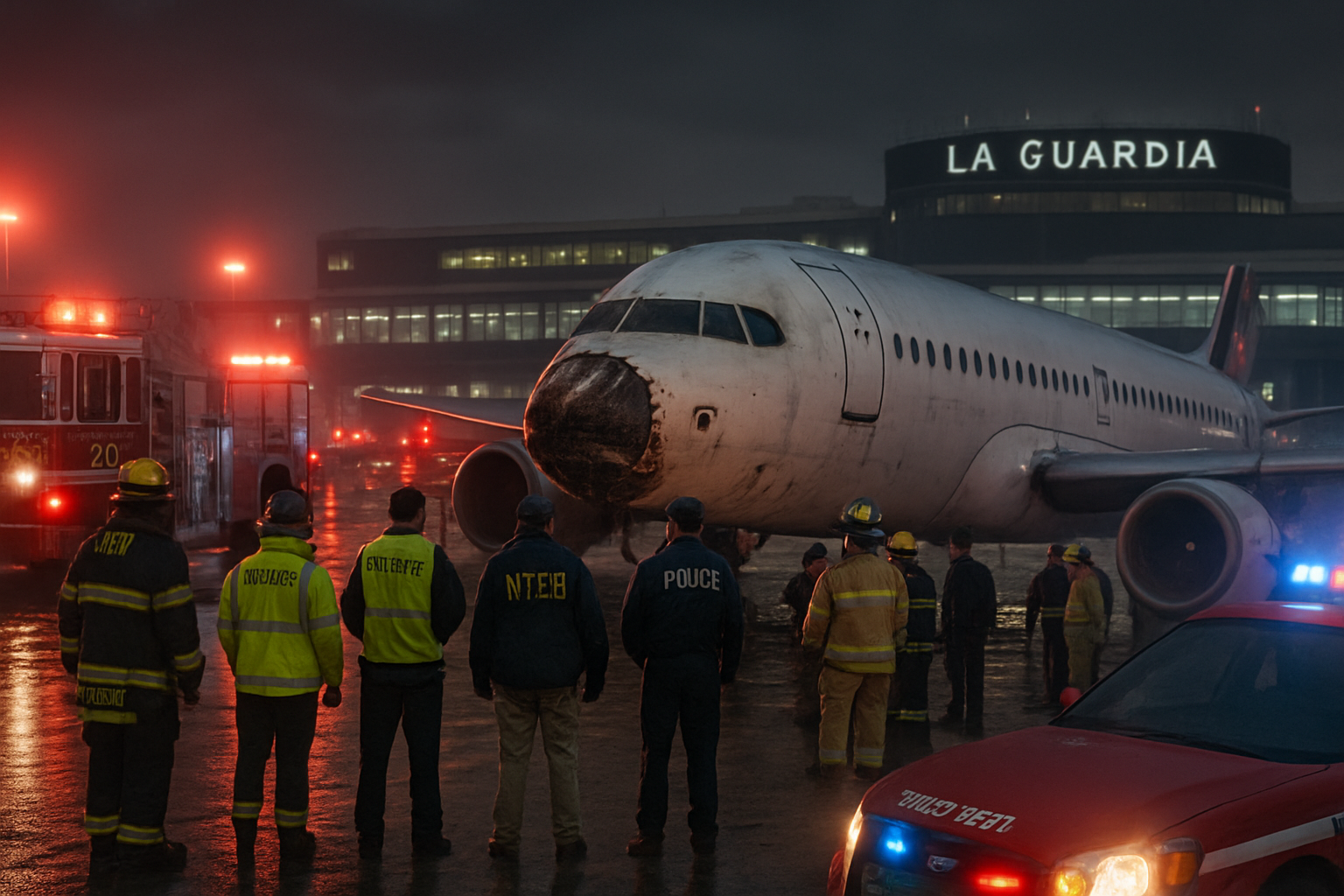
Two pilots were killed and more than 40 passengers were injured when an Air Canada Express flight collided with a Port Authority fire truck during landing operations at New York's LaGuardia Airport on Sunday night, March 22, 2026, in one of the most serious aviation accidents in recent U.S. history.
The Bombardier CRJ-900 regional jet, operated by Jazz Aviation under the Air Canada Express banner, was arriving from Montreal with 72 passengers and four crew members when it struck the emergency vehicle at approximately 11:40 PM EST. The aircraft was traveling at about 30 miles per hour after touchdown when it collided "nose first" with the fire truck, according to Federal Aviation Administration officials.
Fatal Impact and Immediate Response
Both the pilot and co-pilot were killed instantly in the collision, with the aircraft's nose and cockpit section sustaining catastrophic damage. Quebec resident Antoine Forest was identified by Radio-Canada sources as one of the pilots killed in the crash. Forest was from Coteau-du-Lac, Quebec, southwest of Montreal.
Emergency responders rushed to the scene as passengers and crew were evacuated from the main cabin. A total of 41 passengers were transported to area hospitals, along with two firefighters from the struck vehicle. Most injuries were reported as non-life-threatening due to the successful evacuation from the aircraft's main cabin, which remained largely intact despite the severe front-end damage.
"Each name represents a story, a family, dreams, and affections. Not numbers. Bolivians leaving an impossible void to fill."
— Emergency response protocols activated immediately
Airport Operations Disrupted
LaGuardia Airport was completely shut down following the collision, with the FAA issuing a ground stop that remained in effect until 2:00 PM Monday. The closure of one of the nation's busiest domestic hubs created ripple effects throughout the national aviation network, affecting thousands of passengers and hundreds of flights.
Air traffic control recordings captured the immediate response to the incident, with controllers acknowledging the collision and directing emergency crews to remain in place while first responders arrived on scene. The recordings reveal the professional response of air traffic personnel as they coordinated the emergency response while securing the accident site.
Investigation Launched
The National Transportation Safety Board (NTSB) and Federal Aviation Administration immediately launched a comprehensive investigation into the collision. Federal authorities are focusing on multiple factors including mechanical systems, weather conditions, communication protocols, and emergency vehicle coordination procedures.
Preliminary reports indicate the Port Authority fire truck was responding to a separate, unrelated emergency incident when it was struck by the landing aircraft during routine operations. Officials have ruled out terrorism or hostile activity, emphasizing that the collision occurred during normal flight operations in standard airspace.
Ongoing Safety Concerns
The LaGuardia incident occurs amid a challenging year for aviation safety in 2026. The industry has faced multiple crises including the Middle East aviation disruption that canceled over 18,000 flights worldwide, European strikes, and several high-profile safety incidents globally.
Aviation safety experts note that runway incursions and ground vehicle conflicts remain rare but serious operational concerns at busy airports. The collision highlights potential vulnerabilities in coordination between aircraft operations and emergency vehicle responses during simultaneous activities.
Industry and Regulatory Response
The investigation findings are expected to influence airport safety procedures globally, with particular focus on protocols governing emergency response coordination during active flight operations. Questions have been raised about the adequacy of current procedures for managing emergency vehicles in proximity to aircraft operations at major airports.
Jazz Aviation, which operates the Air Canada Express service, has a strong safety record operating regional aircraft throughout North America. The Bombardier CRJ-900 is considered a reliable regional aircraft with extensive operational history, though the investigation will examine all potential mechanical and operational factors.
Human Cost and Community Impact
The loss of two experienced pilots represents both a human tragedy and the loss of valuable aviation expertise. The aviation industry's exceptional safety record depends heavily on the knowledge and skills of experienced flight crews, making such losses particularly significant for the broader aviation community.
Support services have been activated for the families of those killed and injured, with both Air Canada and port authority officials coordinating comprehensive assistance programs. The airline industry maintains extensive protocols for supporting those affected by aviation accidents, including long-term care and financial assistance.
Looking Forward
As the investigation continues, the aviation industry will closely examine the findings for lessons that can enhance safety protocols. Potential improvements may include enhanced communication systems between air traffic control and emergency vehicles, improved coordination protocols for simultaneous operations, and possibly redesigned airport layouts that better separate emergency vehicle routes from active aircraft operational areas.
The LaGuardia collision serves as a reminder of the complex operational environment at major airports, where multiple activities must be carefully coordinated to maintain safety. While such incidents remain exceptionally rare, each provides crucial learning opportunities for continuous improvement in aviation safety procedures and emergency response protocols.