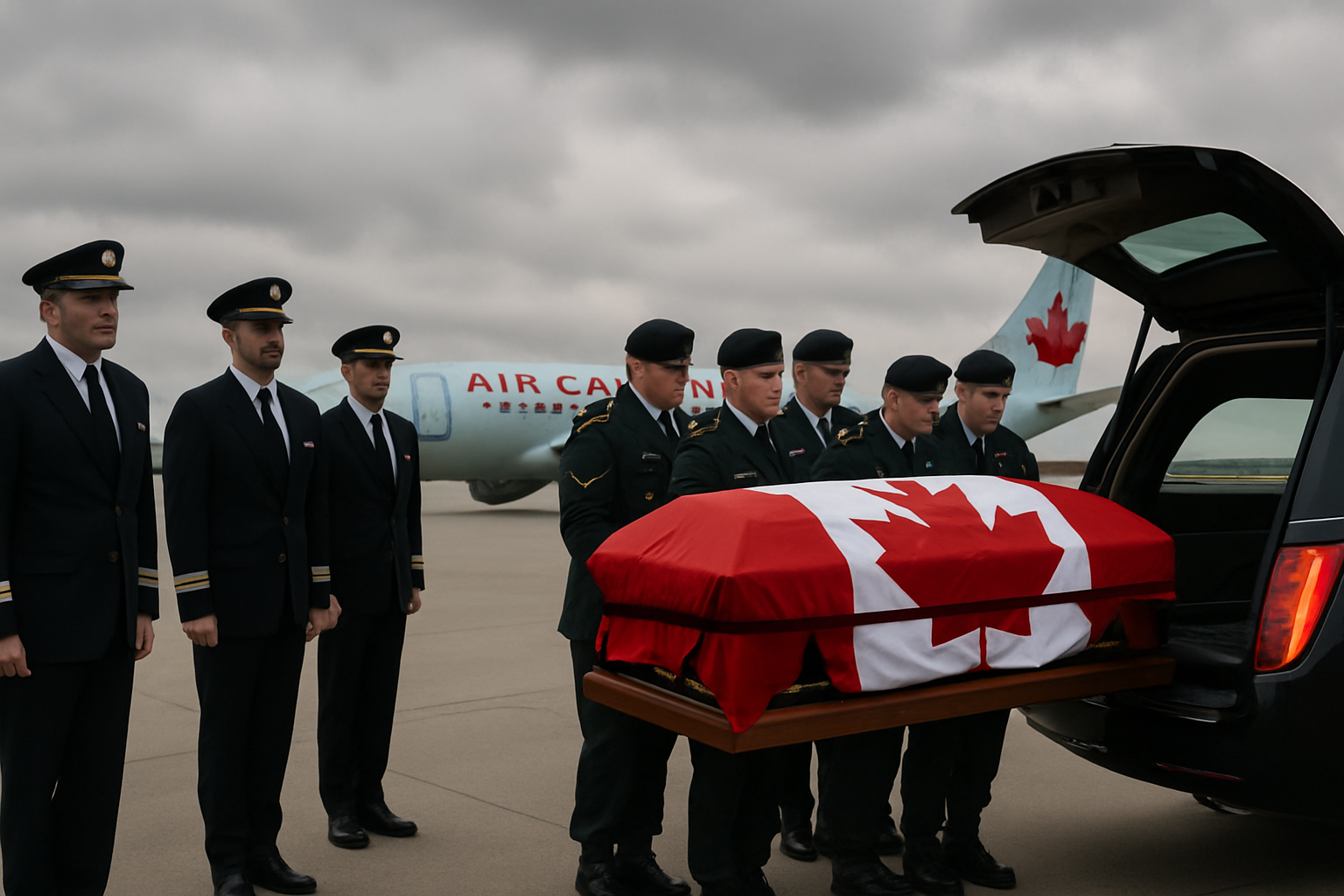
The bodies of the two Air Canada pilots who died in a devastating collision at LaGuardia Airport on Sunday have been repatriated to Canada, bringing some closure to a tragedy that has shaken the aviation community and raised serious questions about airport safety protocols.
The solemn ceremony marked the return of Jazz Aviation First Officer Mackenzie Gunther and pilot Antoine Forest from Coteau-du-Lac, Quebec, whose Air Canada Express flight collided with a Port Authority fire truck during landing operations at the New York airport. The repatriation comes as investigations continue into the deadliest aviation incident at LaGuardia in recent memory.
Tragedy Unfolds at LaGuardia
The collision occurred at 11:40 PM EST on Sunday, March 22, when Air Canada Express Flight 8646, operated by Jazz Aviation, struck a Port Authority fire truck during what should have been a routine landing. The Bombardier CRJ-900 aircraft, carrying 72 passengers and 4 crew members from Montreal, was traveling approximately 30 mph after touchdown when it collided with the emergency vehicle on Runway 4.
Both pilots were killed instantly as the aircraft's nose and cockpit section were completely destroyed upon impact. The collision left 41 passengers and 2 firefighters from the struck fire truck injured, though most passenger injuries were classified as non-life-threatening due to a successful evacuation from the main cabin.
"The deaths of two young aviators have shaken up the industry,"
— Air Line Pilots Association spokesperson
Among the remarkable survival stories was flight attendant Solange Tremblay, who was ejected from the aircraft while still strapped in her crew seat. She survived with leg fractures requiring surgery, with her daughter Sarah Lepine calling her survival a "total miracle" attributed to the four-point crew restraint system.
Investigation Focus on Air Traffic Control Procedures
The National Transportation Safety Board (NTSB) has launched a comprehensive investigation examining the circumstances that led to the fatal collision. Initial findings reveal serious concerns about air traffic controllers working the midnight shift taking on additional responsibilities beyond their primary duties in LaGuardia's busy airspace.
According to NTSB investigators, controllers were "juggling additional roles beyond primary responsibilities" during the incident, raising critical questions about operational procedures and coordination between air traffic control, emergency vehicle dispatch, and ground operations. The fire truck was responding to a separate, unrelated emergency incident when it was struck by the landing aircraft.
The investigation has been complicated by partial government shutdown affecting NTSB investigators' security clearances and site access, according to NTSB Chair Jennifer Homendy, who reported airport access delays preventing timely wreckage examination.
Airport Operations and Safety Concerns
The collision forced a complete closure of LaGuardia Airport through Monday afternoon at 2:00 PM, with the FAA issuing a ground stop that created nationwide aviation network disruption. The closure of such a critical domestic hub demonstrated the cascading effects that a single airport shutdown can have on the interconnected aviation system, affecting thousands of passengers across the country.
Aviation safety experts note that runway incursions and ground vehicle conflicts remain a serious operational concern at major airports, despite significant technological advances in ground radar and communication systems. The investigation is expected to focus particularly on protocols for coordinating emergency responses with active flight operations during midnight shift operations.
Human Cost and Aviation Community Impact
The loss of Antoine Forest, a 30-year-old pilot from Coteau-du-Lac, Quebec, and co-pilot Mackenzie Gunther represents a significant tragedy for both their families and the broader aviation community. Forest's death has particularly affected the Quebec community of Coteau-du-Lac, where he was remembered as a dedicated young pilot in the early stages of what promised to be a distinguished career.
Air Canada has activated comprehensive support protocols for the victims' families and injured passengers, including counseling services, family assistance programs, and regulatory coordination. The airline industry's accident response procedures have been tested once again, demonstrating the importance of having robust support systems in place for such tragic events.
Broader Aviation Safety Context
This incident occurs during what has been a challenging year for aviation safety in 2026. The LaGuardia collision is part of a broader pattern that has included the Middle East crisis cancelling over 18,000 flights globally, multiple military aviation accidents in Latin America, and various safety incidents that have tested protocols worldwide.
Despite these challenges, the commercial aviation industry maintains an exceptional safety record. The International Air Transport Association's 2025 report showed 51 accidents among 38.7 million flights globally, with eight fatal incidents. However, each incident provides crucial lessons for improving safety protocols and emergency response procedures.
Investigation Timeline and Expected Outcomes
The NTSB investigation is expected to continue for several months, with investigators examining mechanical systems, weather conditions, communication protocols, and emergency vehicle coordination procedures. The black box flight data recorders have been successfully recovered and are being analyzed to piece together the exact sequence of events.
The findings are expected to have significant implications for global airport safety procedures, particularly regarding enhanced communication systems between air traffic control and emergency vehicles. Questions have been raised about the adequacy of current protocols for coordinating emergency responses with active flight operations at major airports.
Industry experts anticipate that the investigation results will influence international safety standards and airport operations procedures globally, potentially leading to improved coordination protocols for simultaneous aircraft operations and ground emergency responses.
Moving Forward
As the aviation community mourns the loss of two experienced pilots, the focus now turns to ensuring that their deaths were not in vain. The investigation's findings will be crucial in strengthening safety frameworks that protect millions of travelers worldwide through improved emergency response coordination and enhanced air traffic control procedures.
The repatriation of Antoine Forest and Mackenzie Gunther marks a somber milestone in this ongoing investigation, bringing their bodies home while their legacy continues through the safety improvements their tragic deaths may inspire. The aviation industry's commitment to learning from every incident remains a cornerstone of its exceptional safety record, even as each loss reminds us of the human cost when safety protocols fail.