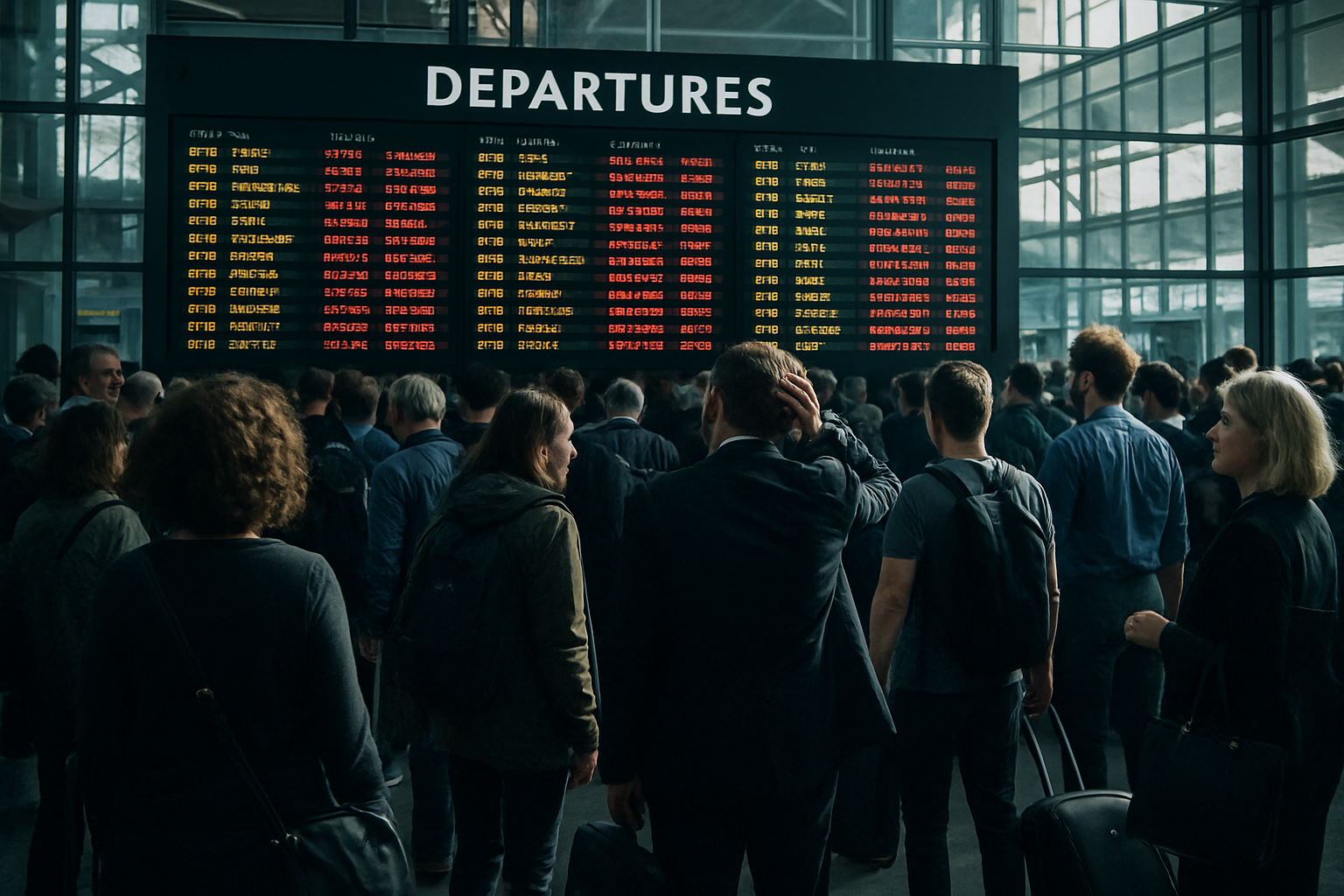
Airport authorities in Lisbon admitted Friday that severe border control delays during morning operations forced passengers to miss connecting flights, while airlines face mounting pressure from fuel costs that have surged over 120% since March, creating a perfect storm of disruptions across the global travel industry.
According to a statement from ANA - Portugal, "today, during the morning period, extremely high waiting times were recorded at Lisbon airport border control for both departures and arrivals," marking the latest in a cascade of operational failures that have plagued international travel throughout 2026.
Fuel Crisis Reaches Breaking Point
The admission comes as Cathay Pacific announced it has become the latest major airline to reduce flight frequencies in response to skyrocketing fuel prices triggered by ongoing Middle East conflicts. The Hong Kong-based carrier joins a growing list of airlines implementing emergency cost-cutting measures as jet fuel prices have surged from $85-90 to $150-200 per barrel since March 2026.
"Airlines are facing the most severe operational crisis since COVID-19," said industry analyst Maria Santos. "The combination of fuel price volatility and infrastructure failures is creating an impossible situation for both carriers and passengers."
The fuel crisis stems from the closure of the Strait of Hormuz, a critical waterway handling 40% of global oil transit. Iranian authorities effectively declared the strait "unsafe" in March, forcing major shipping companies including Maersk and MSC to suspend operations and leaving over 150 oil tankers stranded with billions of dollars worth of cargo.
European Airport Chaos Spreads
Lisbon's border control failures represent just one front in a broader European aviation crisis. The implementation of the EU's Entry/Exit System (EES), which requires biometric data from non-EU citizens, has created widespread delays across European airports despite promises of streamlined operations.
Airlines from France, Germany, Italy, and Spain have expressed coordinated concerns about system readiness, with some warning of potential 4-hour queues during peak summer travel periods. The European Commission has already authorized partial EES suspensions for summer 2026, with full implementation postponed until September.
"We're seeing the convergence of multiple crises - technological failures, geopolitical instability, and infrastructure limitations - all hitting the travel industry simultaneously."
— Dr. Elena Rodriguez, Aviation Industry Expert
Airlines Implement Emergency Measures
The crisis has forced airlines to adopt unprecedented operational strategies. Norwegian Airlines deployed 125 additional flights across the Nordic region after SAS cancelled over 1,000 flights due to unsustainable fuel costs. Meanwhile, Malaysian Airlines CEO Nasaruddin Bakar has taken a contrarian approach, viewing the crisis as an opportunity to expand while competitors reduce capacity.
"We see this crisis as an opportunity to expand while our competitors are reducing capacity," Bakar stated. "Malaysia Airlines Group has secured 36% of our fuel needs for 2026 and we're targeting 50% by Q2."
However, not all carriers have been able to maintain such optimism. Low-cost carrier AirAsia has implemented significant cost-cutting measures, including capacity reductions and fare increases, directly attributing the moves to fuel pressure from ongoing West Asian conflicts.
Passenger Impact Reaches Critical Levels
The cumulative effect of these disruptions has created a nightmare scenario for travelers. Individual passenger costs have reached extreme levels, exemplified by Swedish traveler Emily Grosser, who was forced to pay $560 for alternative routing from Paris to Australia after her Dubai connection was cancelled.
Travel insurance has proven inadequate, with standard policies excluding war-related cancellations. This has driven a fundamental shift toward package tours over independent travel, as travelers seek comprehensive coverage frameworks that protect against extraordinary circumstances.
Austrian Consumer Centres have confirmed that travelers experiencing "anxiety" about regional conflicts have no recourse unless they book organized tours, highlighting critical gaps in current protection systems.
Regional Winners and Losers Emerge
The crisis has created clear winners and losers in the global tourism landscape. Croatia has positioned itself as a safer European alternative, maintaining Europe's most extensive seasonal healthcare network with 62 tourist medical clinics for the 2026 season. Spain, with its capacity for 513.6 million tourist nights annually, has captured significant redirected demand from traditional Middle Eastern destinations.
Conversely, destinations dependent on Middle Eastern aviation hubs face severe challenges. New Zealand's tourism recovery is threatened as one-third of European travelers typically use Middle Eastern airports for connections. The Caribbean faces what experts describe as a "perfect storm" of Middle East disruptions combined with Cuba's complete aviation isolation.
Technology Solutions Struggle to Keep Pace
Despite significant infrastructure investments exceeding $570 billion globally, technology solutions have struggled to address the scale of current challenges. Rome's Trevi Fountain has implemented a €2 entry system generating €6 million annually in managed access revenue, while Venice has expanded entry fees to 60 days in 2026, demonstrating how destinations are adapting through crowd management rather than capacity expansion.
Croatia leads in technological integration, combining AI travel planning with comprehensive medical infrastructure, but even these advanced systems cannot overcome the fundamental challenges of fuel costs and geopolitical instability.
Long-Term Industry Transformation
Industry experts warn that the current crisis represents a watershed moment that will reshape travel patterns for decades. Enhanced security screening, mandatory conflict insurance, and pre-approval for high-risk destinations are becoming standard requirements rather than temporary measures.
Route diversification has become an urgent priority as airlines seek to reduce dependency on Middle Eastern hubs. The crisis has exposed the vulnerability of modern transportation networks to single-point failures, particularly in geopolitically sensitive regions.
"We're witnessing a fundamental shift from volume-based to quality-focused tourism strategies," explained tourism economist Dr. James Mitchell. "The industry is being forced to prioritize resilience over efficiency, which will have lasting implications for how we travel."
Government Responses Intensify
Governments worldwide have implemented emergency responses ranging from evacuation protocols to strategic fuel reserve releases. The International Energy Agency has coordinated the largest oil reserve release in 50 years, deploying 400 million barrels from 32 countries to stabilize markets.
Cyprus activated its ESTIA evacuation plan for the first time, coordinating the extraction of over 2,000 EU nationals from the UAE. The operation serves as a template for future emergency responses in an increasingly volatile world.
Recovery Timeline Remains Uncertain
Unlike weather-related disruptions that have predictable recovery timelines, the current crisis depends on diplomatic and military resolutions that remain uncertain. Airlines are conducting daily operational reviews but cannot implement long-term scheduling decisions while multiple airspaces remain closed and fuel costs stay elevated.
The crisis has already affected over 18,000 flights worldwide since March, making it the most extensive aviation disruption since the COVID-19 pandemic. Even when stability returns, clearing the backlog of cancelled flights and stranded passengers is expected to take weeks.
As the travel industry continues to navigate these unprecedented challenges, the convergence of operational failures, geopolitical instability, and infrastructure limitations has created what experts describe as the most complex crisis in modern aviation history. The resolution of these issues will likely determine the fundamental structure of international travel for years to come.