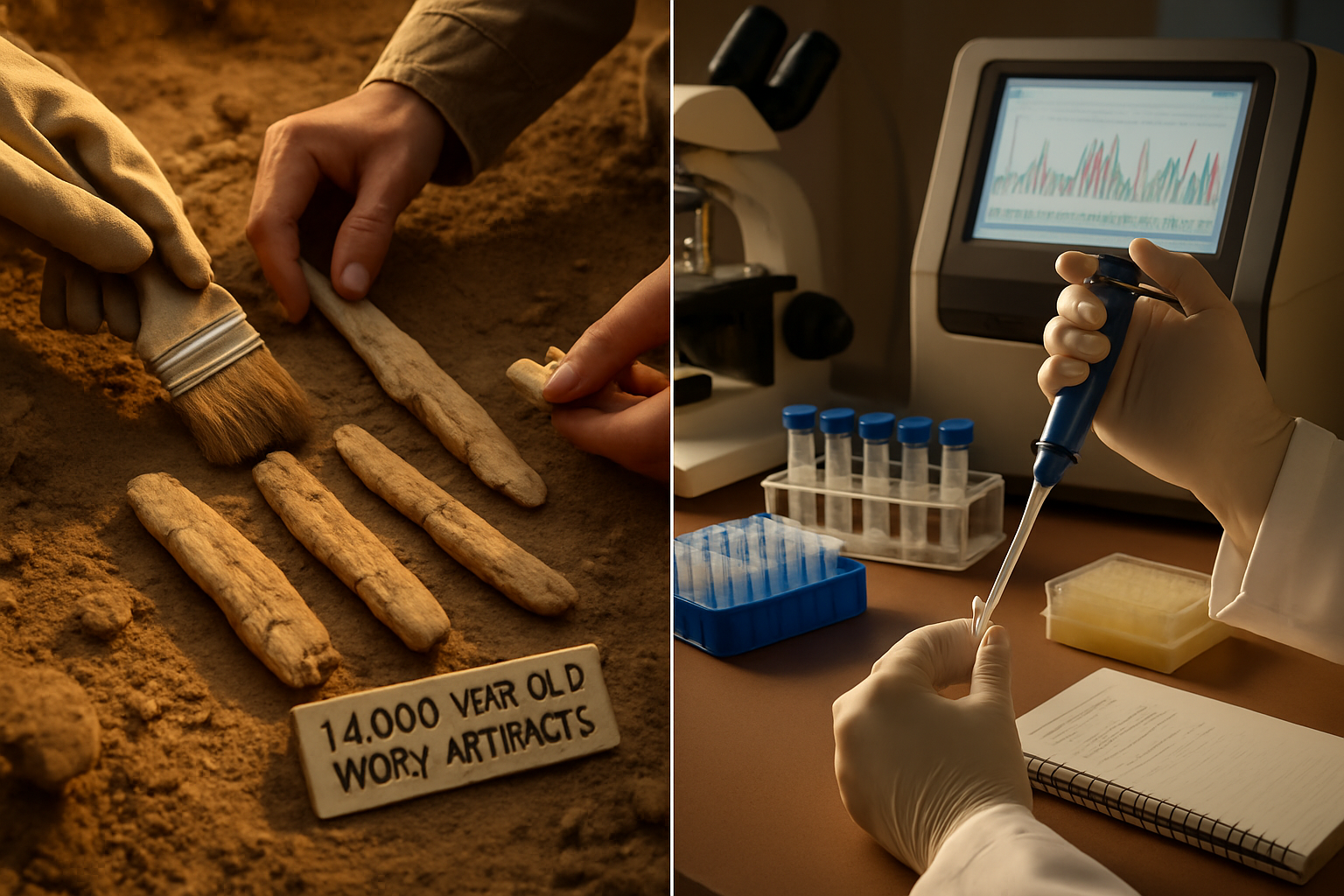
Revolutionary archaeological discoveries in Alaska revealing 14,000-year-old mammoth ivory tools have fundamentally challenged established theories about how the first humans reached the Americas, while simultaneous genetic research has unveiled sophisticated prehistoric mating patterns between Neanderthals and modern humans that reshape our understanding of early human social behavior.
According to groundbreaking research presented by Live Science, these ancient artifacts discovered in Alaska predate the well-known Clovis culture tools found in the southern United States by approximately 600 years, suggesting a dramatically different migration pattern than previously theorized. The discovery indicates that Asian migrants who crossed the Bering Land Bridge advanced through an ice-free interior corridor rather than following coastal routes, as some recent theories have proposed.
Rewriting Human Migration to the Americas
The Alaska discovery represents one of the most significant contributions to understanding early American settlement patterns in recent decades. The mammoth ivory tools, crafted with sophisticated techniques that demonstrate advanced cognitive abilities, provide concrete evidence that human populations were established in interior Alaska much earlier than the archaeological record previously indicated.
This finding aligns with the broader pattern of archaeological discoveries throughout 2026 that have consistently revealed greater human sophistication and earlier technological development than traditional evolutionary models assumed. The discovery builds upon recent breakthroughs including evidence of fire control 350,000 years earlier than expected and systematic astronomical observation systems dating back 8,000 years in China.
Genetic Revolution Reveals Neanderthal-Human Social Dynamics
Simultaneously, international genetic research has uncovered remarkable insights into prehistoric human social behavior through analysis of X-chromosome DNA patterns. The research reveals that when Homo sapiens first encountered Neanderthal populations across Europe, Asia, and the Middle East, the resulting interbreeding followed specific patterns that suggest sophisticated social dynamics rather than random encounters.
The genetic evidence shows a conspicuous absence of Neanderthal genes in modern X-chromosomes, indicating that Neanderthal males predominantly mated with modern human females during the crucial period between 45,000 and 28,000 years ago. This pattern suggests complex mate selection preferences, community acceptance of inter-group relationships, and sophisticated social structures that challenge simplistic views of prehistoric human behavior.
"The evidence suggests Neanderthals may have been more pleasant and generous than modern humans, possessing social qualities that made them attractive partners."
— International Research Team, X-chromosome DNA Analysis
Methodological Advances Enable Breakthrough Discoveries
Both discoveries exemplify what researchers are calling the "2026 Archaeological Renaissance," characterized by the integration of traditional archaeological expertise with revolutionary analytical techniques. Advanced chemical analysis, sophisticated dating methodologies, genetic sequencing, and environmental reconstruction are unlocking previously inaccessible layers of human history.
The Alaska mammoth tool research employed cutting-edge geological analysis and detailed artifact examination, while the Neanderthal genetic studies utilized advanced X-chromosome analysis and population modeling techniques unavailable to previous generations of researchers. This convergence of traditional fieldwork with modern analytical capabilities has produced unprecedented insights into early human capabilities and social organization.
International Cooperation Drives Scientific Progress
These breakthroughs demonstrate the essential role of international cooperation in modern archaeological and genetic research. The Neanderthal study involved collaboration between Austrian, Swedish, and Singaporean research teams, while the Alaska discovery required coordination between multiple institutions and expertise spanning geology, archaeology, and environmental science.
This collaborative approach reflects broader trends in 21st-century scientific research, where significant discoveries increasingly result from diverse international teams bringing together specialized knowledge from multiple fields. The success of these projects provides a template for future archaeological research combining traditional methods with cutting-edge technology and international partnerships.
Implications for Understanding Human Development
The convergence of these discoveries fundamentally challenges gradual development narratives, suggesting that advanced cognitive capabilities, symbolic thinking, and sophisticated social structures emerged much earlier in human history than previously understood. The Alaska tools demonstrate complex planning and advanced technical skills, while the genetic evidence reveals rich social and emotional lives among early humans during crucial evolutionary periods.
The research indicates that early humans possessed intellectual and social sophistication during the European expansion period, emphasizing capabilities over limitations in understanding human development. This represents a fundamental shift from viewing prehistoric humans as gradually progressing from primitive to complex toward recognizing sophisticated ancient communities capable of advanced technical skills and coordinated social action.
Climate Change and Archaeological Preservation
The timing of these discoveries carries particular urgency as climate change threatens archaeological sites globally. With January 2026 marking the 18th consecutive month of temperatures exceeding 1.5°C above pre-industrial levels, environmental pressures increasingly affect archaeological sites worldwide, requiring urgent documentation and preservation efforts.
Many sites containing ancient treasures face threats from climate change, development pressures, and natural deterioration, necessitating systematic archaeological preservation efforts and enhanced international cooperation for collaborative research that transcends national boundaries.
Future Research Directions
The Alaska discovery has opened new avenues for investigation, with continued excavations planned to uncover additional skeletal material and potentially other "lost" early American artifacts. Detailed analysis using advanced imaging techniques, chemical analysis, and comparative studies with modern tool-making techniques will help understand the full sophistication of these early technologies.
The genetic research methodologies are being applied to investigating other prehistoric human behaviors, migration patterns, and population dynamics across different regions and time periods. Future studies will focus on comparative analysis of human-Neanderthal interactions across Europe and Asia, requiring additional funding and international partnerships for comprehensive understanding of early human social organization.
Broader Context of Scientific Discovery
These discoveries occur within a remarkable period of archaeological and genetic breakthrough that is fundamentally altering our understanding of human development and prehistoric capabilities. The combination of sophisticated technology, international cooperation, and systematic research approaches is producing unprecedented historical insights that extend far beyond academic interest to practical understanding of human adaptation, cultural expression, and our species' cosmic context.
The research represents a convergence of space archaeology (studying early human migration patterns), bioarchaeology (analyzing ancient human remains), and genetic archaeology (uncovering prehistoric social relationships), demonstrating multiple pathways for historical discovery that provide complementary insights into human development during crucial evolutionary periods.
February 2026 has established new archaeological research standards that combine traditional excavation expertise with cutting-edge analytical techniques, revealing previously invisible aspects of ancient life that inform our understanding of human capabilities, social organization, and technological development throughout our species' remarkable journey across the planet.