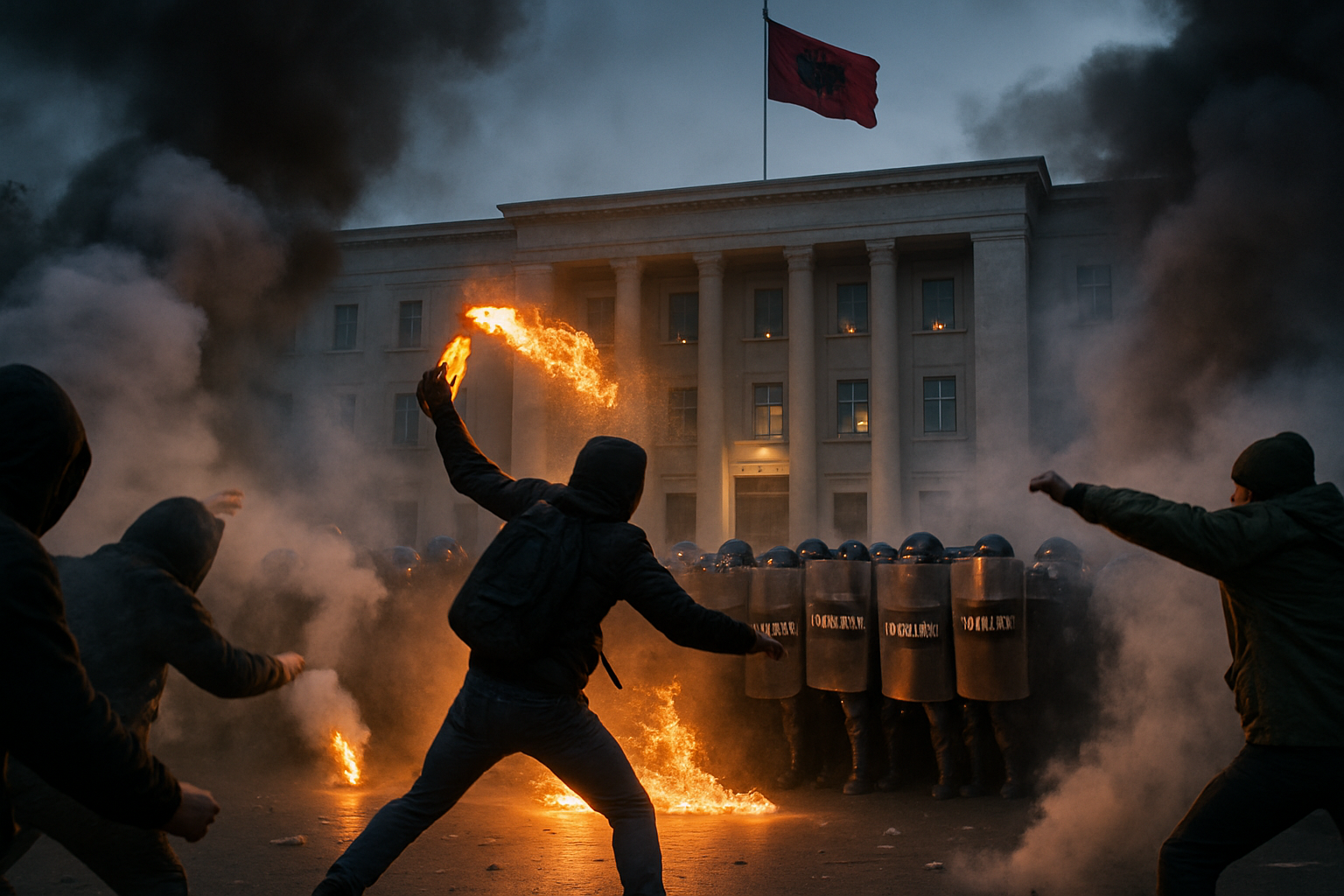
Albania descended into political chaos on February 10, 2026, as violent protesters led by opposition leader Sali Berisha clashed with police forces in central Tirana, resulting in 16 injured officers, hospitalized deputies, and 13 arrests in the country's most severe political unrest in years.
The confrontation began as a planned demonstration by Berisha's Democratic Party (PD) outside the Prime Minister's office but quickly escalated into running battles between protesters and riot police. Demonstrators hurled molotov cocktails, fireworks, and smoke bombs at law enforcement, forcing police to respond with water cannons and tear gas to disperse the crowds.
Violence Erupts at Parliament
The most intense confrontations occurred when protesters attempted to breach police barriers around Albania's Parliament building. Video footage captured dramatic scenes of masked demonstrators launching incendiary devices while police in riot gear attempted to maintain order with shields and batons.
State Police confirmed that 16 officers sustained injuries ranging from burns to physical trauma during the clashes. The injured officers were transported to hospitals for treatment of what authorities described as "burns and physical damage" from the attacks.
"This was not a protest but an attempt to kill state police officers in the line of duty,"
— Erion Braçe, Socialist Party Deputy
The violence extended beyond confrontations with police, as protesters also clashed with ordinary citizens attempting to navigate the city. Video evidence showed demonstrators blocking traffic and physically attacking vehicles that tried to pass through protest areas.
Opposition Deputy Hospitalized
Democratic Party deputy Bledion Nallbati was rushed to Trauma Hospital with what party officials described as head injuries sustained during the clashes. Berisha himself visited Nallbati at the hospital, characterizing the injury as a "political assault" and blaming police commander Sokol Bizhga for ordering the attack.
"Deputy Bledion Nallbati has a hematoma in soft tissues and according to hospital protocol will remain under observation for a certain time to see if there will be other consequences from the blow," Berisha stated from the hospital, threatening that those responsible would face consequences.
The incident involving Nallbati became a particular flashpoint, with Berisha accusing authorities of deliberately targeting opposition politicians and promising that perpetrators would "have responsibility until their last day."
Mass Arrests and Police Response
Albanian State Police moved decisively to control the situation, arresting 13 protesters in connection with the violence. Authorities indicated that additional arrests could follow as they review extensive video footage from the confrontations.
Police justified their response as necessary to protect both officers and civilians, with Commissioner statements emphasizing the "remarkable restraint" shown by forces despite facing deadly projectiles. The police deployment included water cannon vehicles, riot control units, and mounted patrols to manage the crowds.
Beyond arrests at the scene, police also detained protesters who had returned to continue demonstrations later in the evening. The situation remained tense throughout the night as small groups of protesters attempted to regroup near government buildings.
Berisha's Defiant Response
Speaking from the Democratic Party headquarters after the clashes, Sali Berisha remained defiant, announcing plans for another major protest on February 20. He characterized the day's events as evidence of government oppression and called for continued resistance against what he termed Prime Minister Edi Rama's "narco-dictatorship."
Berisha specifically targeted police leadership, warning that officers who "violated citizens and deputies" would face justice. He portrayed his supporters as peaceful protesters facing unprovoked police brutality, despite extensive evidence of protester-initiated violence.
"The self-restraint, courage and peaceful stance of the protesters is a hundred times more powerful than the violence of Edi Rama's police,"
— Sali Berisha, Democratic Party Leader
The opposition leader's rhetoric reflected his broader strategy of portraying the current government as illegitimate while positioning himself as a defender of Albanian democracy, despite his own controversial political history.
Government and Civil Society Condemnation
Government officials condemned the violence in the strongest terms, with Socialist Party deputies characterizing the events as attempted assassination of police officers rather than legitimate political protest.
Deputy Erion Braçe issued a particularly harsh statement via social media, declaring that the day's events constituted "an attempt to kill state police officers on duty" and demanding that such attacks not be forgiven as they had been in previous incidents.
Political analysts expressed concern about the escalating violence, with some observers noting that Berisha's protest strategy appeared to be growing more desperate as his political options narrowed. Roland Bejko, a prominent analyst, suggested that Berisha had led the Democratic Party to "its final kilometer" through increasingly extreme tactics.
Broader Political Context
The violent protests occur against the backdrop of Albania's ongoing political crisis, with the opposition challenging the legitimacy of Edi Rama's Socialist government. The confrontations also come as Albania continues its EU accession negotiations, raising questions about the country's democratic stability and rule of law.
International observers have previously expressed concerns about political polarization in Albania, particularly regarding Berisha's role given his designation as "persona non grata" by the United States due to corruption allegations. These latest incidents are likely to intensify international scrutiny of Albanian politics.
The violence also reflects broader tensions over judicial reforms and anti-corruption efforts that have created friction between political forces in Albania. Recent constitutional court decisions and ongoing investigations into high-level officials have contributed to the charged political atmosphere.
Regional and International Implications
The violent scenes in Tirana have drawn attention from regional neighbors and EU partners, with Bulgarian and Romanian media providing extensive coverage of the clashes. The events underscore concerns about democratic backsliding in the Western Balkans region.
EU officials have consistently emphasized the importance of peaceful political dialogue and respect for democratic institutions in candidate countries. These violent confrontations could potentially impact Albania's European integration timeline if they signal broader instability.
The protests also highlight the challenge facing democratic institutions when opposition forces resort to violence rather than working within established political processes. This dynamic has implications beyond Albania's borders for other countries experiencing political polarization.
Looking Ahead
With Berisha promising another major protest on February 20, Albanian authorities face the challenge of maintaining public order while respecting democratic rights to peaceful assembly. The government will need to balance security concerns with the need to demonstrate that political expression remains protected.
The hospitalization of opposition deputy Nallbati adds a particularly sensitive dimension to the crisis, as any perception of deliberate targeting of elected officials could further inflame tensions. The investigation into his injuries will likely become a focal point for political debates.
As Albania grapples with this political violence, the country's democratic institutions face a crucial test. The ability to manage political disagreements through peaceful channels rather than street confrontations will be essential for maintaining stability and advancing European integration aspirations.
The February 10 events represent a concerning escalation in Albanian political tensions, with implications that extend well beyond the immediate participants to affect the country's democratic trajectory and international standing.