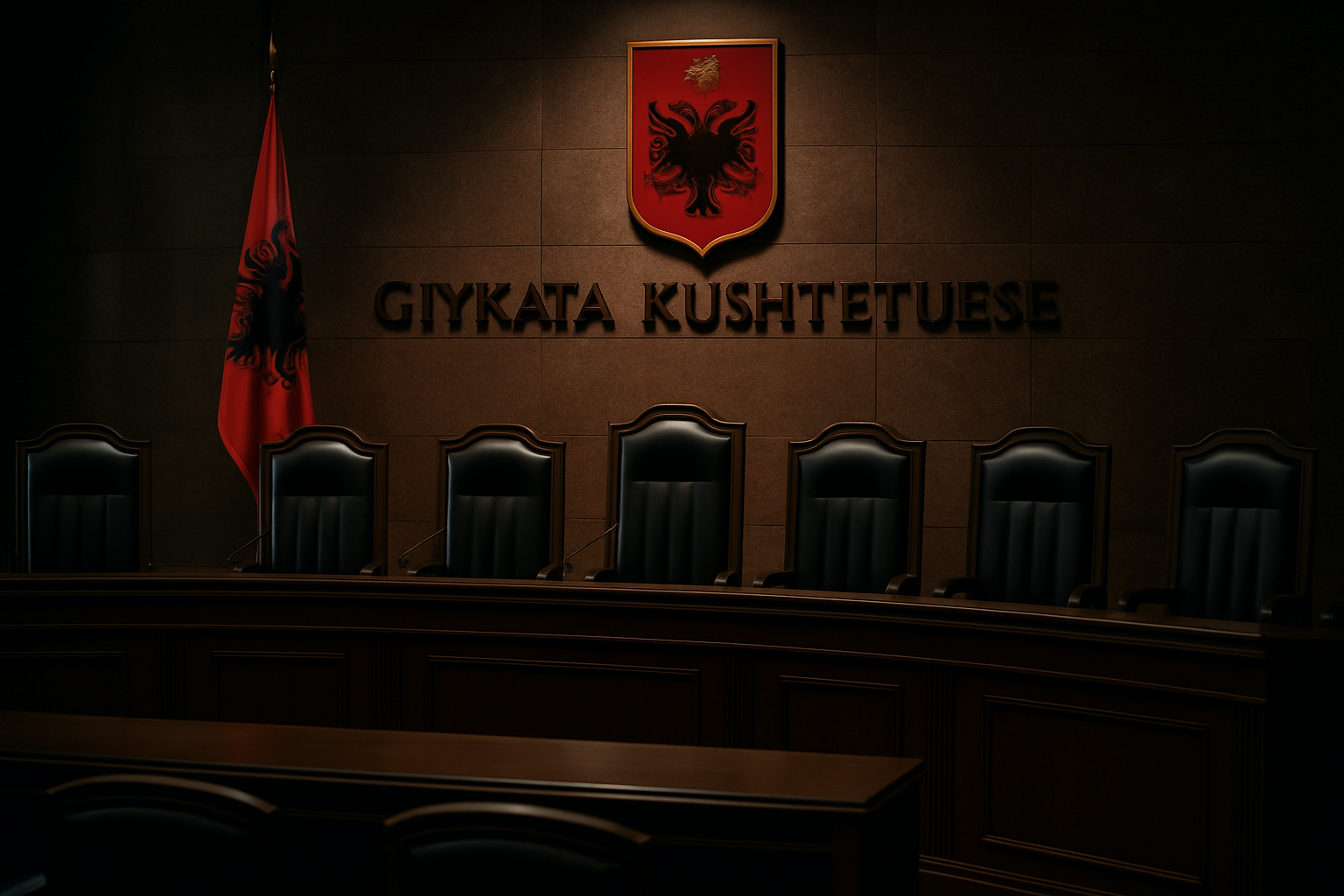
Albania's Constitutional Court delivered a historic 4-4 split decision on February 6, 2026, regarding the controversial case of Deputy Prime Minister and Infrastructure Minister Belinda Balluku, effectively upholding her suspension from office and creating unprecedented political uncertainty in the Balkan nation.
The eight-member Constitutional Court, Albania's highest judicial authority, failed to reach the required majority to overturn the Specialized Court for Corruption and Organized Crime's (GJKKO) December 20, 2025 decision suspending Balluku from her dual roles. The deadlock automatically rejected Prime Minister Edi Rama's appeal for jurisdictional conflict resolution, leaving the suspension intact.
Marathon Deliberations End in Stalemate
Following a grueling 10-hour deliberation session in the Court's Council Chamber, the judges remained deeply divided along apparent ideological lines. The vote split precisely down the middle, with four judges supporting the government's position and four backing the anti-corruption court's authority to suspend high-ranking officials.
Supporting Prime Minister Rama's appeal were Judges Fiona Papajorgji, Marjana Seminit, Gent Ibrahimi, and Sonila Bejtja. These justices argued that the GJKKO had overstepped its jurisdiction by suspending a deputy prime minister, a decision they contended should fall under executive authority.
Opposing the appeal and supporting Balluku's continued suspension were Judges Ilir Toska, Marsida Xhaferllari, Asim Vokshi, and Sandër Beci. This faction maintained that specialized anti-corruption courts possess the constitutional authority to suspend any official, regardless of rank, when facing corruption allegations.
Legal Precedent and Constitutional Crisis
The Constitutional Court's official statement confirmed the outcome: "The Court decided: Rejection of the request. Removal of the suspension measure set by the decision of the Judges' Meeting of December 12, 2025. This decision is final and enters into force upon publication of the decision in the Official Gazette."
This represents the third time the Constitutional Court has convened to address the Balluku case, having previously postponed decisions twice. The persistent delays and ultimate deadlock highlight the deep institutional divisions within Albania's judiciary over the scope of anti-corruption enforcement powers.
"The Constitutional Court voted 4 to 4 on the 'Balluku Case,' leaving in force the decision taken by the Constitutional Court, which suspends the deputy prime minister and minister for Energy and Infrastructure from duty."
— Official Court Statement
Background of the Corruption Investigation
Belinda Balluku's suspension stems from a November 2025 investigation by the GJKKO into alleged corruption and abuse of office related to her tenure as Infrastructure Minister. The specialized court, established as part of Albania's judicial reform program required for EU membership negotiations, ordered her suspension as deputy prime minister and infrastructure minister while maintaining her parliamentary immunity.
The case represents a significant test of Albania's commitment to judicial independence and anti-corruption efforts, key benchmarks for the country's European Union accession process. The EU has consistently emphasized that Albania must demonstrate effective prosecution of high-level corruption to advance its membership bid.
Political Ramifications and Government Response
Prime Minister Edi Rama's government had argued that the GJKKO's decision represented an unprecedented interference in executive authority, claiming that suspending a deputy prime minister exceeded the specialized court's constitutional mandate. The government's position reflected broader tensions between Albania's traditional political establishment and newly empowered judicial institutions.
The deadlock leaves Balluku in a unique constitutional limbo – technically suspended from executive functions but retaining her parliamentary seat. This creates operational challenges for the government, which must now function without one of its key figures while navigating complex EU negotiations and domestic political pressures.
Judicial Independence Under Pressure
The Constitutional Court controversy has intensified amid growing concerns about pressure on Albania's judiciary. The High Judicial Council (KLGJ) issued an unprecedented statement on February 6, warning about increasing "pressure" on judges and the judicial system.
"While we understand critical positions expressed by public officials or private subjects, particularly written and audiovisual media, which contribute to increasing transparency and effectiveness of the judicial system," the KLGJ stated, "we have recently noted with concern a 'pressure' on judges and the judiciary, which has a growing tendency, as well as the manifestation of some positions or statements with a noticeable impact on informing public opinion that undermine the figure and dignity of judges."
European Integration Implications
The Balluku case has become emblematic of Albania's struggle to balance political stability with judicial reform requirements. European Union officials have closely monitored the proceedings as an indicator of Albania's commitment to rule of law principles and anti-corruption measures.
The Constitutional Court's inability to reach consensus reflects broader institutional challenges facing Albania as it seeks to modernize its governance structures while maintaining political cohesion. The deadlock may complicate Albania's EU negotiation timeline, as Brussels has consistently emphasized the need for effective, independent judicial institutions.
Opposition and Civil Society Response
Opposition parties have characterized the deadlock as vindication of their claims that the Rama government has attempted to undermine judicial independence. Civil society organizations focused on transparency and good governance have similarly praised the specialized court system's resilience against political pressure.
The case has also highlighted the complex relationship between Albania's various judicial institutions, from specialized anti-corruption courts to the Constitutional Court, each with distinct mandates and political constituencies.
Looking Forward: Unresolved Questions
With the Constitutional Court's definitive rejection of the government's appeal, Belinda Balluku's suspension remains in effect indefinitely, pending resolution of the underlying corruption investigation. The government must now decide whether to reshuffle cabinet responsibilities or attempt alternative legal strategies.
The deadlock also raises fundamental questions about the balance of power in Albania's constitutional system. Future cases involving high-ranking officials may face similar challenges if institutional divisions persist within the judiciary.
As Albania continues its European integration process, the Balluku case will likely serve as a crucial precedent for how the country manages the tension between political accountability and governmental stability. The outcome demonstrates both the strength of Albania's anti-corruption institutions and the deep political divisions that continue to challenge the nation's democratic development.