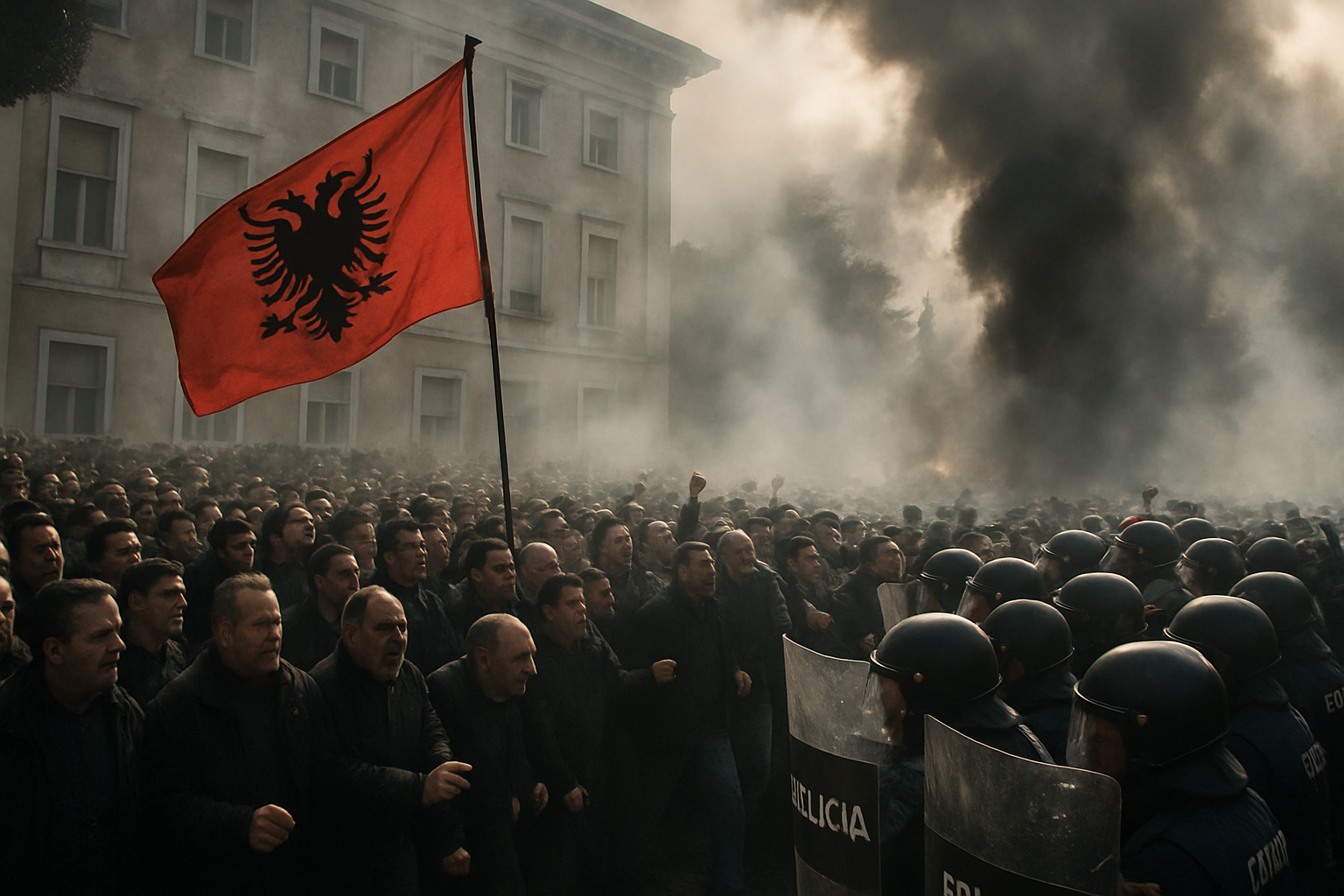
Opposition protesters in Albania escalated their demonstrations to unprecedented levels of violence on February 20, 2026, throwing molotov cocktails and fireworks at government buildings in Tirana, including the Prime Minister's office and Parliament, marking a dangerous deterioration in the country's political climate.
The violent confrontations began immediately after Democratic Party leader Sali Berisha concluded his speech to supporters gathered outside the Prime Minister's office. Protesters, organized under the cover of tents despite clear weather, launched a coordinated attack using homemade explosives and incendiary devices against state institutions.
Coordinated Violence Against State Institutions
Unlike previous demonstrations, this protest featured a systematic approach to violence. Protesters positioned themselves strategically behind tents and prepared molotov cocktails in advance, indicating premeditation rather than spontaneous unrest. The assault targeted both the Prime Minister's office and Parliament building, with demonstrators moving between locations in an organized manner.
Police responded immediately with water cannons after the initial barrage of explosives. The confrontation continued for several hours, with protesters eventually retreating from the Prime Minister's office and regrouping at Parliament—a pattern observed in previous demonstrations but with significantly escalated violence.
"Here's the square, here's the battleground, here's the criminal group hiding under tents (even though it's not raining) ready for the molotov cocktails of a deranged old man."
— Taulant Balla, Socialist Party Parliamentary Group Chairman
Security Concerns and Police Response
The State Police had declined to provide security for the protest due to advance warnings about potential violence, an unusual step that underscored the serious security concerns. Despite this, law enforcement officers were deployed to maintain order and protect government buildings.
Interior Minister Albana Koçiu issued a strong condemnation of the violence, emphasizing the distinction between legitimate protest rights and criminal behavior. "Violence is not a solution," she declared, calling for organizers to urge protesters to express their views peacefully rather than through destructive means.
Political Context and EU Implications
The violent demonstrations occur during a critical period for Albania's European Union accession process. The country has been working to meet EU membership requirements, including maintaining democratic institutions and rule of law—standards that violent political confrontations directly undermine.
This latest escalation follows a pattern of increasingly violent opposition protests that began in February 2026. Previous demonstrations resulted in 16 police officers being hospitalized, 13 arrests, and substantial property damage when protesters used similar tactics against law enforcement.
Opposition Leadership and Responsibility
The protest was led by veteran politician Sali Berisha, who has been designated "persona non grata" by the United States over corruption allegations. His son, Shkëlzen Berisha, was notably present at the demonstration alongside Democratic Party deputy Arjan Ndoja, a former prosecutor from Durrës.
The demonstration began approximately 45 minutes late, with Berisha joining militants on the boulevard around 6:45 PM. The timing and organization suggested careful coordination, with drone footage revealing relatively low participation numbers compared to the scale of violence unleashed.
Government Response and Political Ramifications
The ruling Socialist Party characterized the violence as the work of "criminal groups" rather than legitimate political opposition. Parliamentary leaders emphasized that such tactics only serve to discredit democratic processes and Albania's European integration aspirations.
The escalation raises serious questions about the opposition's strategy and its impact on Albania's democratic institutions. International observers have expressed concern that continued violence could jeopardize the country's EU membership timeline, which requires demonstrated commitment to democratic values and peaceful political competition.
Historical Pattern of Violence
This protest represents the latest in a series of increasingly violent confrontations between opposition supporters and authorities. The pattern shows a troubling escalation from peaceful demonstrations to systematic violence against state institutions, threatening Albania's democratic stability.
Previous incidents in February 2026 saw protesters hospitalize 16 police officers and cause significant property damage through similar molotov cocktail attacks. The recurring nature of such violence suggests deeper political polarization that extends beyond normal democratic opposition.
International Implications
The violent protests come at a particularly sensitive time for Albania's international standing. The country has been working to demonstrate its commitment to European values as part of its EU accession process. Continued political violence undermines these efforts and raises questions about the strength of Albanian democratic institutions.
European officials have consistently emphasized that EU membership requires not only economic reforms but also stable democratic governance and respect for rule of law. The targeting of government buildings with explosive devices directly contradicts these requirements and could impact Albania's European integration timeline.
The protests also highlight broader challenges facing Western Balkan countries in their democratic development. Success or failure in managing this crisis through legal and democratic channels will likely influence how other regional nations approach similar political tensions.
Looking Forward
The escalation to molotov cocktail attacks on government buildings represents a dangerous threshold in Albanian politics. Moving forward, the country faces critical decisions about how to address political opposition while maintaining democratic norms and European integration progress.
The government's response will be closely watched by international partners, particularly as Albania seeks to demonstrate its readiness for EU membership. The ability to manage political dissent through legal and democratic means, rather than allowing it to devolve into violence, will serve as a key test of the country's institutional strength and commitment to European values.