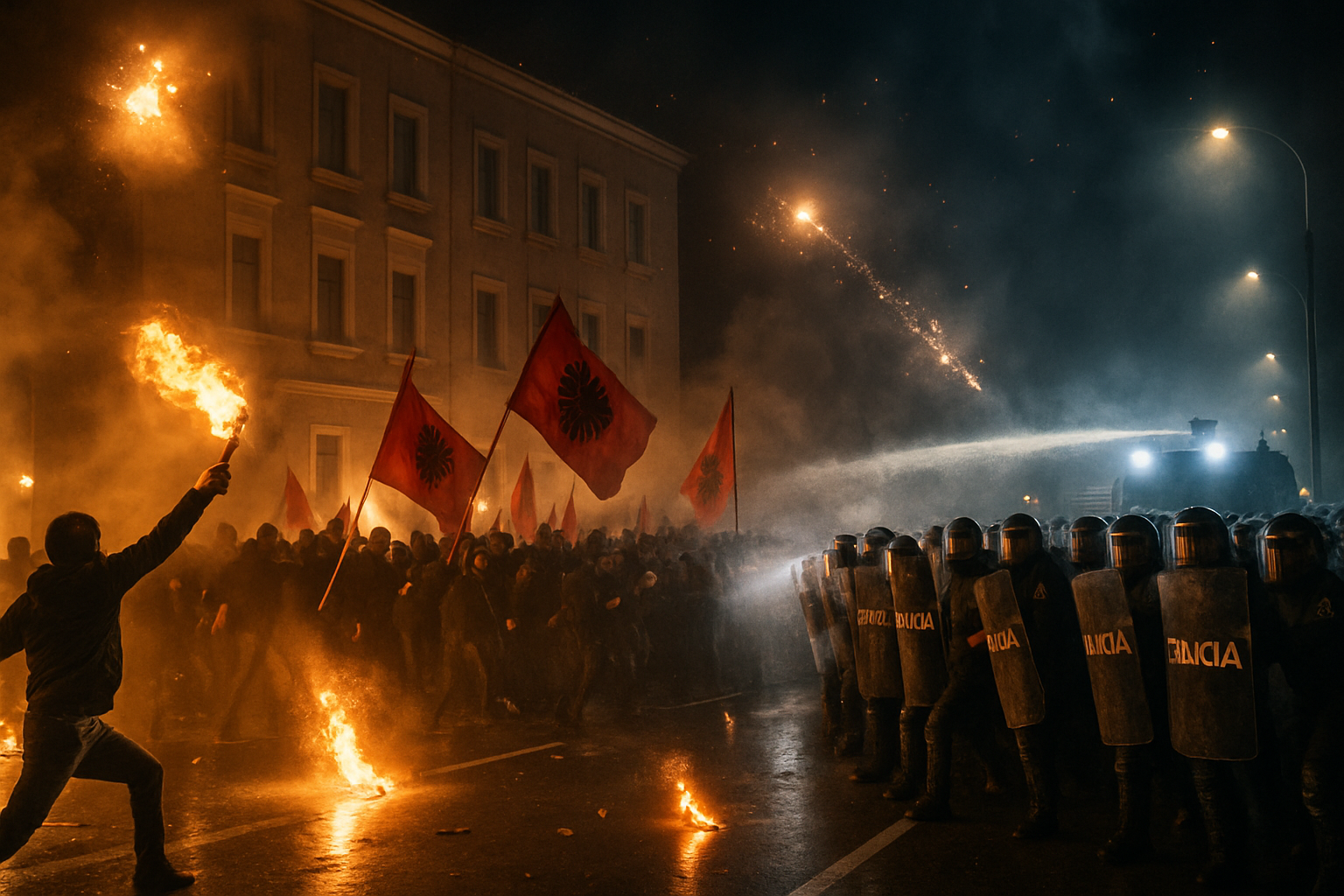
Albania witnessed its worst political violence in years as opposition protests in Tirana turned violent on Tuesday evening, leaving 16 police officers hospitalized with burns and injuries after protesters hurled Molotov cocktails, fireworks, and projectiles at security forces guarding government buildings.
Thousands of Albanians filled the streets of the capital in a demonstration called by the opposition Democratic Party, demanding the resignation of Prime Minister Edi Rama, the dismissal of his government, and the establishment of a technical cabinet to lead the country toward early elections. The protest, which lasted over four hours, quickly escalated from peaceful demonstration to violent confrontation.
Violence Erupts Outside Government Buildings
The demonstration began peacefully with speeches by opposition leaders, including Democratic Party leader Sali Berisha, outside the Prime Minister's office. However, the situation deteriorated rapidly as protesters moved toward the Parliament building and other government facilities.
According to police reports, protesters threw Molotov cocktails, fireworks, smoke bombs, and various projectiles at officers attempting to secure government buildings. The violence resulted in 16 police officers being transported to hospitals with burns and physical injuries, while dozens of protesters were detained by authorities.
"As a result of attacks directed at the police, 16 police officers were injured and transported to hospital for medical assistance, having suffered burns and physical damage,"
— Albanian State Police Statement
Police responded with water cannons, tear gas, and riot control units in an effort to disperse the increasingly violent crowds. The confrontations extended beyond government buildings, with reports of violence occurring on several streets throughout central Tirana.
Media and Political Figures Targeted
The violence extended beyond clashes with police. A television operator caught fire during the confrontations, and a TV station vehicle was also engulfed in flames. Opposition deputy Bledion Nallbati was reportedly assaulted and suffered head injuries requiring hospitalization.
Democratic Party leader Sali Berisha made serious accusations against security forces, claiming police used rubber bullets against protesters. He presented a protester, Ilir Tushe, who he claimed had been struck in the head by a rubber bullet fired by a sniper.
"They used rubber bullets and hit the protester in the forehead, which poses a danger to life. Protester Ilir Tushe was hit by a sniper without any kind of motive,"
— Sali Berisha, Democratic Party Leader
Corruption Scandal Fuels Political Crisis
The violent protests erupted amid escalating political tension over the ruling Socialist majority's continued blocking of the arrest of Deputy Prime Minister Belinda Balluku, who faces serious criminal accusations from the Special Prosecution against Corruption and Organized Crime.
The case has created a significant constitutional crisis, with Albania's Constitutional Court reaching an unprecedented 4-4 deadlock in February regarding Balluku's status. The deadlock automatically rejected PM Rama's jurisdictional appeal and upheld her suspension from executive duties, though she retains her parliamentary seat.
The specialized court's decision to suspend Balluku in December 2025 over corruption allegations has become a test of judicial independence versus executive authority in the context of Albania's EU accession process. The High Judicial Council issued an unprecedented warning about growing "pressure" on judges and the judiciary, citing threats to judicial dignity.
Opposition Demands and Continued Resistance
Beyond the immediate protests, civil society activist Adriatik Lapaj, whose movement has been conducting continuous protests for 65 days, criticized what he termed "tourist protests" by the Democratic Party. Speaking from outside the Prime Minister's office, Lapaj emphasized his movement's demand for sustained citizen engagement rather than symbolic demonstrations.
"The battle against Prime Minister Edi Rama is not won with symbolic or temporary protests. We have been in continuous protest for 65 days,"
— Adriatik Lapaj, Civil Society Activist
Lapaj's movement has maintained that the need to overthrow the government and democratize the country requires urgent and sustained citizen commitment, calling for unity under the national flag rather than party symbols.
International Implications and EU Accession Concerns
The violent confrontations occur during a critical period for Albania's European Union accession process, with Brussels closely monitoring the country's democratic institutions and rule of law commitment. The political crisis and violent protests threaten to complicate Albania's EU negotiation timeline, given the emphasis on independent judicial institutions and democratic stability.
Greek media outlets reported extensively on the violence, with headlines describing "violent clashes between demonstrators and police in Tirana" and protesters chanting "Rama go" in reference to the Prime Minister. Italian media confirmed that 14 agents were injured in the confrontations, while Bulgarian sources described it as the third consecutive national protest demanding the government's resignation.
The crisis represents a significant challenge for Albania's international standing as the country seeks to balance political stability with judicial reform requirements for European integration. International observers are viewing the events as indicators of Albania's struggle to maintain democratic governance while addressing corruption at the highest levels of government.
Police Response and Legal Consequences
Albanian State Police emphasized that officers showed restraint despite facing deadly projectiles, using megaphones throughout the demonstration to call on violent protesters to distance themselves from violence. However, the sustained attacks on police forces led to the deployment of riot control measures and the arrest of multiple protesters.
Police warned that those responsible for the violence would face legal consequences, stating that the perpetrators "will appear before the law" for their actions. The confrontations represent the most serious challenge to public order in Albania in recent years, testing the capacity of democratic institutions to manage political opposition through legal channels versus street violence.
Democratic Institutions Under Strain
The events highlight the ongoing challenges facing Albanian democracy as the country navigates competing demands for accountability, political stability, and European integration. The escalation from peaceful protest to violent confrontation demonstrates the difficulty of managing political tensions through institutional channels when public trust in government institutions remains low.
The crisis also reflects broader patterns of political polarization affecting the Western Balkans region, where traditional opposition strategies increasingly involve street demonstrations and institutional challenges rather than purely electoral competition. The success or failure of Albania's ability to resolve this crisis through democratic means will have implications for regional democratic development and European integration processes.
As Albania continues to grapple with corruption allegations at the highest levels of government while seeking EU membership, the violent protests serve as a stark reminder of the fragility of democratic institutions and the ongoing challenges of building sustainable governance in transitional democracies.