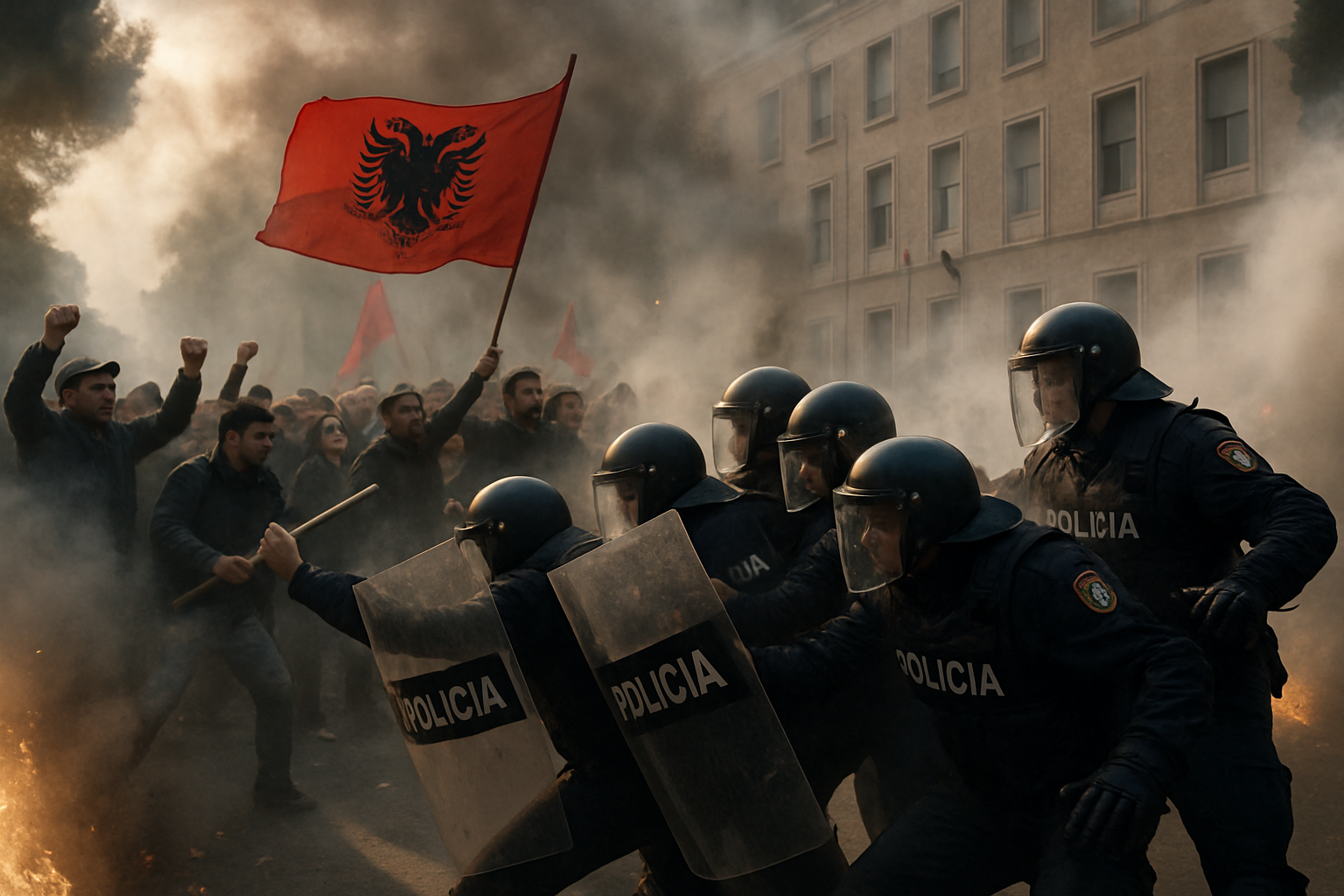
Violent clashes erupted in Tirana on Thursday evening as Albanian opposition protesters threw Molotov cocktails and fireworks at police officers and government buildings, resulting in over 40 arrests and multiple injuries in what authorities describe as the most serious political violence in years.
The Democratic Party (PD), led by Sali Berisha, organized what it called the "fourth national protest," but demonstrations quickly escalated into coordinated attacks on the Prime Minister's office and Parliament buildings. Police responded with water cannons, tear gas, and sound grenades as protesters retreated between government institutions in what appeared to be a systematic campaign of violence.
Systematic Violence and Coordinated Attacks
Unlike previous spontaneous protests, Thursday's demonstrations showed clear signs of advance preparation. Protesters positioned strategically around key government buildings had prepared incendiary devices beforehand and moved in organized formations between the Prime Minister's office and Parliament following an established pattern of escalation.
The violence began immediately after Berisha's speech to supporters, with masked demonstrators openly preparing Molotov cocktails in broad daylight. Video footage showed protesters systematically breaking sidewalks with hammers to create projectiles, demonstrating a level of coordination that alarmed security officials.
"The protesters threw Molotov cocktails, fireworks, and smoke bombs at police officers, creating unprecedented scenes of violence in the capital,"
— Democratic Party sources
Interior Minister Albana Koçiu condemned the violence, emphasizing the distinction between legitimate protest rights and criminal behavior. "The right to protest is untouchable, but violence is not a solution," she declared, as police began making arrests throughout the evening.
Controversial Leadership and International Implications
The protests were led by Sali Berisha, who has been designated "persona non grata" by the United States over corruption allegations. In a revealing moment during post-protest statements, Berisha referred to participants as "forces of armed insurgents," contradicting earlier claims about peaceful demonstrations.
"With the aim of not getting involved in any kind of confrontation, the forces of armed insurgents deviated to the opposite side [of the mosque], but this was not enough," Berisha stated, raising questions about the nature of the gathering and the apparent contradiction between peaceful protest rhetoric and acknowledgment of "armed" participants.
The violence occurred near the Namazgja Mosque, where worshippers were conducting evening prayers. Prime Minister Edi Rama posted images of the mosque covered in tear gas on social media, writing: "When hatred pushes wickedness to the door of the mosque..."
Casualties and Arrests
Parliamentary Group leader Gazment Bardhi reported that over 40 people were detained during and after the protests, including numerous branch leaders of the Democratic Party. Several injuries were reported, including PD Deputy Luçiano Boçi, who was taken to the University Hospital of Trauma with minor skin injuries from gas canisters thrown by police.
Bardhi accused police of using excessive force, claiming that one protester was beaten during detention and denied medical care until deputies intervened. "Only after being informed was it allowed that the person beaten by police during detention requested medical help," he stated outside Police Station No. 1.
Deputy Flamur Noka was involved in a confrontation with plainclothes police officers near the Democratic Party headquarters, accusing them of attempting to arrest protesters leaving the building. The incident highlighted tensions between opposition politicians and security forces throughout the evening.
Historical Context and EU Implications
Thursday's violence represents a dangerous escalation in Albanian political tensions, building on a pattern of increasingly violent opposition protests. In February 2026, similar demonstrations resulted in 16 police officers being hospitalized with burns and injuries from Molotov cocktails and fireworks, marking a concerning trend toward systematic political violence.
The timing is particularly significant as Albania pursues European Union membership, with Brussels requiring demonstrated commitment to democratic institutions and rule of law. The systematic nature of the violence, combined with advance preparation of incendiary devices, raises serious concerns about the country's democratic trajectory.
Former President Ilir Meta, currently imprisoned, issued a statement supporting the protests: "February 20, the day of overthrowing dictatorships, confirmed the determination of Albanians to destroy Edi Rama's rotten regime. Neither rubber bullets, nor criminal violence, nor mafia kidnappings of protesters can stop the hurricane of Freedom."
Government Response and Security Measures
State Police had declined to provide security for the protest due to advance warnings of potential violence – a highly unusual step indicating serious security concerns. This decision proved prescient as the demonstration transformed into systematic attacks on government buildings.
Socialist Party Parliamentary Group Chairman Taulant Balla denounced what he called a "criminal group hiding under tents" preparing "Molotov cocktails of the deranged old man," referring to Berisha's leadership role in organizing the violence.
The government's response emphasized that while peaceful protest is a constitutional right, the systematic use of incendiary devices against state institutions crosses all acceptable boundaries of political dissent. Enhanced security protocols are now being considered for future opposition gatherings.
International Concerns and Democratic Institutions
The violence has drawn international attention as a test case for Albanian democratic institutions' capacity to manage political opposition through legal channels rather than street confrontation. European officials have repeatedly emphasized the importance of resolving political disagreements through democratic processes, particularly during Albania's EU accession negotiations.
The systematic nature of Thursday's attacks, involving pre-positioned materials and coordinated movements between government buildings, represents a qualitative escalation from previous protests. International observers are concerned that this pattern of violence could undermine Albania's European integration timeline if not addressed through strengthened democratic institutions.
"Every citizen who protested peacefully and leaves the PD headquarters is arrested by uniformed officers or bandits who have surrounded the entire perimeter of the headquarters without any means of identification,"
— Gazment Bardhi, Democratic Party Parliamentary Group Leader
The crisis highlights broader challenges facing Western Balkan democracies in managing political tensions through institutional channels rather than street violence. Success or failure in addressing this pattern democratically will influence regional approaches to opposition management and European integration processes.
Looking Forward: Democratic Governance Under Pressure
As Albanian authorities investigate Thursday's violence and process the dozens of arrests, the country faces critical decisions about maintaining democratic norms while ensuring public order. The systematic preparation of incendiary devices and coordinated attacks on government buildings represent a threshold crossing that tests the resilience of Albanian democratic institutions.
The incident occurs against the backdrop of ongoing political tensions over judicial reforms and anti-corruption efforts, with Berisha's "persona non grata" status limiting his international diplomatic options. The Democratic Party must now address questions about whether its protest strategy serves legitimate political opposition or crosses into systematic attacks on democratic governance.
European Union officials will closely monitor Albania's handling of this crisis as an indicator of the country's commitment to democratic values and institutional strength. The outcome will significantly influence not only Albania's EU membership timeline but also serve as a precedent for managing similar challenges across the Western Balkans region.
The violence near the Namazgja Mosque, where citizens were engaged in religious worship, adds another dimension to the crisis, highlighting how political confrontations can threaten community spaces and interfere with basic civic life. This aspect has drawn particular condemnation from government officials and civil society groups concerned about maintaining social cohesion during political tensions.