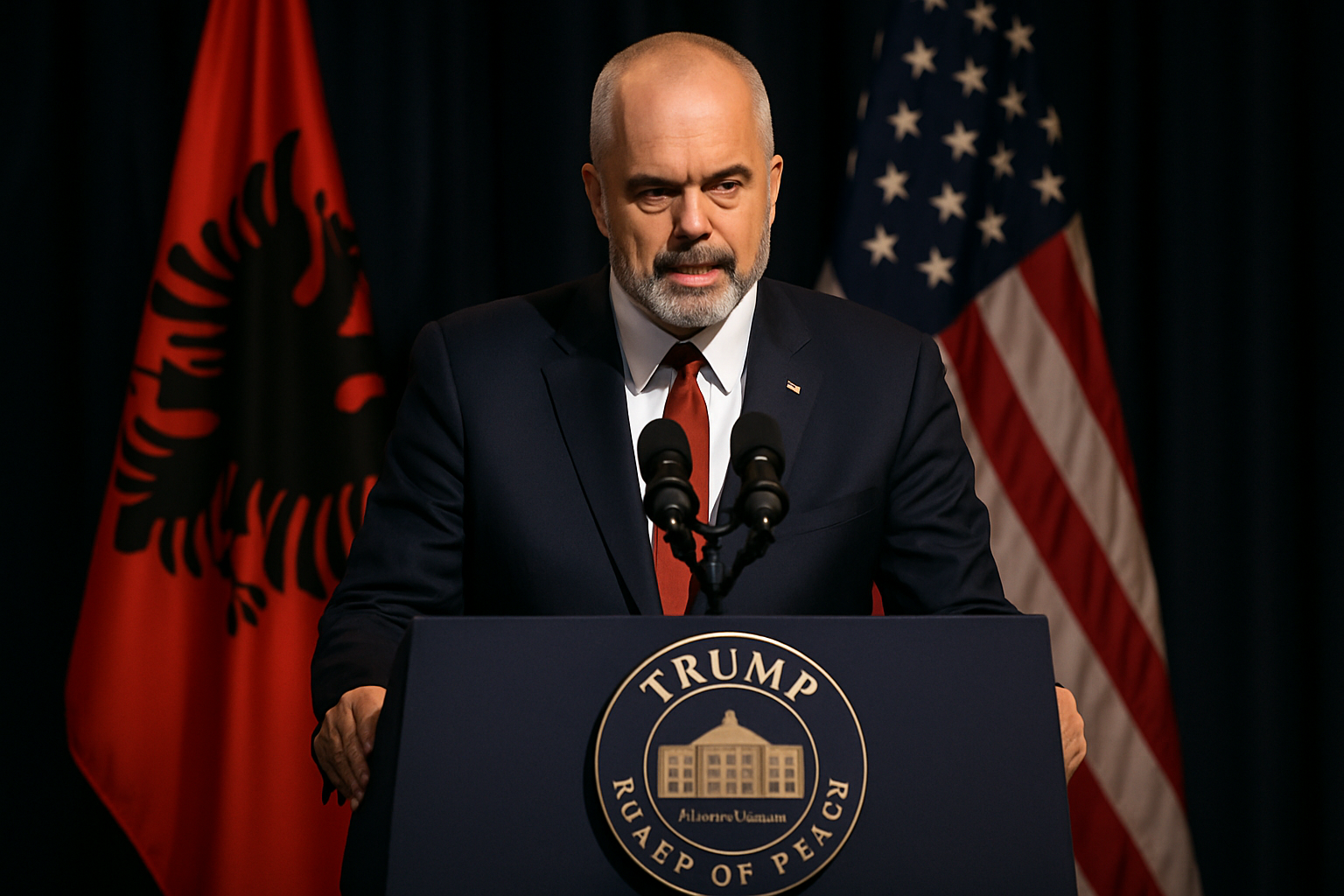
Albanian Prime Minister Edi Rama's participation in President Trump's inaugural Board of Peace meeting in Washington on February 19, 2026, has triggered intense political controversy at home after he used the international platform to raise concerns about the war crimes prosecutions of former Kosovo Liberation Army (KLA) leaders at The Hague.
During his address to the 27-nation gathering at the Donald Trump Institute of Peace, Rama drew attention to what he characterized as the unjust treatment of former KLA commanders, including Kosovo's former President Hashim Thaçi, who face a combined 180 years in prison for alleged crimes against humanity during the 1998-1999 Kosovo War.
Controversial Appeal on International Stage
Rama's decision to raise the Kosovo issue before an international audience that included President Trump has divided Albanian political opinion. The Prime Minister specifically highlighted the cases of four former KLA leaders facing trial at the Kosovo Specialist Chambers in The Hague: Hashim Thaçi, Kadri Veseli, Rexhep Selimi, and Jakup Krasniqi, each facing 45-year prison sentences.
Political analyst Neritan Sejamini, speaking on TV Klan's "Opinion" program, defended Rama's approach, stating that "Rama did well to mention the issue of the trial against former KLA leaders since he was in an international audience." Sejamini argued that the Prime Minister "used the opportunity" to bring attention to what many Albanians view as a fundamentally flawed judicial process.
"This was necessary. He raised this issue in front of an international audience when he had the chance."
— Neritan Sejamini, Political Analyst
Opposition Criticism and Political Reactions
The opposition Democratic Party was quick to criticize Rama's performance, with MP Agron Gjekmarkaj arguing that the Prime Minister appeared distant from Trump during the ceremony. "I saw that Trump was closer to Niko Peleshi and Fatmir Mediu at the prayer breakfast than our Prime Minister was today at the Board of Peace," Gjekmarkaj said during a parliamentary session.
However, government minister Pirro Vengu defended Rama's approach, declaring that "Rama used the Board of Peace as a platform for the interests of Albanians in the region." This perspective was echoed by analyst Preç Zogaj, who praised Rama's strategic use of the limited speaking time to address a "major national issue for Albania."
Political commentator Skënder Minxhozi characterized Rama's speech as "a brave leap into darkness," noting the delicate nature of the Prime Minister's relationship with the Trump administration and the risks involved in raising contentious regional issues on such a high-profile platform.
The Board of Peace Context
Rama's comments came during the inaugural meeting of Trump's Board of Peace, a 27-nation initiative aimed at addressing global conflicts through what the Trump administration calls a "business approach" to diplomacy. The meeting secured over $5 billion in pledges for Gaza reconstruction, but Rama used his platform to advocate for Albanian and Kosovo interests.
The timing was particularly significant given the ongoing proceedings at The Hague, where prosecutors are demanding the harshest sentences in the tribunal's history for the former KLA leaders. The charges include systematic persecution, imprisonment, torture, and murder of Serbian, Albanian, and Roma civilians during the Kosovo conflict.
Strategic Diplomatic Positioning
Journalist Denis Minga, analyzing Rama's performance, noted that the Prime Minister demonstrated "diplomatic maturity" by addressing multiple key issues during his brief speaking opportunity. Minga identified three crucial moments in Rama's speech: his commitment to Gaza stabilization efforts, his offer of Albanian peacekeeping troops, and crucially, his appeal regarding the KLA trials.
The decision to raise the Kosovo issue reflects Albania's ongoing commitment to what it views as the legitimate struggle for Kosovo's independence. Albanian officials have consistently argued that the KLA was engaged in a justified liberation war against Serbian oppression, not criminal activity warranting international prosecution.
Domestic Political Implications
The controversy has exposed deeper divisions in Albanian politics about how to engage with international institutions and navigate complex regional relationships. While some critics argue that Rama should not have used such a forum to raise bilateral concerns, supporters contend that international platforms provide essential opportunities to advocate for Albanian interests.
Opposition politician Ervin Salianji offered a more measured response, stating that Rama's presence at the Washington meeting was "not surprising" since he was there "as a representative of Albania." However, Salianji's comments reflected broader skepticism about the effectiveness of Rama's diplomatic approach.
Regional and International Dimensions
The speech controversy comes at a sensitive time for Balkan regional relations. The Kosovo Specialist Chambers, while established through Kosovo law, operates in The Hague under international oversight and is viewed by many Kosovars as disproportionately targeting KLA veterans while failing to adequately address Serbian war crimes from the same period.
Rama's comments also highlighted the complex relationship between Albania and the United States, particularly under the Trump administration. Albania has positioned itself as a reliable NATO ally and has participated in various international peacekeeping missions, but the Kosovo issue remains a point of ongoing concern for Albanian leaders.
Analysis and Assessment
Political observers noted that Rama's decision to raise the KLA issue demonstrated both political courage and calculated risk-taking. Analyst Zogaj specifically praised Rama for "touching the nerve" of President Trump regarding prosecutor relations, referencing the American president's own legal challenges with special prosecutors.
However, critics argue that the Board of Peace, focused primarily on Middle Eastern conflicts and reconstruction efforts, was not the appropriate venue for raising Balkan-specific issues. Some political commentators suggested that Rama's approach risked overshadowing Albania's constructive contributions to international peacekeeping efforts.
The controversy reflects broader questions about how smaller nations can effectively advocate for their interests in international forums dominated by major powers. Rama's willingness to use his limited speaking time to address what he views as a fundamental injustice demonstrates the ongoing importance of the Kosovo issue in Albanian foreign policy.
As the debate continues in Albanian political circles, the incident serves as a reminder of the complex balancing act required of leaders from smaller nations seeking to maintain good relations with powerful allies while advocating for deeply held national interests and regional concerns.