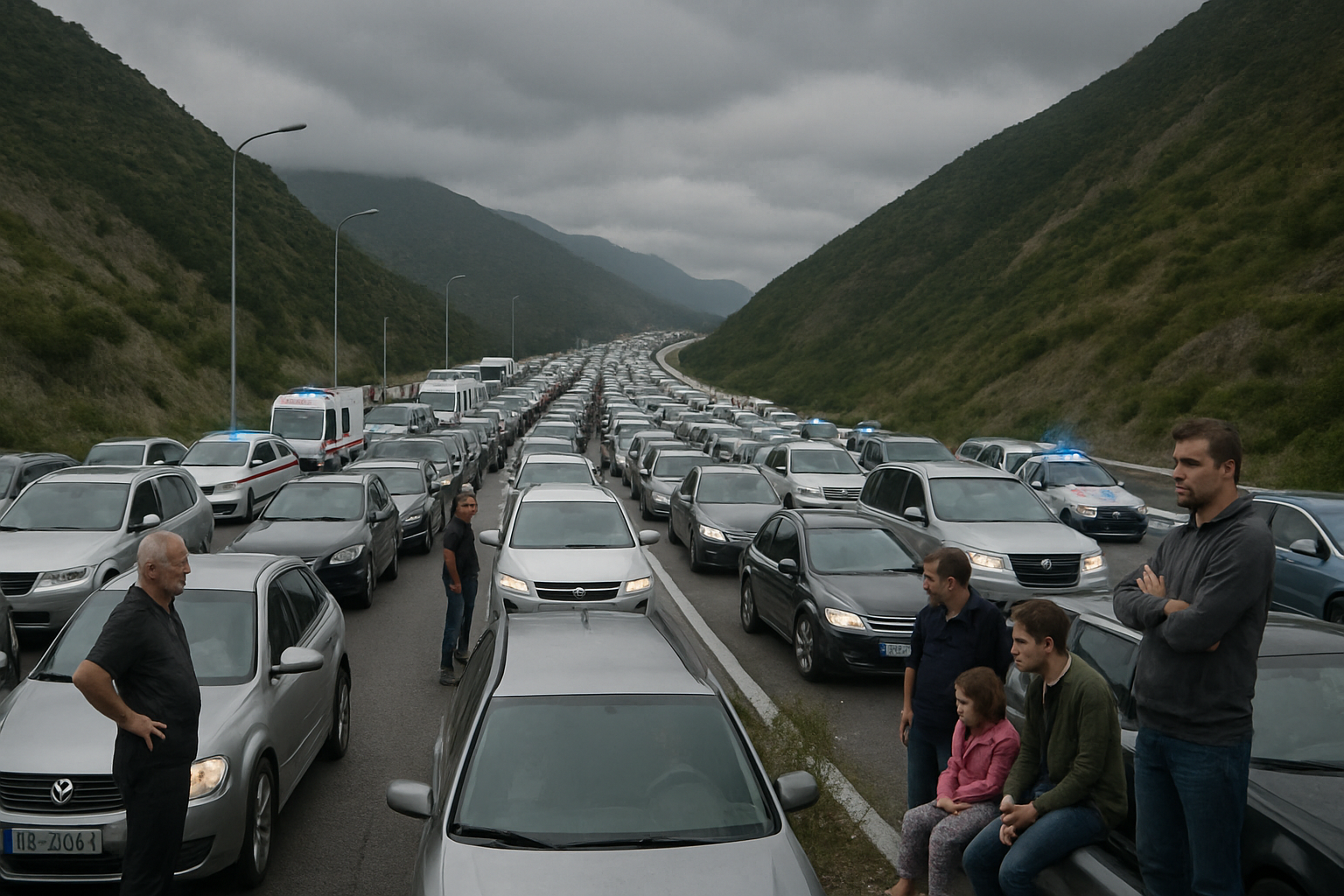
A cascade of infrastructure failures has brought Albania's southeastern transportation network to a complete standstill, with massive landslides blocking primary and alternative routes, creating unprecedented traffic jams and raising fears of regional isolation.
The crisis began Saturday morning when the crucial Librazhd-Pogradec highway suffered severe damage from landslides at the notorious "Arrat e Gurrës" segment, forcing authorities to completely suspend traffic for safety reasons. The situation rapidly deteriorated when the designated alternative route through Maliq-Moglicë-Gramsh also became impassable due to heavy vehicle congestion and additional landslide risks.
Human Drama Unfolds on Blocked Roads
The human cost of the infrastructure breakdown became evident as thousands of travelers found themselves trapped in gridlock lasting over 17 hours. In Maliq, a woman attempting to return to Tirana collapsed after a confrontation with police officers, her desperate plea captured on video: "What is this?! I don't know what's happening. I want to go to Tirana but can't. They told me to go to Gramsh, then they turned me back. They said go there! Where should I go?!"
The scene repeated across the region as hundreds of vehicles, including families with children, became trapped in what witnesses described as "a true catastrophe." One citizen reported: "We turned back from the road. Today has been a real disaster. We came back from Qukësi, the police told us..."
Infrastructure Breakdown Reveals Systemic Vulnerabilities
The crisis exposed critical weaknesses in Albania's transportation infrastructure. The primary Librazhd-Pogradec axis, a vital national corridor connecting the southeast to the capital, has been completely closed due to massive soil erosion and deep cracks in the roadway at the "Arrat e Gurrës" section. This area has long been identified as problematic due to unstable geological conditions.
Authorities opened the Maliq-Moglicë-Gramsh route as a temporary alternative, but this secondary road proved inadequate for the volume of diverted traffic. The situation was exacerbated by heavy vehicles inappropriate for the narrow mountain road, creating bottlenecks that extended over six kilometers. Near the village of Lozhan, single-lane segments further restricted traffic flow.
"The road through Moglicë has completely blocked traffic due to heavy vehicles on roads unsuitable for such transport."
— Traffic Authority Report
Regional Isolation Threat
The simultaneous failure of both primary and alternative routes has created a genuine threat of regional isolation. The blocked infrastructure forces traffic to seek increasingly circuitous routes, with some drivers attempting 300+ kilometer detours through neighboring countries. Travelers from Greece heading to northern Albania have been forced to use routes through Korça, Ersekë, Leskovik, Përmet, Tepelenë, and Fier—adding hours to what should be routine journeys.
Some desperate motorists have attempted unofficial detours through Qafë Thana toward Struga and then through Dibër, demonstrating the lengths to which people will go to maintain connectivity. Local residents have begun creating makeshift solutions, with some drivers from Librazhd finding village routes to reach Prrenjas, though these alternatives are neither sustainable nor safe for heavy traffic.
Weather Compounds the Crisis
The infrastructure failures occurred during a period of unstable weather conditions across the region, with heavy rainfall contributing to soil instability and landslide risks. The combination of saturated ground conditions and aging infrastructure has created a perfect storm for transportation disruption.
Meteorological reports indicate continued atmospheric instability with intermittent rainfall expected through the weekend, raising concerns that conditions may worsen before recovery operations can begin effectively.
Historical Context and Recurring Problems
This crisis represents the latest in a series of infrastructure challenges that have plagued Albania's transportation network. The country's mountainous terrain and seismic activity create ongoing challenges for road maintenance and construction. The "Arrat e Gurrës" section has been identified as particularly problematic due to its geological composition and exposure to weathering.
Previous incidents in the region have highlighted the vulnerability of Albania's road network to extreme weather events. The current crisis occurs against the backdrop of broader European infrastructure challenges, with severe weather patterns testing transportation networks across the continent.
Emergency Response and Recovery Efforts
Albanian authorities have deployed emergency response teams to assess damage and coordinate relief efforts. The Road Authority has announced that "necessary measures are being taken" to address the situation, though no specific timeline for repairs has been provided.
Traffic police have established checkpoints to direct vehicles away from blocked routes, but the scale of the disruption has overwhelmed normal traffic management capabilities. Emergency services report being stretched thin as they respond to multiple incidents across the affected region.
Economic Impact
The transportation crisis is having significant economic implications, affecting everything from daily commuting to international trade routes. Businesses dependent on timely delivery of goods face disruptions, while the tourism sector—crucial to Albania's economy—confronts accessibility challenges during the important winter travel period.
Agricultural producers in the southeastern regions face particular challenges in accessing markets, potentially affecting food supply chains and rural livelihoods. The crisis highlights the critical importance of reliable infrastructure for economic stability and regional development.
Looking Forward: Infrastructure Resilience
The current crisis underscores the urgent need for comprehensive infrastructure modernization and resilience planning. Albania's mountainous geography and increasing frequency of extreme weather events require infrastructure designed for 21st-century challenges rather than historical patterns.
Regional connectivity projects, including the Trans-European Transport Network (TEN-T) Corridor VIII initiative, aim to improve Albania's transportation infrastructure through international cooperation and investment. However, the current crisis demonstrates that immediate action is needed to address existing vulnerabilities while longer-term projects develop.
"This situation reveals the urgent need for diversified transportation networks and climate-resilient infrastructure design."
— Infrastructure Analysis Report
International Implications
The crisis affects not only domestic transportation but also international routes connecting the Western Balkans with broader European networks. Albania's position as a transit country means that infrastructure failures have ripple effects across regional connectivity and trade flows.
The situation may influence discussions about infrastructure investment priorities and the importance of redundant transportation networks in mountainous regions prone to natural disruption.
Immediate Priorities
Authorities face the immediate challenge of restoring basic connectivity while ensuring public safety. Priority actions include assessing structural damage to determine repair requirements, establishing temporary traffic management solutions, and coordinating with neighboring regions to minimize economic disruption.
The crisis also highlights the need for improved emergency communication systems to provide real-time information to travelers and prevent situations where people become stranded without adequate information or support.
As Albania works to resolve this immediate crisis, the events of February 2026 will likely serve as a watershed moment for infrastructure policy and investment priorities. The combination of geographical challenges, climate pressures, and economic development needs requires a comprehensive approach to building transportation networks capable of withstanding future disruptions while supporting continued growth and regional integration.