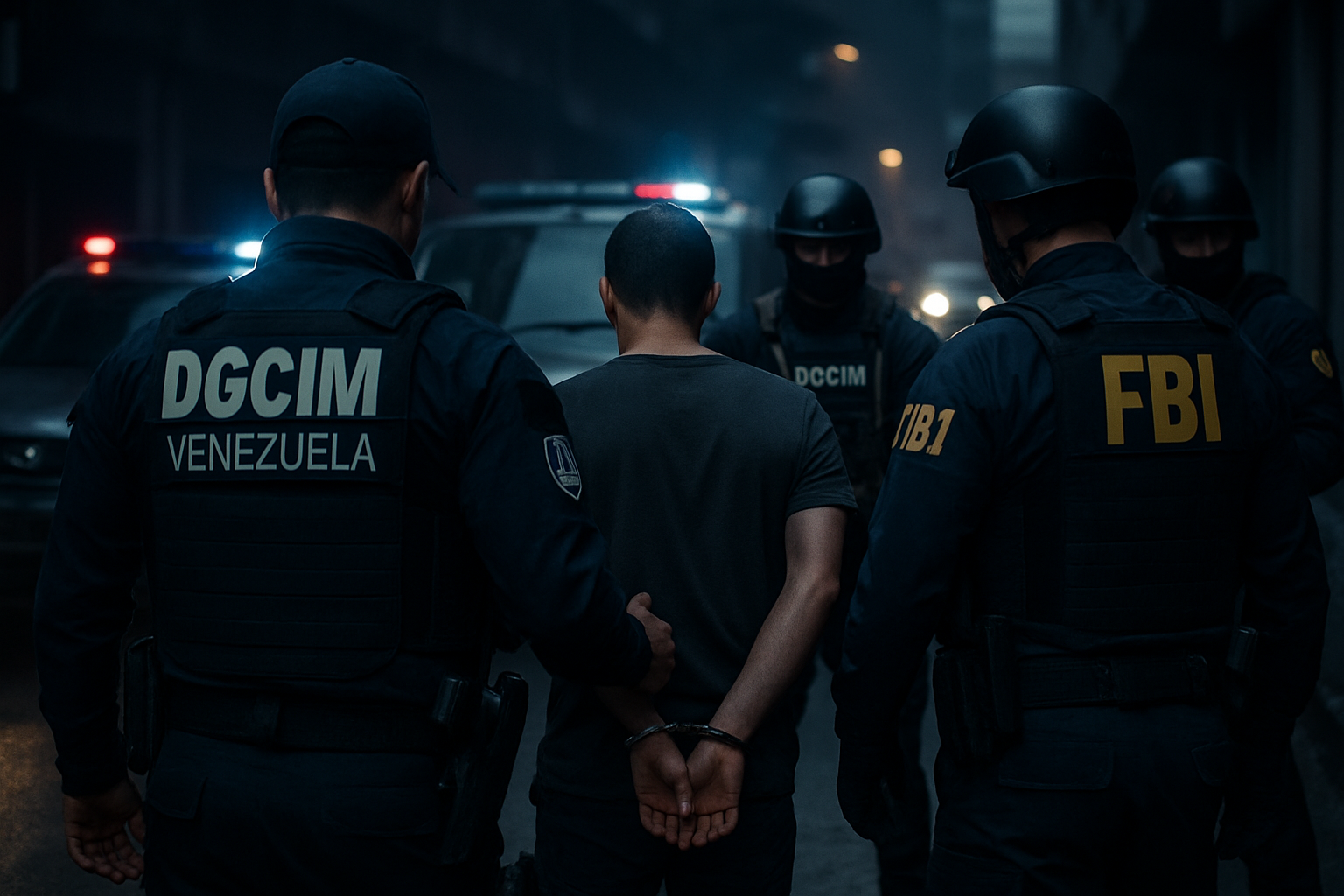
Colombian businessman Alex Saab, widely known as the alleged financial frontman for former Venezuelan President Nicolás Maduro, was detained early Wednesday morning in Caracas in a joint operation between U.S. federal agents and Venezuelan intelligence services, according to multiple Colombian media reports.
The arrest, which occurred around 2:30 AM local time, represents a dramatic shift in Venezuela's cooperation with the United States under Acting President Delcy Rodríguez's interim government, which assumed power following Maduro's capture by U.S. forces in January 2026.
According to Colombian radio station Caracol Radio, Saab was apprehended by agents of the Servicio Bolivariano de Inteligencia Nacional (SEBIN) working in conjunction with the FBI. Italian news agency ANSA reports that Saab is being held at the notorious Helicoide prison in Caracas, awaiting potential extradition to the United States.
From Cabinet Minister to Detention
Saab's arrest comes just weeks after Acting President Delcy Rodríguez removed him from his position as Minister of Industries and National Production in January 2026 as part of a broader cabinet reshuffle following Maduro's downfall. The businessman had held the ministerial post since his triumphant return to Venezuela in December 2023, when he was released as part of a prisoner exchange with the United States.
According to Spanish newspaper El País, Saab was "removed from his cabinet position" earlier this month during the government reorganization that followed Rodríguez's assumption of power after Maduro and his wife Cilia Flores were captured by U.S. military forces.
The detention also reportedly includes Venezuelan businessman Raúl Gorrín Belisario, owner of a pro-Chavez news channel, according to Venezuelan news outlet El Nacional, which cited U.S. intelligence sources.
History of Legal Troubles
This marks Saab's second major detention on international charges. The Colombian-born businessman with Venezuelan citizenship was first arrested in 2020 in Cape Verde while his private jet was refueling during what officials described as a mission to support the Maduro government.
After spending more than three years in U.S. custody facing bribery and money laundering charges, Saab was released in December 2023 as part of a high-profile prisoner exchange that saw the release of American citizens detained in Venezuela. His return to Caracas was celebrated by the Maduro government, which appointed him to the cabinet position he held until this month.
U.S. prosecutors have long accused Saab of serving as Maduro's key financial operative, allegedly helping to move billions of dollars through a network of shell companies while Venezuela's economy collapsed under international sanctions.
Shifting Venezuelan Foreign Policy
The joint operation signals a fundamental transformation in Venezuela's relationship with the United States under the interim government. Since assuming power, Acting President Delcy Rodríguez has pursued unprecedented diplomatic engagement with Washington, including high-level meetings with U.S. Chargé d'Affaires Laura Dogu at the Miraflores Presidential Palace.
Secretary of State Marco Rubio has outlined a three-phase plan for Venezuela's reconstruction: stabilization to address the humanitarian crisis, economic recovery requiring sanctions relief, and democratic transition with free elections. The cooperation in Saab's detention appears to align with this broader diplomatic framework.
The change represents a stark contrast to the Maduro era, when Venezuela regularly accused the United States of attempting regime change and harbored numerous individuals wanted by U.S. authorities.
Regional and International Implications
The operation occurs as Venezuela continues its political transition one month after Maduro's removal from power. The interim government has already begun implementing significant policy changes, including a political prisoner amnesty that has seen the release of opposition figures like Javier Tarazona, director of human rights organization Fundaredes, who was freed on February 1 after more than four years in detention.
Oil exports have surged 60% since Maduro's departure, with the United States displacing China as Venezuela's top oil customer. Chevron has more than doubled its shipments as the U.S. lifted economic blockades that had constrained Venezuelan energy production.
Regional powers, including Brazil and the European Union, have expressed cautious support for Venezuela's democratic transition, while the Dominican Republic has already begun reopening commercial relations and air traffic with Caracas.
Legal Questions and Extradition Process
Venezuelan authorities have not officially confirmed the detention, maintaining a pattern of discretion around high-profile arrests. However, the involvement of both Venezuelan intelligence services and the FBI suggests coordination at the highest levels of both governments.
If confirmed, Saab would likely face extradition proceedings to the United States, where he could confront the same federal charges that led to his previous three-year imprisonment. The businessman's legal team has not yet commented on the reports.
The case will test the interim Venezuelan government's commitment to judicial cooperation with the United States while potentially providing Washington with access to detailed information about the financial networks that sustained the Maduro government during two decades of authoritarian rule.
Economic and Political Context
The detention comes as Venezuela continues to grapple with the legacy of economic collapse under Maduro's leadership. Hyperinflation, infrastructure decay, and oil production that fell from a historical peak of 3 million barrels daily to just 700,000 barrels have left the country facing massive reconstruction challenges.
Power outages, fuel shortages, and food insecurity continue to affect millions of Venezuelans, despite early improvements under the interim government. International investment and technical assistance will be crucial for the country's recovery.
Meanwhile, Maduro and his wife remain in federal custody in New York, housed in 2x3 meter cells while facing drug trafficking and corruption charges. Their detention has removed key obstacles to Venezuela's reintegration into the international community.
Looking Forward
The Saab detention represents another step in Venezuela's dramatic transformation from a pariah state under Maduro to a potential partner in regional stability under the interim government. The cooperation between Venezuelan and U.S. law enforcement agencies would have been unthinkable just months ago.
As Venezuela prepares for eventual democratic elections as part of Rubio's three-phase plan, the handling of figures from the previous government will likely serve as a key indicator of the country's commitment to rule of law and international cooperation.
The case also demonstrates the interim government's willingness to sacrifice loyalty to former allies in favor of improved relations with the United States and the broader international community – a calculation that could prove crucial for Venezuela's long-term recovery and democratic consolidation.