Two extraordinary archaeological discoveries announced March 13, 2026, have sent shockwaves through the international scholarly community, revealing both a lost city from Alexander the Great's empire and the recovery of ancient mathematical texts that disappeared decades ago.
Greek archaeologists have successfully located what they believe to be a major commercial port from Alexander the Great's era, hidden for nearly two millennia, while simultaneously, researchers in France have authenticated a missing page from the famous "Archimedes Palimpsest" - the oldest surviving copy of works by the ancient Greek mathematician Archimedes.
Alexander's Lost Commercial Hub Emerges from Ancient Sands
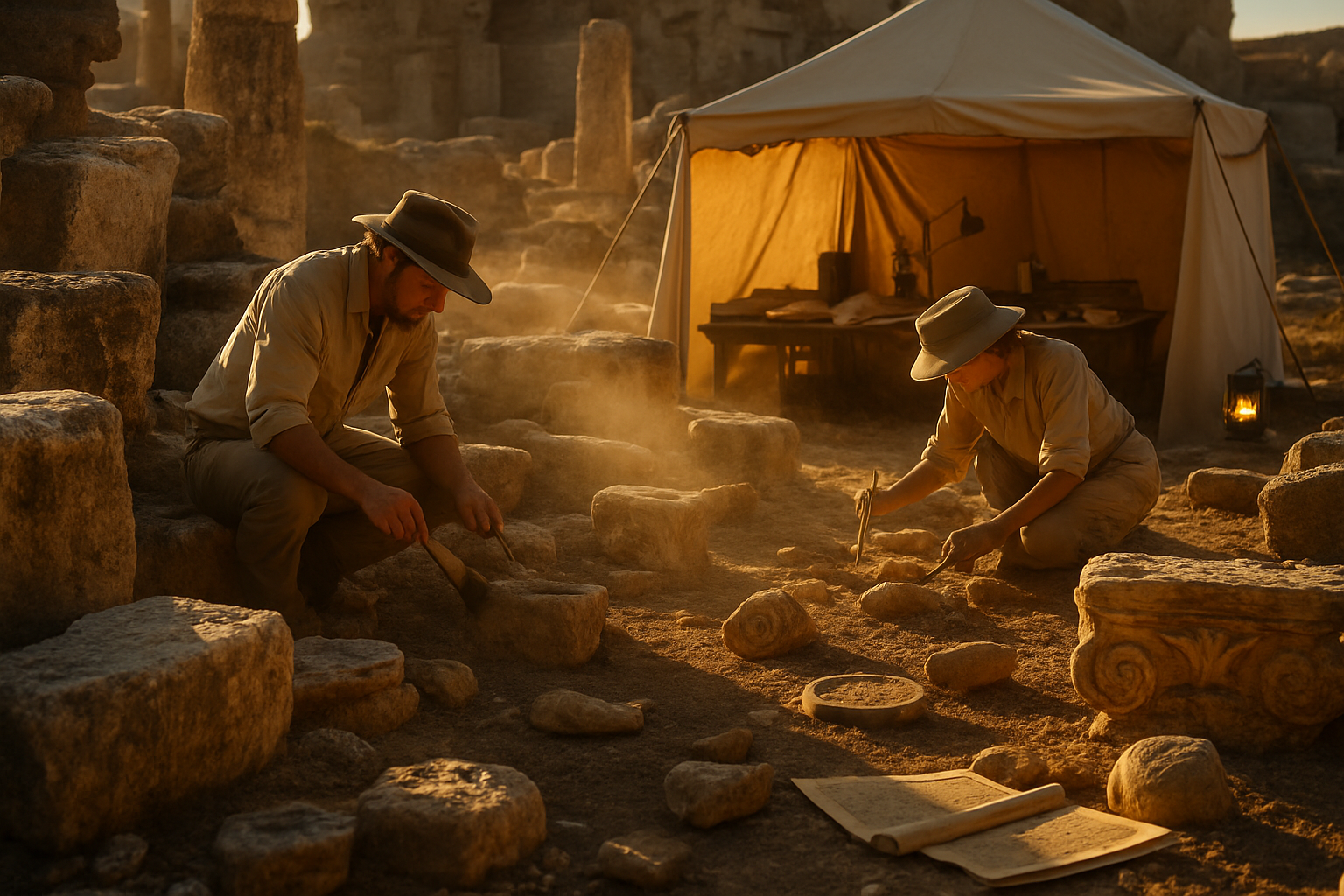
Using cutting-edge geophysical research and advanced drone imaging, Greek archaeological teams have uncovered what appears to be a once-thriving commercial port that connected India with Mesopotamia and the Mediterranean during Alexander's conquests in the 4th century BCE. The discovery, announced by Greek media outlets, represents the culmination of years of systematic archaeological investigation using modern technological approaches.
The lost city served as a crucial commercial hub linking Alexander's vast empire, facilitating trade between the eastern and western territories he conquered during his unprecedented military campaigns from 336 to 323 BCE. The site shows evidence of sophisticated urban planning, including advanced harbor infrastructure, residential quarters, and what appear to be administrative buildings typical of Hellenistic city design.
"This discovery fundamentally changes our understanding of Alexander's commercial network and the sophistication of ancient trade routes," said Dr. Maria Stavridis, lead archaeologist on the project.
— Dr. Maria Stavridis, Lead Archaeologist
Ground-penetrating radar and advanced chemical analysis have revealed extensive foundations, pottery fragments, and coins that definitively place the settlement within Alexander's historical timeframe. The preservation is remarkable, likely due to the arid climate and protective sand covering that has shielded the ruins for centuries.
The Archimedes Manuscript Mystery Solved
In a parallel discovery that has stunned mathematical historians, French researchers have authenticated a missing page from the "Archimedes Palimpsest" that had been lost for decades. The palimpsest, which contains the oldest known copies of several works by the ancient Greek mathematician Archimedes (c. 287-212 BCE), was discovered to have a missing page that has now surfaced in a French museum's collection.
According to Serbian media reports, the missing page was rediscovered in the holdings of a French museum, where it had been catalogued incorrectly for years. The page contains portions of Archimedes' mathematical treatises, including potentially groundbreaking geometric proofs that scholars believed were lost forever.
The Archimedes Palimpsest is historically significant because it preserves works by the mathematician that would otherwise be completely lost to history. The original texts were written on parchment in the 10th century, but in the 13th century, the parchment was recycled by monks who scraped off the mathematical text and wrote religious content over it - a common practice when parchment was scarce and expensive.
Revolutionary Archaeological Techniques
Both discoveries exemplify the ongoing "2026 Archaeological Renaissance" - a period characterized by unprecedented international cooperation and technological innovation in archaeological research. The methods employed in these discoveries represent significant advances over traditional excavation approaches.
For the Alexander site, researchers utilized sophisticated ground-penetrating radar, multispectral satellite imaging, and environmental reconstruction techniques. These non-invasive methods allowed archaeologists to map the entire settlement before any physical excavation, preventing damage to fragile ancient structures and artifacts.
Digital documentation techniques are creating permanent records of both discoveries, enabling global scholarly access while protecting the original materials. Advanced chemical analysis is providing precise dating and revealing construction techniques that illuminate ancient technological capabilities.
Historical Significance and Context
The discovery of Alexander's lost port city provides crucial insights into the economic and administrative structure of one of history's largest empires. Alexander the Great conquered territories spanning from Greece to India, creating a vast network that required sophisticated logistics and commercial infrastructure to maintain.
The recovered Archimedes page adds to our understanding of ancient mathematical knowledge and demonstrates the continuity of scholarly tradition from antiquity through the medieval period. Archimedes' work laid foundations for modern calculus, physics, and engineering, making any recovery of his lost texts invaluable for understanding the development of mathematical thought.
"These discoveries remind us that much of human history remains hidden, waiting for the right combination of technology, scholarship, and persistence to bring it to light," noted Professor Jean-Baptiste Durand, a specialist in ancient manuscripts at the Sorbonne.
— Professor Jean-Baptiste Durand, Sorbonne University
Climate Change and Archaeological Urgency
Both discoveries occur against the backdrop of increasing urgency in archaeological preservation. January 2026 marked the 18th consecutive month that global temperatures exceeded 1.5°C above pre-industrial levels, creating unprecedented threats to archaeological sites worldwide through extreme weather, rising sea levels, and environmental degradation.
Many ancient sites face imminent threats from climate change, development pressures, and natural deterioration, making systematic archaeological documentation and preservation efforts more critical than ever. The success of these recent discoveries demonstrates the importance of sustained international cooperation and investment in archaeological research during this crucial window of opportunity.
International Cooperation and Future Research
The authentication and study of both discoveries required extensive international collaboration. Greek archaeologists worked with specialists from multiple European institutions, while the Archimedes manuscript analysis involved scholars from France, Greece, and other nations with expertise in ancient texts and mathematical history.
Future research plans include expanded excavation at the Alexander site using the same non-invasive techniques that led to the initial discovery. For the Archimedes manuscript, scholars are conducting detailed analysis to determine if the recovered page contains previously unknown mathematical proofs or geometric theorems.
Both discoveries contribute to the broader understanding of ancient civilizations' technological and intellectual capabilities, challenging assumptions about the limitations of pre-modern societies and revealing the sophisticated networks of knowledge, trade, and cultural exchange that characterized the ancient Mediterranean world.
Broader Implications for Archaeological Science
These discoveries represent significant advances in archaeological methodology, demonstrating how modern technology can unlock historical secrets that traditional excavation methods might miss or damage. The success of non-invasive techniques in locating Alexander's port city provides a template for future archaeological research in environmentally sensitive or politically challenging locations.
The recovery of the Archimedes manuscript page highlights the importance of systematic cataloguing and re-examination of museum collections, where countless historical treasures may be hiding in plain sight, misidentified or undervalued due to limited resources or historical oversight.
As climate change and development pressures threaten archaeological sites globally, the methods pioneered in these discoveries offer hope for preserving human heritage while advancing our understanding of ancient civilizations. The combination of advanced technology, international cooperation, and sustained scholarly commitment demonstrates humanity's capacity to recover and preserve the knowledge of previous generations for future study and inspiration.