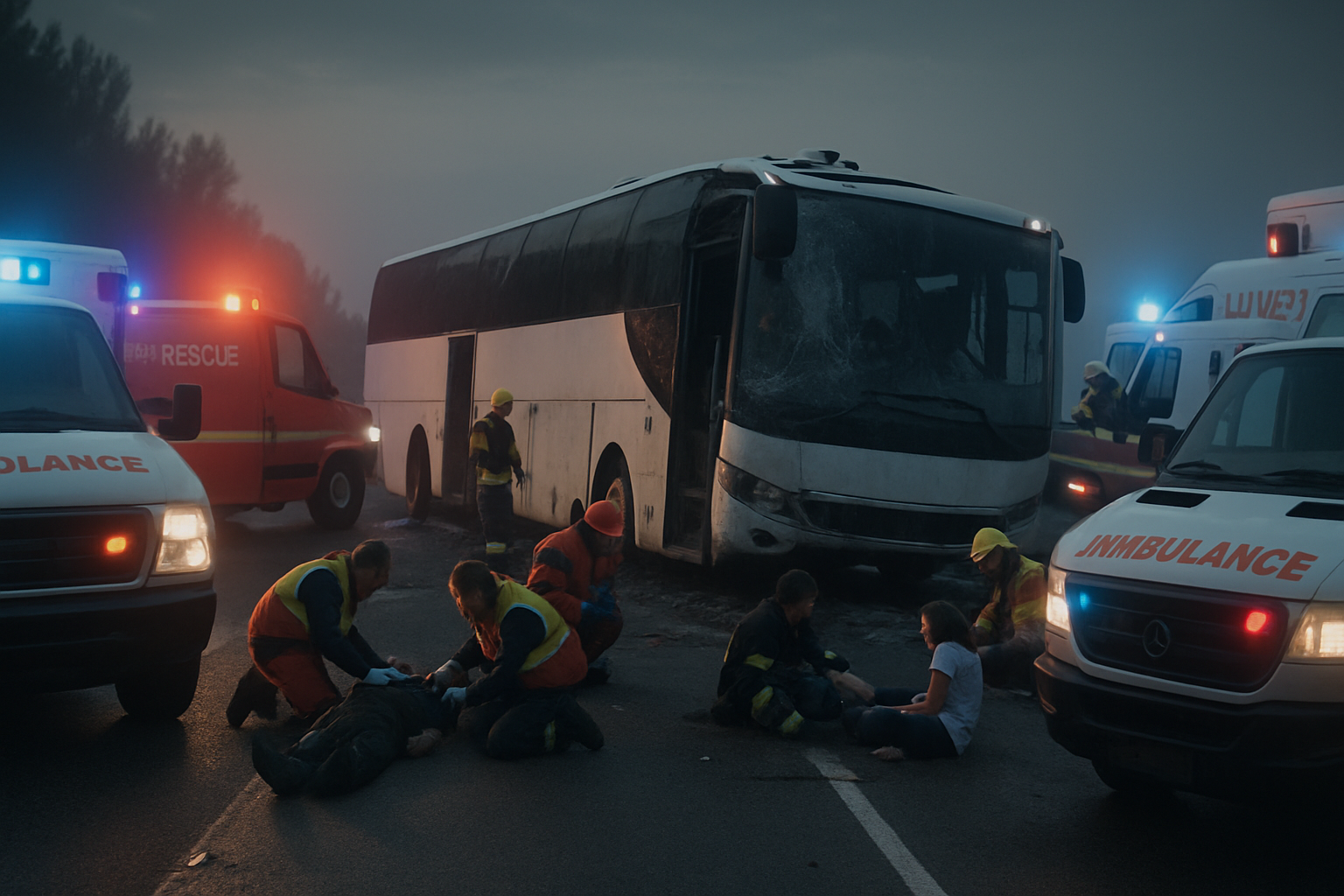
A passenger bus carrying travelers between Annaba and Hajar El-Dis overturned on Algeria's National Route 44 on April 25, 2026, injuring 38 people in what has become the latest incident in an escalating global transportation safety crisis that has claimed hundreds of lives across multiple continents.
The accident occurred at approximately 3:20 PM local time on the Wadi El-Nil section toward Berhal in the Bouni municipality of Annaba province. Algeria's Civil Protection services deployed two rescue trucks and five ambulances to respond to the emergency, transporting victims aged between 5 and 66 years to local hospitals with various injuries and shock conditions.
Initial reports indicated 30 injuries, but the casualty count rose to 38 as emergency responders conducted thorough searches of the overturned vehicle. Seven victims were reported in critical condition, underscoring the severity of the crash on the mountainous highway connecting Algeria's northeastern coastal regions.
Part of Unprecedented Global Crisis
The Algeria bus accident represents just the latest tragedy in what transportation safety experts are calling the most dangerous period for global transportation infrastructure since the COVID-19 pandemic. Planet News investigation has documented over 210 significant transportation incidents across 50+ countries since February 2026, coinciding with the 24th consecutive month of global temperatures exceeding 1.5°C above pre-industrial levels.
This prolonged warming period—the longest sustained temperature increase in recorded history—has created operational conditions that transportation networks were never designed to handle. Extreme weather, aging infrastructure, and increasing traffic volumes have combined to create a perfect storm of safety vulnerabilities.
Algeria has been particularly affected by this crisis. The country recorded 16 deaths and 367 injuries in traffic accidents during a devastating 48-hour period in February 2026, highlighting systemic challenges in road safety infrastructure and emergency response capabilities.
International Incidents Multiply
The Algeria crash comes amid a wave of transportation incidents across multiple countries during the same 24-hour period. In Colombia, two buses were damaged by explosive devices on the Pan-American Highway between Nariño and Cauca departments, with reports of guerrilla forces detonating bombs as the vehicles passed.
According to Colombian media reports, passengers and drivers on both public service buses sustained injuries when "the guerrilla came out and detonated a bomb" targeting the vehicles. The incident demonstrates how transportation safety challenges extend beyond infrastructure failures to include security threats in conflict-affected regions.
"We are witnessing an unprecedented convergence of climate pressures, aging infrastructure, and security challenges that is testing transportation systems worldwide beyond their designed capabilities."
— Transportation Safety Expert
Technology Solutions Hampered by Supply Shortages
While advanced safety technologies exist that could prevent many of these accidents, their implementation has been severely hampered by a global semiconductor shortage that has increased safety system costs sixfold through 2027. Australian researchers at Edith Cowan University have developed AI systems capable of detecting driver impairment with 90% accuracy and fatigue with 95% accuracy using 3D facial analysis, but widespread deployment remains limited.
Similarly, AI-powered predictive maintenance systems that could identify infrastructure failures before they occur face deployment challenges due to computational infrastructure costs and the ongoing semiconductor crisis. These technological solutions represent the future of transportation safety but remain largely inaccessible to developing nations where accidents are most frequent.
Economic and Human Impact
Each traffic fatality costs society hundreds of thousands of dollars in lost productivity, medical expenses, and legal proceedings, with transportation disruptions creating cascading effects through supply chains, agriculture, and tourism. Working populations—including fishermen, construction workers, and agricultural laborers—face disproportionate risks as they depend heavily on shared transportation systems.
The psychological impact extends beyond direct victims to affect families, communities, and emergency services personnel who face increasing strain from the frequency and severity of incidents. Hospitals in affected regions report being overwhelmed by trauma cases, while emergency responders describe unprecedented operational demands.
Successful Prevention Models Exist
Despite the crisis, several countries have demonstrated that dramatic safety improvements are achievable through comprehensive approaches. Sweden's Vision Zero policy has achieved significant fatality reductions through infrastructure design that accounts for human error rather than expecting perfect driver behavior. The Netherlands' Safe System Approach minimizes accident consequences through engineering improvements and enhanced emergency response protocols.
Norway achieved zero recreational boating fatalities in the first quarter of 2026—the first time since 2001 that such a milestone was reached. These successes provide templates for other nations but require sustained political commitment and substantial infrastructure investment.
Climate Adaptation Urgent
Transportation experts emphasize that traditional engineering approaches based on historical weather patterns are inadequate for current environmental volatility. Infrastructure must now anticipate future rather than historical climate conditions, requiring massive investments in climate-resilient design including enhanced drainage, weather-resistant materials, and backup power systems.
"Building back better" has evolved from an optional enhancement to an essential survival strategy in an era of permanent climate volatility. Roads, bridges, and emergency systems are failing under unprecedented temperature fluctuations, extreme precipitation, and storms that exceed design parameters.
International Cooperation Critical
The International Civil Aviation Organization (ICAO) is reviewing emergency vehicle coordination protocols at airports worldwide following multiple incidents, while the EU Civil Protection Mechanism has been activated repeatedly to coordinate assistance among member states facing simultaneous emergencies.
Enhanced international cooperation includes safety standards harmonization, data sharing, emergency response coordination, and technology transfer. However, the scale of the crisis requires transformative rather than reactive approaches, with prevention windows rapidly narrowing as transportation volumes grow and operational environments become more challenging.
Watershed Moment for Transportation Safety
April 2026 represents a critical juncture for global transportation policy, with decisions made now likely to influence safety standards and international cooperation frameworks for decades ahead. The choice between transformative infrastructure adaptation and permanent crisis management has become increasingly urgent as the human cost of inaction mounts.
The convergence of aging infrastructure, climate change, and increasing transportation demand requires fundamental transformation rather than incremental improvements. Success depends on unprecedented international cooperation, sustained political commitment to safety over convenience, and comprehensive solutions that address both immediate safety needs and long-term climate adaptation requirements.
As transportation systems worldwide face challenges beyond their original design parameters, the Algeria bus accident serves as a sobering reminder that the time for reactive crisis management is ending. The international community must act decisively to implement the transformative changes necessary to protect the millions of people who depend on safe transportation every day.