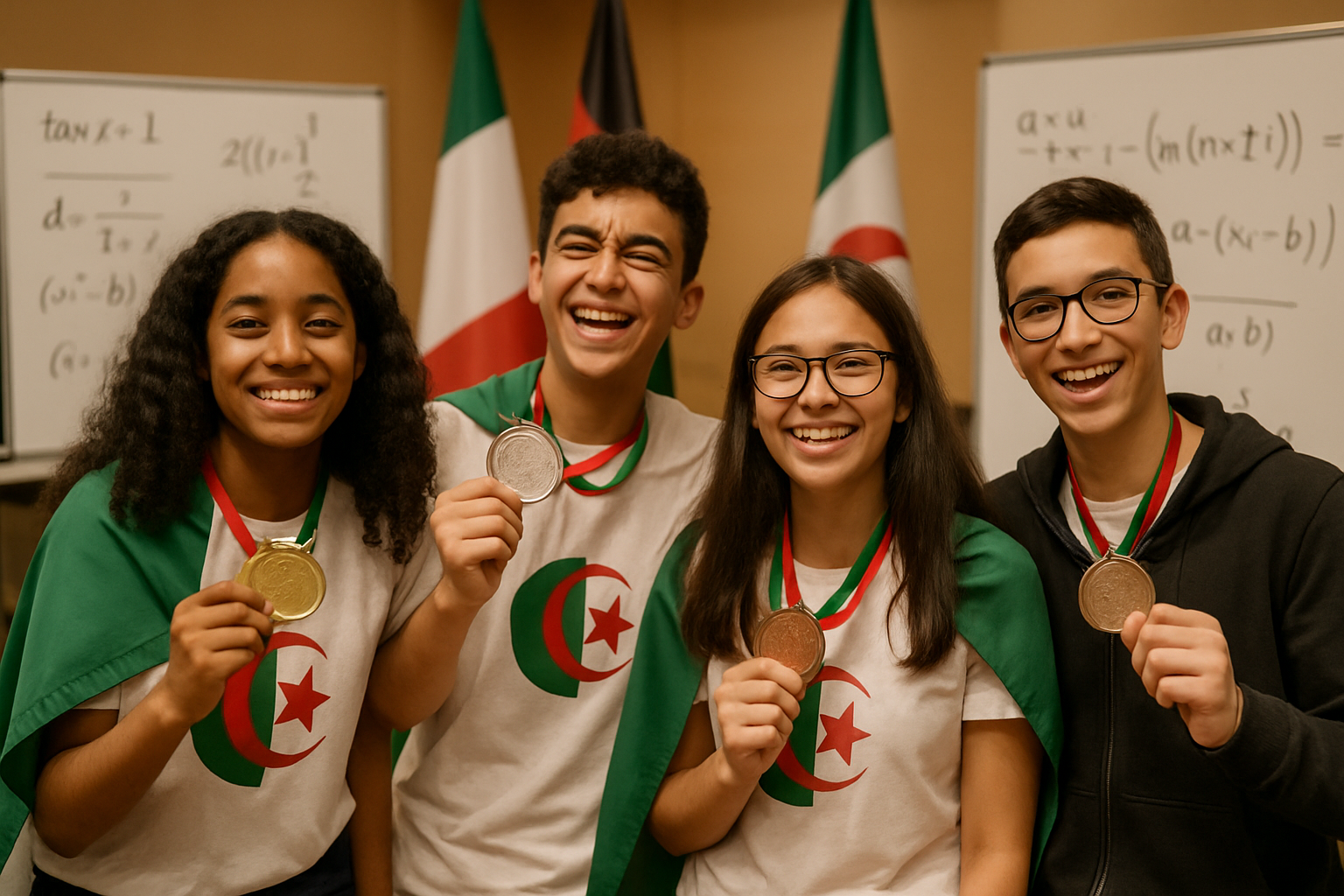
Algeria achieved remarkable success at the 7th International Mathematics Olympiad (OFM) 2026, with students capturing 11 medals out of 12 participants in a stellar display of mathematical excellence that positions the country as a rising force in global academic competitions.
The competition, hosted by the Republic of Djibouti on March 28-29, 2026, was conducted virtually using video conferencing technology, bringing together students from numerous countries in a high-level scientific competition that showcased exceptional mathematical abilities across two age categories.
Outstanding Medal Performance
Algeria's national team demonstrated exceptional prowess, with 11 out of 12 participating students earning medals in the prestigious international competition. The medal distribution included four gold medals, three silver medals, and four bronze medals – a remarkable achievement that reflects the advanced level reached by Algerian students in mathematics.
Education Minister Dr. Mohamed Seghir Saadaoui extended congratulations to the outstanding students who represented Algeria, expressing pride and recognition for their distinguished achievement. The minister's statement emphasized the significance of this success for Algerian higher education and the country's growing reputation in international academic competitions.
"This achievement reflects the advanced level that participating students have reached in this competition"
— Ministry of Education Statement
International Competition Framework
The International Mathematics Olympiad (OFM) 2026 represented one of the most demanding global STEM competitions, requiring participants to navigate complex mathematical problems under time pressure while demonstrating advanced problem-solving capabilities. The virtual format, necessitated by contemporary circumstances, did not diminish the rigor or prestige of the competition.
The competition featured students divided into two categories – younger and older participants – allowing for age-appropriate mathematical challenges while maintaining the highest standards of academic excellence. This structure enabled students across different educational levels to compete fairly while showcasing their mathematical abilities on an international stage.
Educational Excellence Context
Algeria's success occurs within the broader context of the "2026 Educational Technology Renaissance," a documented global phenomenon emphasizing thoughtful integration of digital tools with traditional educational values. The country has been systematically investing in educational infrastructure and teacher development, with recent initiatives including the establishment of the International Journal of Educational Innovation.
The mathematics olympiad achievement builds on Algeria's growing commitment to STEM education, including previous participation in astronomy and astrophysics olympiads, demonstrating a comprehensive approach to scientific education that spans multiple disciplines.
This success aligns with international trends showing that sustained political commitment, comprehensive stakeholder engagement, and balanced innovation approaches yield superior educational outcomes. Countries implementing prevention-first educational strategies – investing proactively in student development rather than reactive intervention – consistently demonstrate enhanced academic performance.
Strategic Educational Investment
The remarkable performance reflects Algeria's systematic approach to mathematics education, involving dedicated preparation programs, qualified instructors, and supportive educational infrastructure. The success of 11 out of 12 participants suggests not just individual brilliance but institutional effectiveness in developing mathematical talent.
Education Minister Mohamed Saghir Saadaoui's leadership has emphasized educational innovation and international cooperation, positioning Algeria as a potential North African leader in educational research and policy development. This mathematical olympiad success provides tangible evidence of these strategic investments yielding measurable results.
International Recognition and Future Implications
Algeria's outstanding performance at the 2026 International Mathematics Olympiad establishes the country as a serious contender in global academic competitions. The achievement demonstrates that developing nations can access world-class educational opportunities through strategic investments in teacher training, student support, and systematic preparation programs.
The success also contributes to Algeria's broader educational transformation, which includes technology integration, cultural preservation, and international cooperation efforts. By achieving excellence while maintaining authentic educational relationships and cultural values, Algeria provides a template for other nations seeking to balance global competitiveness with local identity.
Looking ahead, this mathematics olympiad triumph is likely to inspire increased investment in STEM education, enhanced international educational partnerships, and continued emphasis on developing mathematical talent across all educational levels. The achievement positions Algeria's students for future success in university admissions, international competitions, and careers requiring advanced mathematical competency.
Recognition of Educational Excellence
The congratulations from Education Minister Dr. Mohamed Seghir Saadaoui reflect not only pride in student achievement but recognition of the comprehensive educational ecosystem that made this success possible. Teachers, administrators, families, and communities all contribute to creating conditions where students can achieve their highest potential.
This international recognition serves multiple purposes: celebrating individual student excellence, validating educational approaches, attracting international attention to Algerian educational capabilities, and inspiring future generations of students to pursue mathematical studies.
The achievement occurs during a critical juncture in global educational policy, where success in international competitions increasingly influences national educational strategies and resource allocation. Algeria's impressive showing provides evidence that thoughtful educational investment, combined with cultural sensitivity and international cooperation, can yield remarkable results.
As Algeria continues building its reputation as an educational leader in North Africa and beyond, this mathematics olympiad success stands as a defining moment – proof that with proper support, preparation, and commitment, Algerian students can compete successfully at the highest international levels while contributing to their country's growing academic excellence.