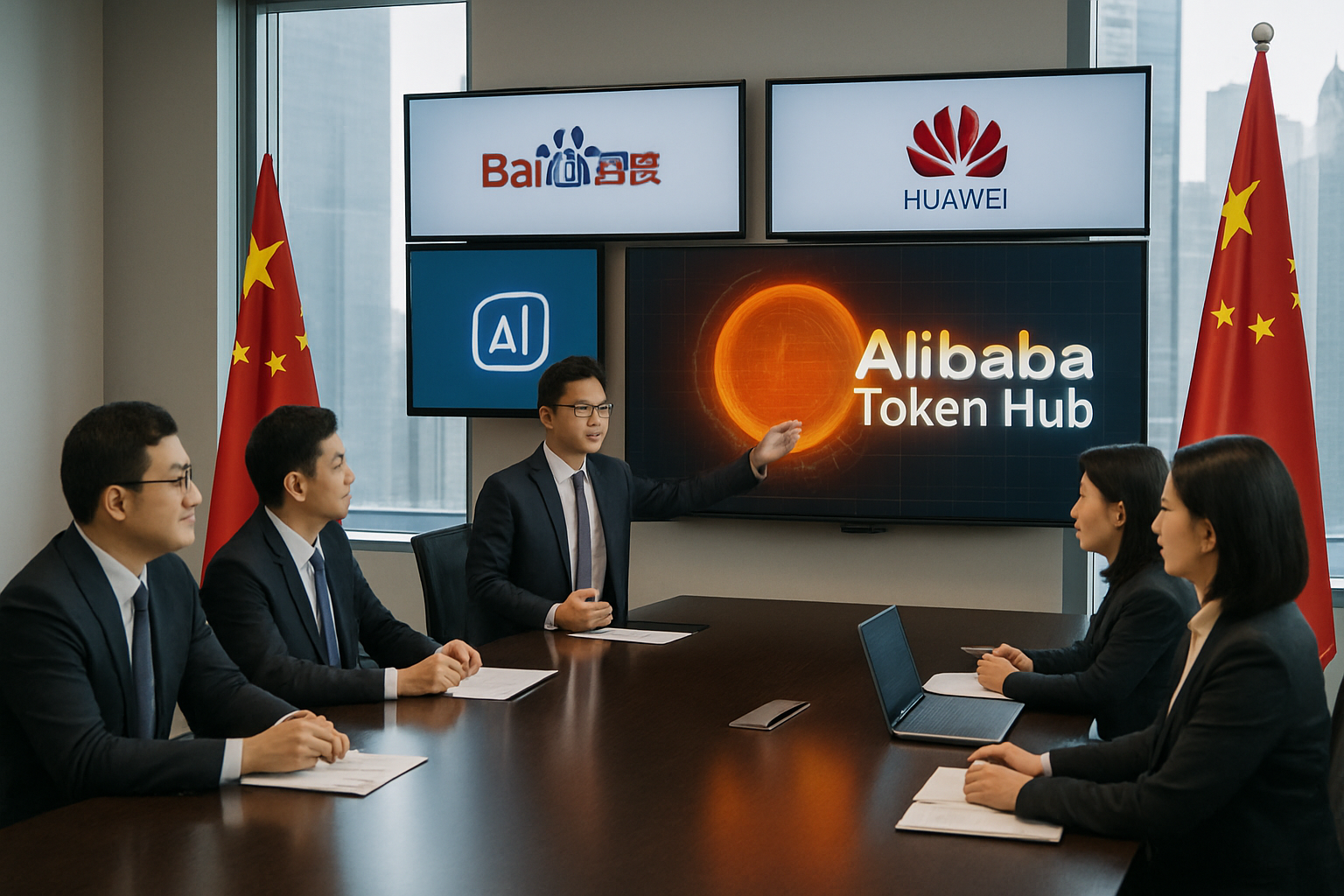
Alibaba Group Holding announced a major restructuring of its artificial intelligence operations on Monday, creating the Alibaba Token Hub (ATH) Business Group under CEO Eddie Wu Yongming's direct leadership, even as China faces mounting geopolitical pressure from the Trump administration over the ongoing Strait of Hormuz crisis.
The timing of Alibaba's strategic AI consolidation coincides with unprecedented diplomatic tensions, as President Trump threatens to postpone his highly anticipated Beijing summit unless China helps break Iran's blockade of the critical oil transit route. The convergence of China's technological advancement push with escalating Middle East geopolitics highlights the complex challenges facing Beijing as it balances domestic innovation priorities with international obligations.
Alibaba's Token Economy Gambit
The newly established Token Hub brings together all of Alibaba's core AI teams and products under one unified structure, including the prestigious Tongyi Laboratory, developer of the company's Qwen series of language models. This consolidation represents the e-commerce giant's most ambitious push into what industry analysts are calling the "emerging token economy."
CEO Eddie Wu Yongming's direct oversight of the new division signals the strategic importance Alibaba places on AI integration across its vast ecosystem. The Token Hub structure is designed to accelerate development and deployment of AI technologies across Alibaba's cloud services, e-commerce platforms, and digital payment systems.
"This restructuring positions us at the forefront of the token economy revolution," an Alibaba spokesperson stated, though the company has remained tight-lipped about specific technical details of the new organizational structure.
— Alibaba Group Representative
The move comes as China continues its aggressive expansion in artificial intelligence despite ongoing global semiconductor shortages that have driven memory chip prices up sixfold, affecting major manufacturers like Samsung, SK Hynix, and Micron until at least 2027.
Geopolitical Storm Clouds
While Alibaba positions itself for AI leadership, the broader geopolitical landscape presents unprecedented challenges for Chinese tech companies and the government alike. Trump's ultimatum linking his Beijing visit to China's intervention in the Strait of Hormuz crisis has forced Beijing into an uncomfortable position between its energy security needs and diplomatic traditions.
China, as the world's largest buyer of Gulf oil, depends heavily on stable energy routes through the Strait of Hormuz. The Iranian blockade threatens approximately 20% of global oil transit, creating economic pressures that extend far beyond energy markets into technology sector investments and development priorities.
The diplomatic crisis represents a significant test for China's foreign policy approach, which has traditionally emphasized non-interference in international conflicts. Beijing's response to Trump's demands could have lasting implications for US-China relations and China's broader Belt and Road Initiative partnerships in the Middle East.
AI Development Amid Global Tensions
Despite the geopolitical turbulence, China's artificial intelligence sector continues its rapid advancement. The Token Hub announcement follows a pattern of Chinese tech giants consolidating AI resources to compete more effectively in the global technology race. Recent memory shows that Eddie Wu previously formed an internal AI task force to coordinate group-wide resources for foundational model development, reflecting what industry observers call "Chinese technological sovereignty push."
The global AI landscape has become increasingly competitive, with Alphabet committing $185 billion to AI infrastructure in 2026 and Amazon exceeding $1 trillion in development plans. Chinese companies like Alibaba face the additional challenge of navigating international trade restrictions while maintaining competitive advantage in domestic and international markets.
Industry analysts note that Alibaba's timing may be strategically sound, as the global memory semiconductor crisis is forcing innovation in memory-efficient algorithms and hybrid processing approaches. This constraint-driven innovation could provide Chinese companies with advantages in developing more efficient AI systems.
International Implications
The convergence of Alibaba's AI restructuring with the Strait of Hormuz crisis illustrates the increasingly intertwined nature of technology development and geopolitical strategy. China's response to the current diplomatic pressure could influence international tech partnerships, supply chain arrangements, and global AI governance frameworks.
European observers have noted China's continued technological advancement despite Western export restrictions, with the Token Hub announcement demonstrating sophisticated capabilities in AI development. The multipolar AI landscape emerging from current geopolitical tensions may reshape global technology cooperation for decades to come.
Beijing's handling of the dual challenges—advancing domestic AI capabilities while managing international diplomatic pressures—will likely serve as a template for how major economies navigate the intersection of technological sovereignty and global interdependence.
Looking Ahead
As Alibaba moves forward with its Token Hub initiative, the success of the venture will depend partly on broader geopolitical stability and China's ability to maintain access to international markets and partnerships. The ongoing Strait of Hormuz crisis adds uncertainty to an already complex global technology landscape marked by supply chain constraints and regulatory intensification.
The coming months will reveal whether China can successfully balance its technological ambitions with international diplomatic obligations, and whether companies like Alibaba can continue their AI advancement despite geopolitical headwinds. The Token Hub represents more than just corporate restructuring—it embodies China's determination to maintain technological leadership regardless of external pressures.
Industry watchers will be closely monitoring both Alibaba's AI developments and China's diplomatic responses as these parallel tracks continue to evolve throughout 2026, potentially reshaping the global technology and geopolitical landscape for years to come.