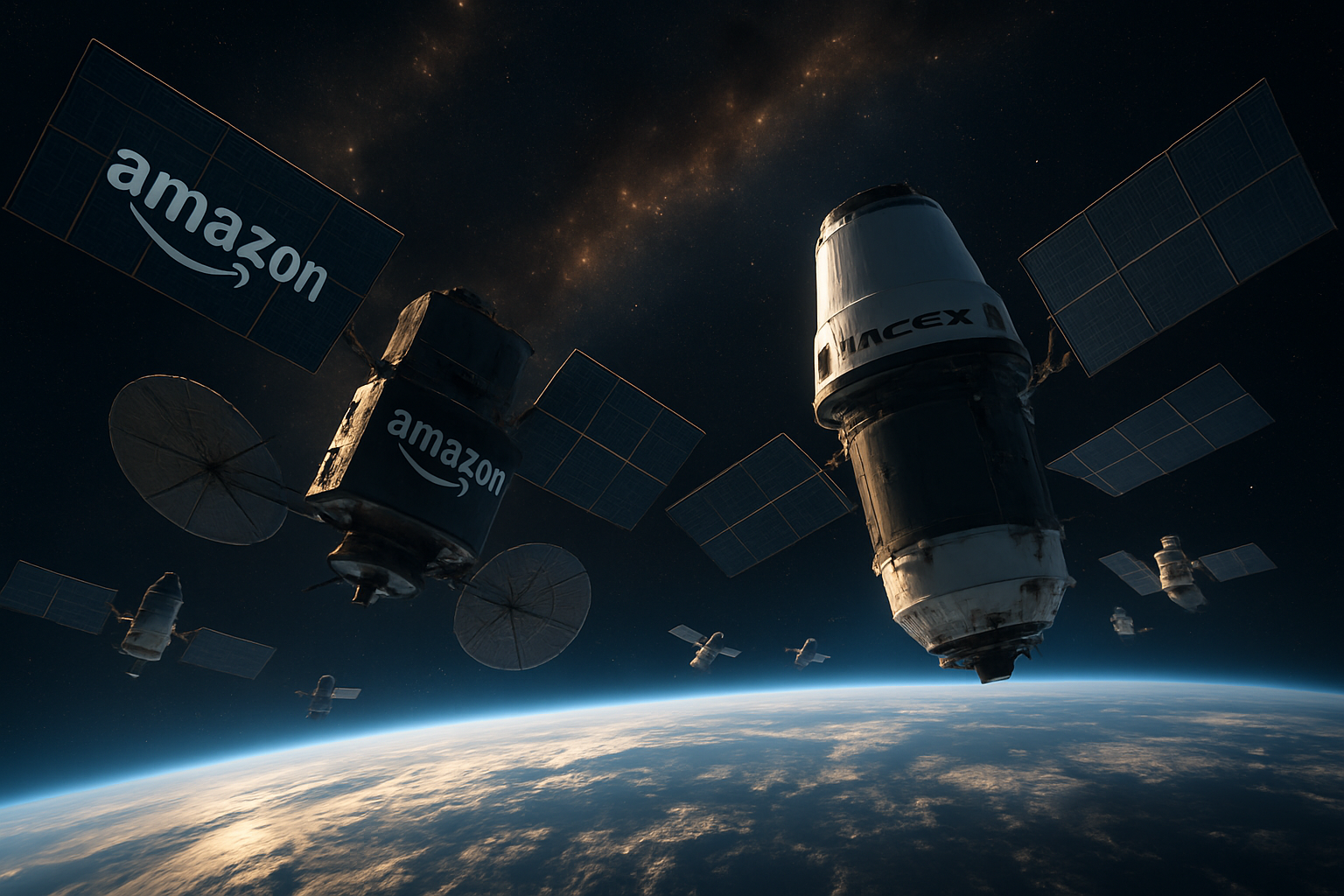
Amazon has reportedly entered advanced negotiations to acquire Globalstar, a satellite communications group valued at nearly $9 billion, marking a significant escalation in the competitive battle against Elon Musk's SpaceX Starlink satellite network.
The potential acquisition represents Amazon's most aggressive move yet to establish a meaningful presence in the satellite internet market, which has been dominated by SpaceX's Starlink constellation. The deal, if completed, would give Amazon control of Globalstar's existing satellite infrastructure and ground operations, providing immediate capabilities to compete in the burgeoning space-based communications sector.
Strategic Context of the Space Economy Golden Age
This acquisition comes during what industry experts have termed the "space economy golden age," with the global space economy projected to exceed $1 trillion by 2030. The timing is particularly significant as SpaceX prepares for a potentially historic June 2026 IPO that could value the combined SpaceX-xAI entity at over $1.7 trillion, making it the largest public offering in history.
Amazon's pursuit of Globalstar reflects broader industry dynamics where space-based infrastructure is transitioning from experimental to essential. The global memory crisis, with semiconductor prices increasing sixfold and affecting major manufacturers like Samsung, SK Hynix, and Micron, has intensified interest in space-based data centers and satellite communications as alternatives to constrained terrestrial infrastructure.
Competitive Landscape and Strategic Implications
SpaceX's Starlink has already demonstrated significant strategic capabilities, including the ability to control access to its services for geopolitical purposes. The company notably blocked unauthorized Russian military use of Starlink in Ukraine, highlighting the intersection of commercial space services and international relations. With over 5,000 active satellites in orbit, Starlink has established a commanding presence in satellite internet provision.
Amazon's move through Globalstar would provide an alternative to SpaceX's growing monopoly in satellite communications. This diversification is crucial given recent concerns about SpaceX's operational challenges, including reported satellite explosions and safety issues that have raised questions about the sustainability of rapid constellation deployment.
"The space economy is at a critical juncture where commercial capabilities are becoming essential infrastructure for modern civilization."
— Industry Analysis, Space Technology Reports
Technological and Infrastructure Challenges
The satellite communications sector faces significant technical and regulatory challenges. The European Space Agency has warned that over 34,000 tracked orbital objects, plus millions of untrackable debris pieces, create collision risks at 17,500 mph orbital speeds. This space debris crisis represents a growing threat to all satellite operators, requiring sophisticated management systems and international cooperation.
Environmental concerns have also emerged following Austrian research that documented atmospheric pollution from rocket launches, including tenfold elevated lithium concentrations from Falcon-9 debris. These findings underscore the need for sustainable space development practices as the industry scales up operations.
International Competition and Cooperation
The Amazon-Globalstar negotiations occur within a broader context of intensifying international space competition. China has advanced its Shenlong reusable spacecraft program and plans lunar crews by 2030, while Pakistan has selected astronauts for China's Tiangong space station missions. European nations are pursuing space independence through initiatives like Germany's €10 billion SATCOMBw 4 satellite system and Sweden's Isar Aerospace facilities.
Meanwhile, international cooperation continues through platforms like the International Space Station, where ongoing research missions are conducting critical studies for future lunar settlements and Mars exploration. This dual dynamic of competition and cooperation characterizes the current space landscape.
Economic and Market Implications
The potential $9 billion Globalstar acquisition would represent one of the largest satellite industry transactions, reflecting the premium valuations now placed on space assets. Amazon's investment aligns with broader corporate commitments to space infrastructure, including Alphabet's $185 billion AI infrastructure investment and Blue Origin's application for a 51,600-satellite constellation supporting space-based data centers.
The economic significance extends beyond immediate market competition. Space-based services are becoming essential for modern economies, with applications spanning telecommunications, navigation, weather monitoring, and emerging uses like space-based computing to address terrestrial infrastructure constraints.
Regulatory and Governance Challenges
The expansion of commercial satellite constellations raises complex governance questions that current international frameworks struggle to address. The 1967 Outer Space Treaty was designed for government space activities and proves inadequate for managing massive commercial constellations. Thailand's leadership of UN space governance initiatives reflects growing recognition that space-related challenges require coordinated international responses.
The potential for "orbital cage" effects, where satellite constellations impede future space access, necessitates careful regulatory oversight. Scientists warn that millions of planned satellites could affect natural night sky visibility and create unprecedented collision risks requiring proactive management.
Future Outlook and Strategic Positioning
Amazon's pursuit of Globalstar represents a critical decision point for the future trajectory of the space economy. Success could establish a viable alternative to SpaceX's dominance while contributing to space technology democratization. The acquisition would position Amazon to participate in the transition from AI-focused technology development to space-based infrastructure deployment.
The outcome will significantly influence how space-based services evolve to serve global communications needs while addressing terrestrial infrastructure limitations. As space capabilities become essential for modern civilization, the competitive dynamics between Amazon, SpaceX, and other emerging players will shape humanity's relationship with space-based technologies for decades to come.
The negotiation's resolution will occur during a pivotal period for space exploration, coinciding with NASA's Artemis II mission preparations and the continued development of lunar settlement capabilities. These concurrent developments underscore 2026 as a watershed year for establishing the foundations of humanity's spacefaring civilization.