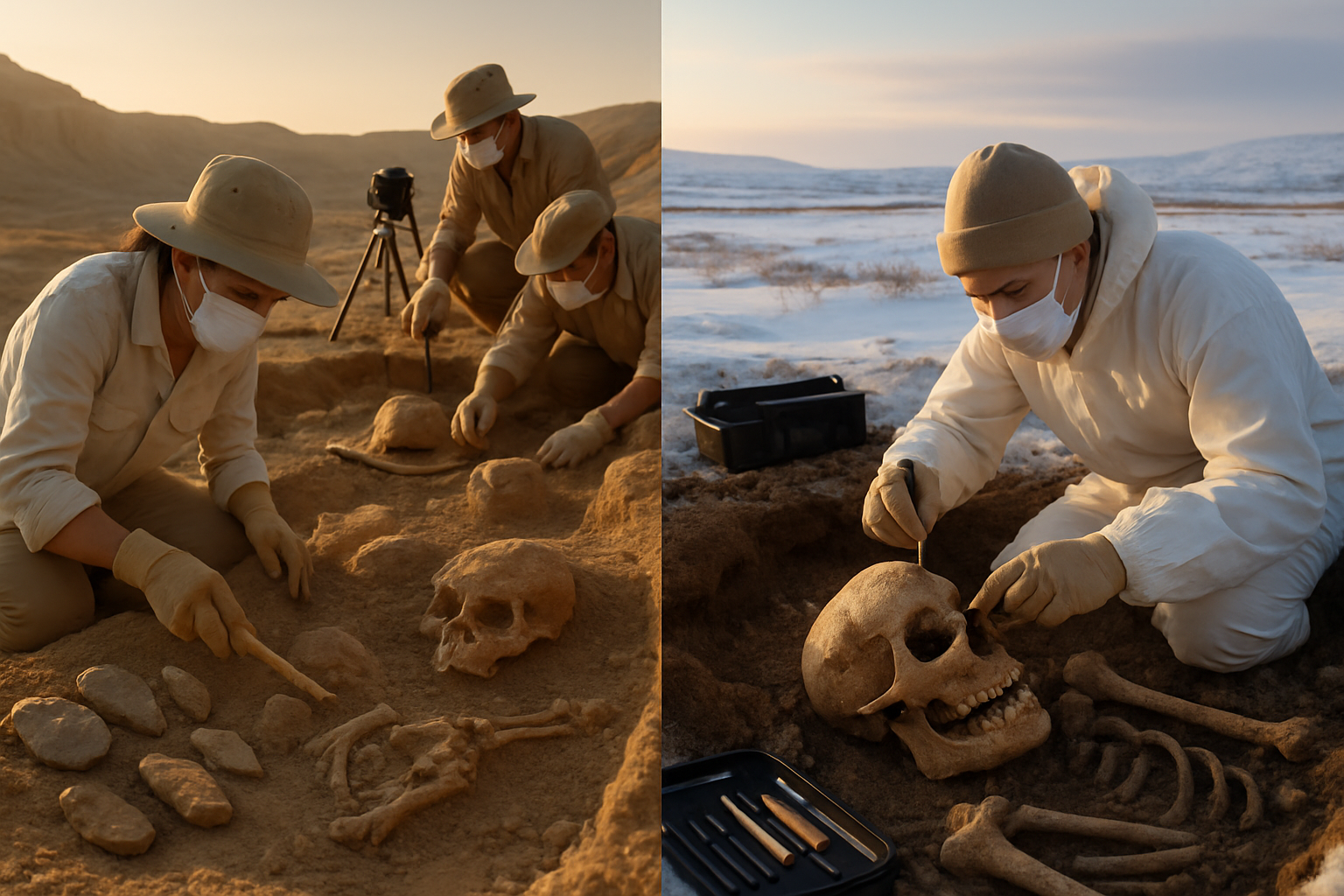
Two extraordinary archaeological discoveries are fundamentally reshaping our understanding of early human history, revealing both the ancient complexity of human migration patterns and the sophisticated medical practices of our ancestors.
A groundbreaking study from Israel has dramatically altered the timeline of human migration out of Africa, while Russian scientists have uncovered evidence of remarkably advanced surgical techniques from 2,500 years ago in Siberia. These discoveries represent a significant leap forward in our understanding of early human capabilities and movement patterns across continents.
Israel Discovery Rewrites Human Migration History
Research teams working at the prehistoric site of 'Ubeidiya in Jordan Valley have achieved a archaeological milestone by redating the site to 1.9 million years ago, placing early hominins in the Levant at the same time period as the oldest Georgian sites. This finding suggests that at least two distinct groups of human ancestors left Africa simultaneously, challenging long-held assumptions about a single migration wave.
The implications of this discovery extend far beyond simple chronology. According to the research team, the evidence suggests that early human migration out of Africa was far more complex and coordinated than previously understood. Rather than a single exodus, multiple groups of early humans appear to have embarked on separate journeys from Africa during the same timeframe, establishing parallel migration routes.
This revelation builds upon extensive archaeological work documented throughout 2026, which has shown a consistent pattern of discoveries revealing greater complexity in early human behavior and technological capabilities. The 'Ubeidiya site joins a growing body of evidence that our ancestors possessed more sophisticated planning and coordination abilities than traditional evolutionary models suggested.
Siberian Surgical Marvel Reveals Ancient Medical Expertise
In a parallel breakthrough, Russian scientists have employed advanced tomography techniques to reveal evidence of complex maxillofacial surgery performed on a woman from the Pazyryk culture approximately 2,500 years ago. The discovery, made at the Ukok Plateau in Siberia, demonstrates surgical intervention that the patient remarkably survived.
The sophisticated nature of this ancient surgical procedure challenges assumptions about the medical capabilities of pre-modern civilizations. The surgery involved precise manipulation of facial bone structures, requiring not only advanced anatomical knowledge but also surgical tools and techniques that enabled the patient's recovery and survival.
"This discovery represents a quantum leap in our understanding of ancient medical practices. The precision and success of this surgery indicates a level of medical sophistication that we previously associated with much later periods."
— Research Team, Siberian Archaeological Institute
Advanced Archaeological Methodologies Driving Discovery
Both discoveries showcase the power of modern archaeological techniques in uncovering previously hidden aspects of human history. The Israeli research team employed advanced geological analysis and sophisticated dating methodologies to establish the revised timeline, while the Russian investigation utilized cutting-edge CT scanning technology to reveal surgical evidence without damaging the ancient remains.
These methodological advances represent a broader transformation in archaeological research documented throughout 2026. The integration of advanced imaging, chemical analysis, genetic sequencing, and environmental reconstruction methods is enabling researchers to extract unprecedented detail from archaeological sites worldwide.
The convergence of traditional archaeological expertise with modern analytical tools is revealing layers of human history that were previously inaccessible. This technological revolution in archaeology is producing a cascading effect of discoveries that collectively paint a picture of early humans as far more sophisticated than previously understood.
Global Archaeological Renaissance Context
These discoveries occur within what researchers have termed the "2026 Archaeological Renaissance," a period of exceptional discovery frequency and quality spanning multiple continents. From dinosaur nesting sites in Argentina to ancient fire control evidence in England, the year has witnessed an unprecedented surge in significant archaeological findings.
The pattern suggests that improved analytical techniques, combined with international cooperation and systematic fieldwork approaches, are unlocking historical secrets at an accelerating pace. Climate change urgency is also driving more intensive archaeological investigation, as sites face increasing environmental threats requiring rapid documentation and preservation.
Previous major discoveries throughout 2026 have consistently revealed greater complexity in ancient human capabilities. Evidence of fire control 350,000 years earlier than expected, sophisticated astronomical observation systems dating back 8,000 years, and complex ancient civilizations across multiple continents all point to a fundamental reassessment of human development timelines.
Implications for Understanding Human Evolution
The Israeli migration findings force a complete reconsideration of how early humans organized and executed their expansion beyond Africa. The evidence suggests coordinated movement patterns that required communication, planning, and resource management capabilities far beyond what simple survival instincts alone could produce.
Similarly, the Siberian surgical discovery indicates that ancient human communities developed medical knowledge systems capable of supporting complex interventions. The successful completion of facial surgery implies not only individual surgical skill but also community support systems, sterilization techniques, and post-operative care protocols.
These revelations align with a broader pattern of 2026 archaeological discoveries that consistently reveal greater ancient human sophistication across technological, social, and cognitive domains. The cumulative evidence suggests that traditional evolutionary models significantly underestimated the pace and sophistication of early human development.
International Cooperation and Future Research
Both discoveries exemplify the power of international archaeological cooperation. The Israeli research benefits from collaboration with Georgian archaeological teams, while the Russian findings contribute to broader Eurasian archaeological networks. This cooperative approach is enabling comparative analysis across sites and cultures, revealing patterns that isolated studies might miss.
Future research directions include expanded investigation of similar sites across the migration corridor from Africa to Asia, searching for evidence of parallel surgical traditions in other ancient cultures, and continued application of advanced analytical techniques to previously studied materials that may yield new insights.
The success of these discoveries demonstrates that much of human history remains hidden in archaeological sites worldwide, waiting for the right combination of analytical techniques and research approaches to unlock their secrets. The methodological innovations pioneered in these studies are already being applied to other sites, suggesting that the current archaeological renaissance may continue accelerating.
Broader Significance for Human Heritage
These discoveries contribute to a fundamental shift in how we understand human capabilities and development over deep time. Rather than viewing ancient humans as primitive beings gradually developing complexity, the evidence increasingly points toward sophisticated communities capable of complex planning, advanced technical skills, and coordinated social action much earlier than previously believed.
The preservation and study of these archaeological treasures also highlights the critical importance of systematic excavation and international cooperation in documenting human heritage. With environmental pressures threatening archaeological sites worldwide, the window for recovering this invaluable historical information may be narrowing.
As we continue to uncover the remarkable achievements of our ancestors, these discoveries serve as both humbling reminders of ancient human ingenuity and inspiration for continued archaeological investigation. The story of human development clearly contains many more chapters waiting to be discovered and understood.