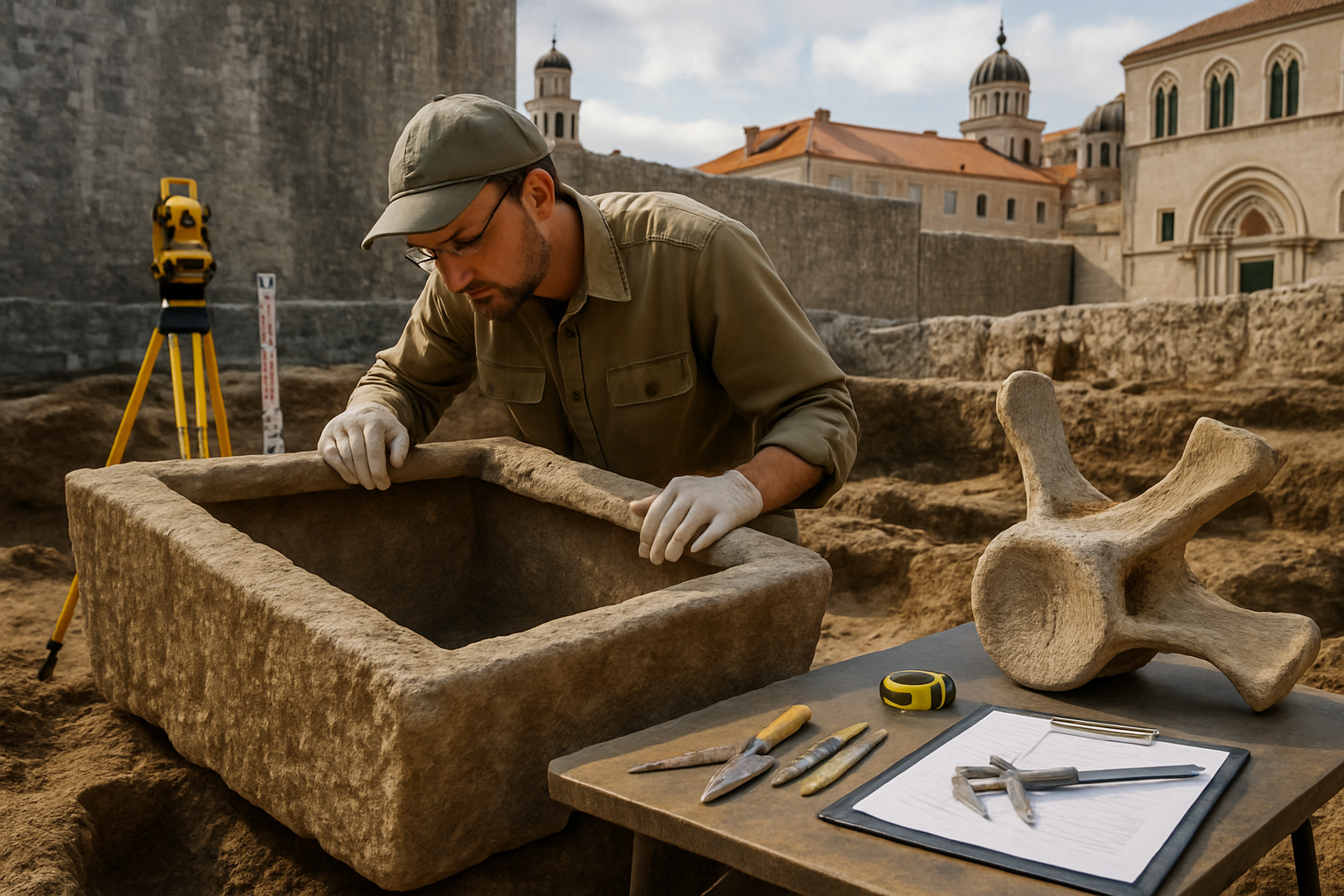
Two remarkable archaeological discoveries on opposite sides of the globe are providing new insights into both ancient human civilizations and prehistoric marine life, as Croatia's historic Dubrovnik unveiled a significant ancient sarcophagus while Australia completed one of its most challenging fossil excavations in Victoria's Bellarine Peninsula.
The discoveries, announced simultaneously on February 26, 2026, represent the continuing global archaeological renaissance that has characterized recent months, with sophisticated analytical techniques and international cooperation producing unprecedented insights into Earth's deep history.
Dubrovnik's Ancient Burial Chamber
In the heart of Croatia's UNESCO World Heritage city of Dubrovnik, archaeologists have made a major discovery that promises to shed new light on the region's ancient past. A large sarcophagus, measuring approximately two meters in length, has been uncovered in the historic center during routine construction work, marking one of the most significant archaeological finds in the area in recent decades.
The discovery represents the first major late antiquity burial chamber found within Dubrovnik's historic core, offering researchers an unprecedented window into the region's post-Roman period. Initial assessments suggest the sarcophagus dates to between the 4th and 6th centuries AD, a crucial transitional period when the area was evolving from Roman administrative control into the early medieval Adriatic cultural sphere.
"This discovery is extraordinary not just for its preservation, but for its location," explained Dr. Marija Petrović, lead archaeologist with the Croatian Conservation Institute. "Finding such an intact burial structure within the historic city center provides us with invaluable context about how ancient communities organized their sacred spaces and burial practices."
The sarcophagus appears to be carved from local limestone, demonstrating the sophisticated stoneworking capabilities of late antiquity craftspeople in the region. Preliminary examinations reveal intricate decorative elements that suggest the burial was intended for a person of significant social standing, possibly a local administrator or religious figure.
Australia's Prehistoric Marine Giant
Meanwhile, on Australia's Bellarine Peninsula in Victoria, marine archaeologists have successfully completed what researchers describe as one of the largest and most technically challenging excavations in the state's history. The target: a 21-million-year-old whale fossil that promises to unlock crucial answers about the evolution of these marine giants.
The fossilized remains, discovered along the coastline near Ocean Grove, represent an exceptionally rare specimen from the Miocene epoch, a period crucial to understanding how modern whale species evolved from their ancient predecessors. The fossil's size and exceptional preservation have excited paleontologists worldwide, who believe it may represent a previously unknown species or provide unprecedented insights into whale evolutionary biology.
"This discovery represents a true time capsule from an era when Australia's coastlines looked dramatically different," said Professor Sarah Mitchell, a marine paleontologist from Melbourne University who led the excavation team. "The level of preservation is extraordinary, and the size of this specimen suggests we're dealing with one of the larger marine predators of its time."
The excavation required specialized equipment and techniques to carefully extract the massive fossil from the coastal rock formations without damage. Team members worked for months using precision tools, 3D mapping technology, and careful chemical analysis to ensure every fragment was preserved for future study.
Scientific Context and Global Significance
These discoveries come at a time when archaeological and paleontological research is experiencing unprecedented productivity through the combination of traditional fieldwork expertise with cutting-edge analytical technologies. Both Croatian and Australian teams employed advanced techniques that would have been impossible just a decade ago.
In Dubrovnik, researchers are using ground-penetrating radar and digital imaging to map the complete extent of the burial site without disturbing surrounding structures. Chemical analysis of the sarcophagus materials will provide precise dating and information about ancient quarrying and construction techniques.
The Australian whale fossil is undergoing CT scanning and isotope analysis that will reveal details about the ancient marine ecosystem, including ocean temperatures, food chains, and migration patterns during the Miocene period. These insights have implications for understanding both evolutionary biology and current climate change impacts on marine ecosystems.
Broader Archaeological Renaissance
Both discoveries contribute to what researchers are calling the "February 2026 Archaeological Renaissance," a period characterized by remarkable finds across multiple continents. Recent months have seen breakthrough discoveries ranging from ancient human migration evidence to sophisticated early civilizations, all enhanced by improving international cooperation and analytical capabilities.
Dr. Elena Rodriguez, an archaeological coordinator with the European Archaeological Research Consortium, noted the significance of simultaneous discoveries. "What we're seeing is not just individual spectacular finds, but a coordinated global effort to understand our planet's history. The techniques developed for one discovery often benefit research at sites thousands of kilometers away."
The Croatian discovery adds to growing evidence of sophisticated late antiquity communities throughout the Mediterranean, while the Australian fossil contributes to understanding how marine ecosystems evolved during crucial climatic transitions millions of years ago.
Preservation and Future Research
Both sites face the ongoing challenge of balancing research opportunities with preservation requirements. In Dubrovnik, the discovery has temporarily halted planned construction while archaeologists determine the full extent of the site. Croatian authorities are working with UNESCO representatives to ensure the find is properly integrated into the city's World Heritage management plans.
The Australian fossil faces different challenges, primarily related to coastal erosion and climate change impacts that threaten similar sites along the country's extensive coastline. The successful excavation provides a model for rapid response to discoveries in environments under environmental pressure.
Future research will involve international collaboration, with Croatian specimens potentially traveling to specialized laboratories for comparative analysis, while Australian fossil materials will be studied by marine evolution experts worldwide. Digital documentation is ensuring that insights from both discoveries remain accessible to researchers globally.
Implications for Understanding the Past
These discoveries represent different but complementary approaches to understanding Earth's history. The Dubrovnik sarcophagus provides insights into human social organization, religious practices, and technological capabilities during a crucial transitional period in European history. The Australian whale fossil offers evidence about environmental conditions and evolutionary processes that shaped life on Earth millions of years ago.
Together, they demonstrate the remarkable diversity of information that archaeological and paleontological research can provide about our planet's past. From ancient burial practices to prehistoric marine ecosystems, these discoveries contribute to the growing body of knowledge that helps us understand both human development and the broader context of life on Earth.
As analysis continues, both discoveries are expected to yield additional insights that will influence academic understanding and potentially inspire new research directions in their respective fields. The February 2026 finds stand as testament to the continued potential for archaeological discovery to surprise, educate, and inspire our understanding of the deep past.