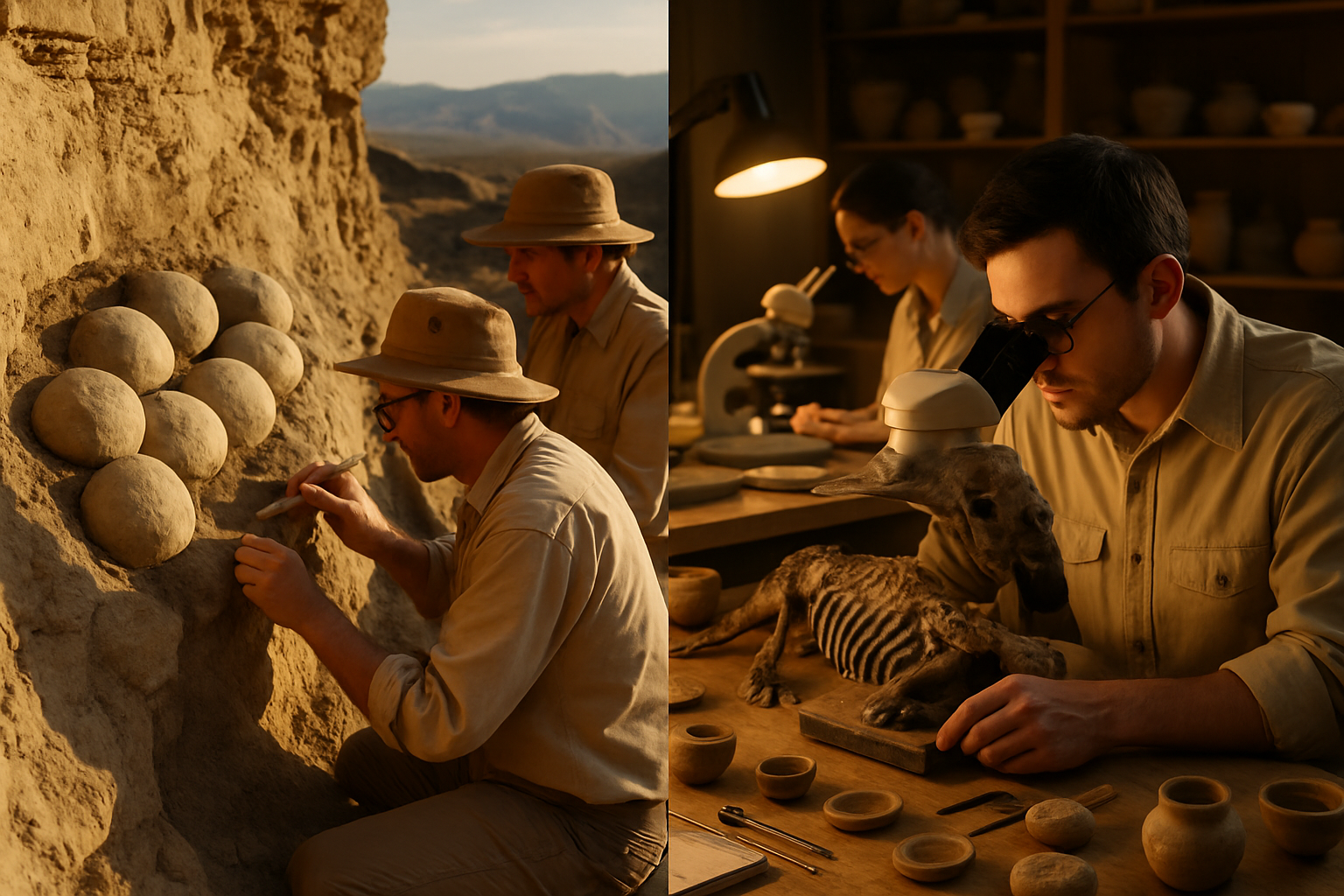
Three revolutionary archaeological discoveries spanning Argentina, Bulgaria, and Canada are rewriting our understanding of prehistoric life and ancient civilizations, with findings dating from 290 million years ago to medieval times revealing extraordinary insights into Earth's distant past.
The simultaneous discoveries represent a remarkable convergence of paleontological and archaeological breakthroughs that demonstrate the continuing potential for transformative scientific revelations. From pristine dinosaur nests preserved for 150 million years to the world's oldest fossilized predator vomit, these findings are providing scientists with unprecedented windows into prehistoric ecosystems and ancient human societies.
Argentina's Pristine Dinosaur Nest Discovery
In a stunning paleontological breakthrough, researchers in Argentina have uncovered an intact dinosaur nest containing 10 perfectly preserved eggs embedded in a cliff face for approximately 150 million years. The discovery, announced by Clarín, represents one of the most significant dinosaur nesting sites ever found in South America.
According to the research team, the careful arrangement of the eggs provides compelling evidence that this was not an accidental accumulation of fossilized remains, but rather an original nest constructed by a dinosaur during the Jurassic period. The positioning and organization of the eggs within the rock formation demonstrate deliberate nesting behavior, offering rare insights into dinosaur reproductive strategies.
"The disposition of the eggs indicates that this is not an accidental accumulation, but an original nesting site created by a dinosaur."
— Argentine Research Team
The pristine preservation of the nest site allows paleontologists to study not only the eggs themselves but also the surrounding geological context, providing valuable information about the environmental conditions during the Jurassic period. This discovery adds to Argentina's already impressive roster of paleontological finds and reinforces the country's position as one of the world's premier locations for dinosaur research.
Bulgaria's Archaeological Renaissance
Meanwhile, in Bulgaria, the National Archaeological Institute with Museum at the Bulgarian Academy of Sciences (NAIM-BAN) has presented the nineteenth edition of their traditional "Bulgarian Archaeology" exhibition, showcasing over 300 artifacts from 31 archaeological sites spanning the breadth of Bulgarian civilization.
The exhibition represents far more than a simple accounting of the past season's work—it constitutes a comprehensive panorama of Bulgarian history that takes visitors on a journey through time, from prehistoric settlement mounds at Provadiya and Yunatsite to the aristocratic splendor of Pliska, Tarnovgrad, and Kaliakra.
This year's collection includes several standout discoveries that have captured the attention of both archaeologists and the public. The exhibition demonstrates the sophisticated technological and artistic achievements of ancient Bulgarian civilizations, with artifacts spanning thousands of years of human occupation in the region.
The carefully curated display connects prehistoric communities with medieval kingdoms, illustrating the continuous thread of human settlement and cultural development in the Bulgarian lands. These discoveries contribute to our understanding of how ancient civilizations adapted to changing environmental and political conditions over millennia.
Canada's Revolutionary Prehistoric Discovery
Perhaps the most unusual and groundbreaking discovery comes from Canada, where researchers from the University of Manitoba have identified what may be the world's oldest fossilized predator vomit. At nearly 290 million years old, this extraordinary specimen offers unique insights into predator-prey relationships long before the age of dinosaurs.
Paleontologist Mark MacDougall describes the find as providing direct evidence of predator-prey relationships preserved in what he calls a "prehistoric time capsule." The fossilized regurgitate contains identifiable remains of prey animals, allowing scientists to reconstruct ancient food webs and ecological relationships with unprecedented detail.
"The find provides direct evidence of predator-prey relationships in a prehistoric time capsule."
— Mark MacDougall, Paleontologist
This discovery is simultaneously groundbreaking and, as researchers note with some humor, somewhat gross. However, the scientific value of fossilized predator vomit cannot be overstated. Such preservation is extremely rare, making this specimen invaluable for understanding how ancient terrestrial ecosystems functioned before the evolution of dinosaurs.
The 290-million-year-old specimen predates dinosaurs by millions of years, offering a glimpse into Paleozoic predator behavior and ecosystem dynamics. The research provides evidence of complex predator-prey relationships in early terrestrial environments and helps scientists understand how these ancient ecosystems were structured.
Scientific Methodology and International Cooperation
These discoveries exemplify the sophisticated methodological approaches that characterize modern archaeological and paleontological research. The Argentine dinosaur nest investigation employed advanced geological analysis and careful excavation techniques to preserve the site's integrity while extracting maximum scientific information.
Bulgarian archaeologists have combined traditional excavation methods with cutting-edge analytical techniques, including advanced imaging and chemical analysis, to understand the cultural and technological sophistication of ancient Bulgarian civilizations. The comprehensive nature of the NAIM-BAN exhibition demonstrates how individual discoveries contribute to broader understanding of human cultural evolution.
The Canadian research required specialized techniques for analyzing ancient organic materials preserved in extraordinary circumstances. The identification and analysis of 290-million-year-old predator vomit demanded innovative approaches to studying prehistoric biological materials that push the boundaries of paleontological methodology.
Global Context and Future Research
These discoveries occur within a broader context of archaeological and paleontological research renaissance taking place globally. As I documented in previous analysis, February 2026 has witnessed an unprecedented number of significant archaeological discoveries across multiple continents, from fire control evidence challenging human evolution timelines to ancient bacteria with modern medical applications.
The convergence of advanced analytical techniques, international cooperation, and systematic fieldwork is producing remarkable results. DNA analysis, isotope studies, advanced imaging, and sophisticated dating methodologies are revealing previously hidden aspects of both human and natural history.
The economic and educational benefits of these discoveries extend far beyond academic interest. Archaeological tourism, international research collaboration, and enhanced understanding of human adaptation provide practical benefits for contemporary society while enriching our understanding of our place in Earth's history.
Implications for Understanding Earth's History
Together, these three discoveries represent different aspects of Earth's deep history—from the evolution of complex life forms through dinosaur reproduction strategies, to the development of human civilizations, to the functioning of ancient ecosystems. They demonstrate the remarkable preservation potential of geological processes and the continuing capacity for scientific discovery to surprise and inform us.
The temporal span covered by these discoveries—from 290 million years ago to medieval times—illustrates the vast scope of scientific inquiry and the interconnected nature of life on Earth. Each discovery contributes pieces to the larger puzzle of how life has evolved and adapted over geological time.
As climate change and environmental pressures continue to affect archaeological sites and fossil deposits worldwide, the urgency of systematic excavation and preservation efforts becomes increasingly apparent. These discoveries remind us that much of Earth's history remains hidden and that continued investment in archaeological and paleontological research yields unprecedented insights into our planet's past and, by extension, its future.