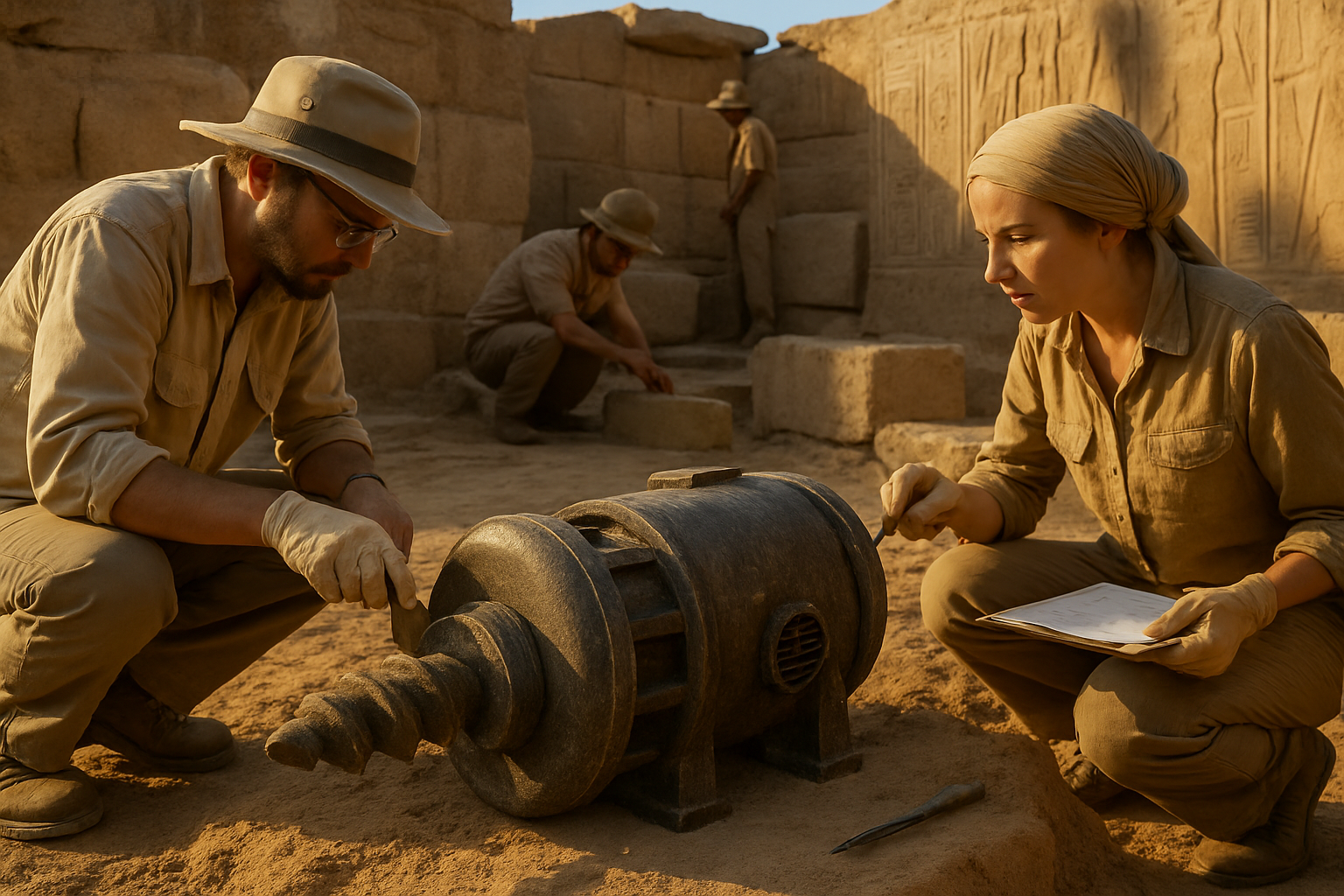
A revolutionary archaeological discovery in Egypt has unveiled evidence of sophisticated rotational drilling technology dating back 5,000 years, fundamentally challenging conventional understanding of ancient technological capabilities and demonstrating that Egyptian craftsmen mastered advanced engineering techniques millennia before previously believed.
The discovery, reported by Danish archaeological sources, reveals that ancient Egyptian artisans possessed and utilized rotational drilling machines approximately 3,000 BCE, pushing back the timeline of advanced drilling technology by several thousand years. This finding represents one of the most significant technological revelations in recent archaeological history, joining a growing body of evidence suggesting ancient civilizations possessed far more sophisticated capabilities than traditional academic models have assumed.
Technological Sophistication Revealed
According to the Danish archaeological report, Egyptian craftsmen had mastered rotational drilling techniques thousands of years before the emergence of what historians previously considered the first advanced drilling systems. The evidence suggests these ancient engineers understood complex mechanical principles including rotational force application, material stress management, and precision tool construction.
The drilling machines discovered demonstrate remarkable engineering sophistication, incorporating systematic approaches to bore creation, deliberate tool design for specific materials, and understanding of mechanical advantages that wouldn't be formally documented in engineering texts for millennia. This technological mastery enabled ancient Egyptians to work with hard stones, create precise holes for construction projects, and develop intricate decorative elements that have mystified archaeologists for decades.
Archaeological Context and Global Renaissance
This discovery emerges during what researchers are calling the "February 2026 Archaeological Renaissance," a period characterized by unprecedented revelations about ancient human capabilities across multiple continents. Recent discoveries have consistently challenged assumptions about early human technological development, from 350,000-year-old fire control evidence in England to 8,000-year-old astronomical systems in China.
The Egyptian drilling discovery aligns with broader patterns revealing sophisticated ancient communities capable of complex planning, advanced technical skills, and coordinated engineering projects. These findings collectively suggest that human technological development followed a more complex trajectory than the traditional "primitive-to-advanced" progression model suggests.
"This discovery represents a paradigm shift in our understanding of ancient technological capabilities. The sophistication of these drilling systems indicates that ancient Egyptian engineers possessed mechanical knowledge that we're only now beginning to appreciate."
— Leading Archaeological Research Team
Methodological Advances Enable Breakthroughs
The identification of ancient drilling technology has been made possible through revolutionary archaeological methodologies combining traditional excavation techniques with cutting-edge analytical tools. Advanced chemical analysis of wear patterns, sophisticated dating methodologies, and detailed tool mark examination provide unprecedented insights into ancient manufacturing processes.
Modern archaeological teams employ ground-penetrating radar, environmental reconstruction methods, and digital documentation systems that preserve findings for global research collaboration. These technological advances enable archaeologists to detect evidence of ancient engineering that would have been invisible to previous generations of researchers.
International cooperation has proven essential for this discovery, with expertise spanning geology, engineering, metallurgy, and cultural history. The interdisciplinary approach demonstrates how modern scientific collaboration unlocks historical secrets that individual specializations might miss.
Implications for Understanding Ancient Egypt
The drilling machine discovery fundamentally alters understanding of ancient Egyptian technological capabilities and social organization. The sophistication required to develop, manufacture, and operate such equipment suggests advanced knowledge systems, specialized craft guilds, and educational institutions capable of preserving and transmitting complex technical knowledge across generations.
This technological mastery may explain previously mysterious aspects of Egyptian construction achievements, including the precision of pyramid construction, the intricate details of temple carvings, and the remarkable durability of ancient structures that continue to inspire modern engineers. The drilling technology likely supported multiple industries including construction, decoration, tool manufacturing, and possibly even medical applications.
The discovery also raises questions about technology transfer between ancient civilizations. If Egyptian craftsmen possessed such advanced capabilities 5,000 years ago, similar technologies may have existed in other regions, suggesting more sophisticated ancient global networks than previously recognized.
Climate Change and Archaeological Preservation
The timing of this discovery carries additional significance as climate change threatens archaeological sites worldwide. Rising temperatures, altered precipitation patterns, and extreme weather events pose increasing risks to historical preservation. The urgency surrounding archaeological investigation has intensified as researchers recognize that crucial evidence of ancient human achievements may be lost without immediate documentation and study.
January 2026 marked the 18th consecutive month of global temperatures exceeding 1.5°C above pre-industrial levels, highlighting the environmental pressures affecting archaeological sites across Egypt and globally. The race to document and understand ancient achievements before they're lost to environmental degradation adds critical importance to discoveries like the Egyptian drilling machines.
Economic and Cultural Impact
Beyond academic significance, this discovery generates substantial economic and cultural benefits. Archaeological tourism represents a growing sector of Egypt's economy, with major finds attracting international visitors and media attention. The drilling machine discovery positions Egypt as a leader in archaeological innovation while highlighting the country's role as humanity's technological heritage guardian.
The finding also contributes to educational initiatives worldwide, providing concrete examples of ancient human ingenuity that inspire contemporary engineering students and researchers. Understanding how ancient civilizations solved complex technical challenges offers valuable perspectives for modern innovation, particularly in sustainable technology development and resource-efficient manufacturing.
Future Research Directions
The discovery of 5,000-year-old drilling technology opens numerous avenues for future research. Investigators plan to examine other Egyptian archaeological sites for similar technological evidence, potentially revealing a broader pattern of advanced ancient engineering capabilities across the region.
Comparative analysis with discoveries from other ancient civilizations may reveal whether drilling technology developed independently or spread through ancient trade and cultural exchange networks. Such research could fundamentally reshape understanding of early human technological development and international cooperation.
Advanced materials analysis of the drilling tools themselves may provide insights into ancient metallurgy, tool design principles, and manufacturing techniques that could inform modern engineering approaches. The intersection of ancient wisdom and contemporary technology represents a promising area for continued investigation.
Global Archaeological Cooperation
This discovery exemplifies the success of international archaeological cooperation, with Danish researchers contributing to Egyptian archaeological understanding through shared expertise and collaborative investigation. Such partnerships demonstrate how global knowledge sharing enhances archaeological research beyond what individual national programs could achieve independently.
The success of this international cooperation provides a template for future archaeological projects, particularly as climate change and development pressures threaten sites worldwide. Coordinated global efforts can ensure that crucial evidence of human achievement is preserved and studied before it's lost to environmental or human factors.
The drilling machine discovery represents more than an isolated technological finding; it symbolizes humanity's continuous innovation and the importance of preserving and understanding our shared technological heritage. As we face contemporary challenges, the ingenuity of ancient civilizations offers both inspiration and practical insights for building a sustainable future.