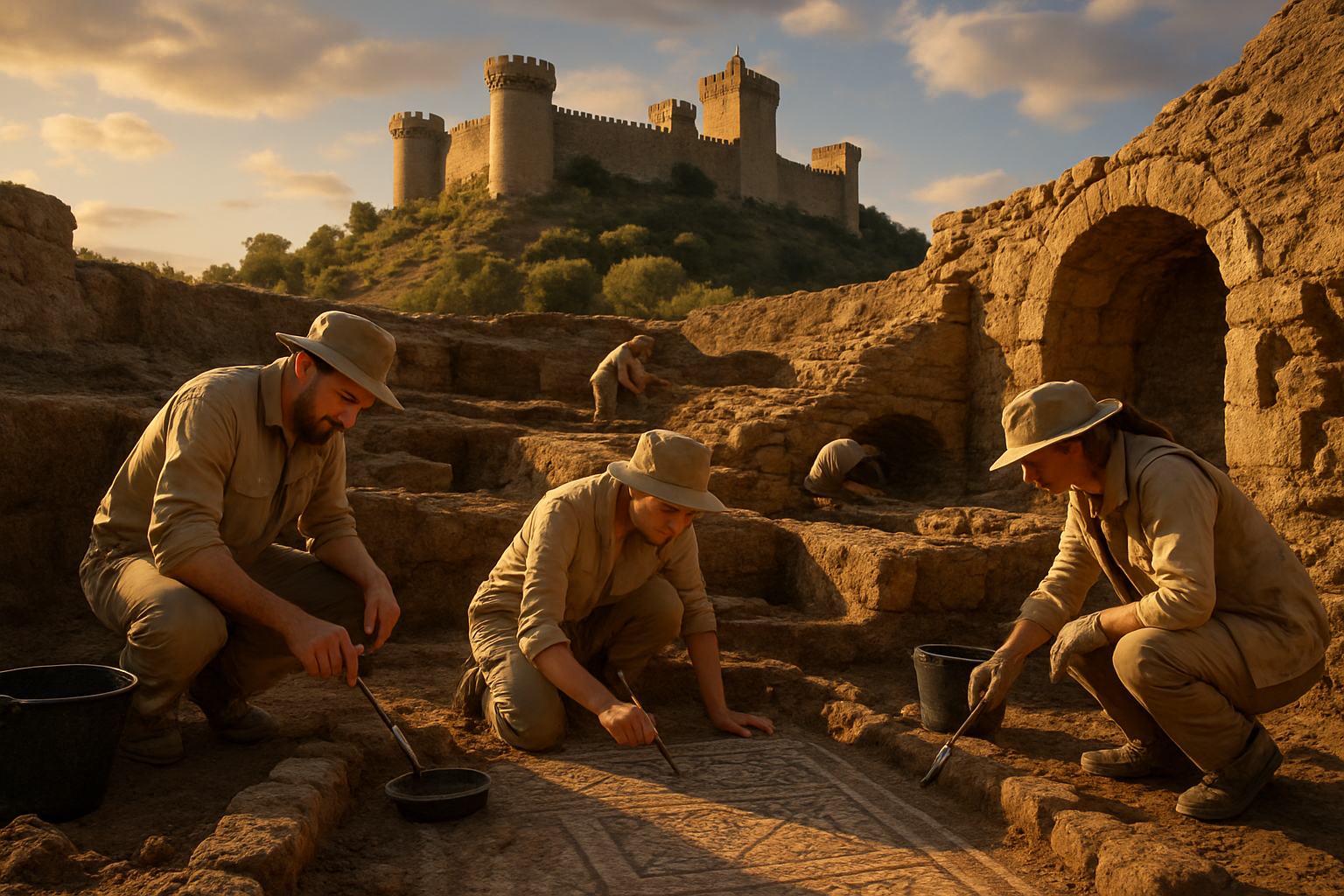
A wave of extraordinary archaeological discoveries across Europe is revealing forgotten chapters of our shared history, from Roman artifacts stolen during World War II to medieval fortress networks that once protected ancient trade routes.
Recent investigations spanning Austria, Bulgaria, and beyond are demonstrating how modern archaeological techniques combined with historical detective work are recovering lost treasures and uncovering connections between ancient civilizations that have remained hidden for centuries.
Roman Mosaic Returns Home After 80 Years
In a remarkable story of wartime theft and eventual justice, Austrian authorities have confirmed that an erotic Roman mosaic looted from Italy during World War II has finally been returned to its homeland. The intricate artwork, taken from a Roman villa by a member of the German Wehrmacht, represents one of countless cultural artifacts seized during the conflict that are only now finding their way home.
The mosaic's journey from its original Roman villa setting to modern restitution illustrates the complex challenges facing cultural heritage preservation. Advanced forensic analysis allowed experts to definitively identify the artwork's Italian origins, providing the evidence needed for successful repatriation.
"Each returned artifact represents not just a recovered treasure, but a restored piece of cultural identity that belongs to all humanity."
— Dr. Maria Petrovi?, Croatian Conservation Institute
This restitution comes as part of a broader European movement toward addressing historical injustices in museum collections and private art markets, with institutions increasingly taking proactive approaches to investigating artifact provenance and facilitating voluntary repatriations.
Bulgarian Fortress Networks Reveal Ancient Connections
Archaeological research in Bulgaria's Rhodope Mountains has uncovered fascinating parallels between the fortress of Peristerа near Peshtera and similar defensive structures near Bracigovo. Dr. Rosen Peevski's investigations have revealed that coins and jewelry discovered at both sites correspond in style and historical period, suggesting a coordinated network of medieval fortifications.
The discoveries indicate that what researchers initially viewed as isolated defensive positions were actually part of a sophisticated communication and trade network spanning the region. Advanced ground-penetrating radar and digital imaging techniques have revealed previously unknown defensive features and hidden chambers, demonstrating how modern technology enhances traditional archaeological methods while maintaining historical authenticity.
These findings are particularly significant as they challenge conventional narratives about medieval Bulgarian society, revealing complex stories of international trade, cultural exchange, and technological innovation that connected the Balkan Peninsula to broader European and Asian networks.
Youth Engagement in Cultural Heritage
Perhaps most encouraging is the growing engagement of young people in cultural preservation efforts. The "Wonders of Bulgaria" Youth Academy in Peshtera brought together over 100 students aged 11-17 to explore Rhodope legends and Bulgarian history, demonstrating how archaeological discoveries can inspire new generations of cultural guardians.
These educational initiatives, organized by the Cultural Heritage Society and other preservation organizations, are creating lasting connections between young people and their historical roots. The program combines traditional storytelling with cutting-edge archaeological techniques, showing students how ancient mysteries continue to unfold through modern scientific methods.
A Continental Renaissance in Discovery
These Bulgarian and Austrian discoveries are part of what researchers are calling the "2026 Archaeological Renaissance" - a period of unprecedented international coordination in cultural preservation and discovery. Similar breakthroughs across Europe include authenticated Rembrandt paintings dismissed for decades, Viking-era finds in Scandinavia, and Roman settlements revealed through climate change effects.
The convergence of advanced analytical techniques with traditional scholarship is producing remarkable results. DNA analysis, isotope studies, sophisticated imaging, and environmental reconstruction are revealing previously invisible aspects of ancient life, while international cooperation enables resource and expertise sharing that individual nations could not achieve alone.
Technology Meets Tradition
Modern archaeological success stories demonstrate how cutting-edge technology enhances rather than replaces human expertise and cultural understanding. Digital documentation creates permanent records accessible globally while respecting source communities, virtual reality enables immersive experiences without compromising artifact integrity, and advanced conservation techniques protect delicate materials while maintaining public accessibility.
The Austrian mosaic's authentication relied on advanced chemical analysis unavailable to previous generations, while Bulgarian fortress investigations employed ground-penetrating radar to reveal defensive features invisible to traditional excavation methods. Yet these technological tools remain in service of fundamentally human goals: understanding our shared past and preserving cultural heritage for future generations.
Climate Urgency Drives Preservation
Archaeological sites across Europe face unprecedented threats from climate change, with extreme weather, moisture fluctuations, and temperature changes causing accelerated deterioration of historic structures. This environmental pressure is driving urgent documentation and preservation efforts, as researchers race to record and protect sites before potential irreversible damage occurs.
The timing of recent discoveries takes on added significance as many archaeological treasures remain threatened by environmental factors beyond human control. January 2026 marked the 18th consecutive month of global temperatures exceeding 1.5°C above pre-industrial levels, emphasizing the critical importance of systematic excavation and preservation efforts.
Economic and Educational Impact
Cultural heritage preservation is proving to be strategic infrastructure equivalent to transportation, communication, and healthcare systems. Archaeological discoveries generate substantial economic benefits through cultural tourism, international media attention, and enhanced diplomatic relationships while creating employment across archaeology, conservation, museums, and tourism sectors.
The educational benefits extend beyond academic institutions to community engagement, with successful programs demonstrating how heritage preservation serves multiple functions: community bonding, economic development through cultural tourism, international cultural diplomacy, and intergenerational knowledge transfer.
Looking Forward: Templates for Global Stewardship
The success of European archaeological initiatives in 2026 is establishing precedents for 21st-century cultural stewardship that balance innovation with tradition, local authenticity with international cooperation, and economic viability with cultural integrity. These practical templates are proving adaptable across diverse cultural and economic contexts worldwide.
As archaeological methods continue to evolve and international cooperation deepens, the potential for future discoveries seems limitless. The Roman mosaic's return to Italy and the revelation of medieval Bulgarian fortress networks represent just the beginning of what promises to be a golden age of archaeological research and cultural heritage recovery.
The ongoing archaeological renaissance demonstrates that much of our human story remains hidden, requiring continued investment in research, international cooperation, and community engagement. Each discovery not only enriches our understanding of the past but provides valuable insights for addressing contemporary challenges through the wisdom and resilience of previous generations.