Revolutionary archaeological discoveries are rewriting the history of human cognitive development, with researchers uncovering evidence of symbolic communication systems that predate previously known writing by an astounding 40,000 years, while new genetic analysis reveals sophisticated social patterns between Neanderthals and early modern humans.
Two groundbreaking studies published this week fundamentally challenge established timelines of human intellectual evolution and social development, suggesting our ancestors possessed far more advanced cognitive capabilities than previously believed during the crucial period when Homo sapiens first encountered Neanderthals in Europe.
Revolutionary Writing Discovery in German Caves
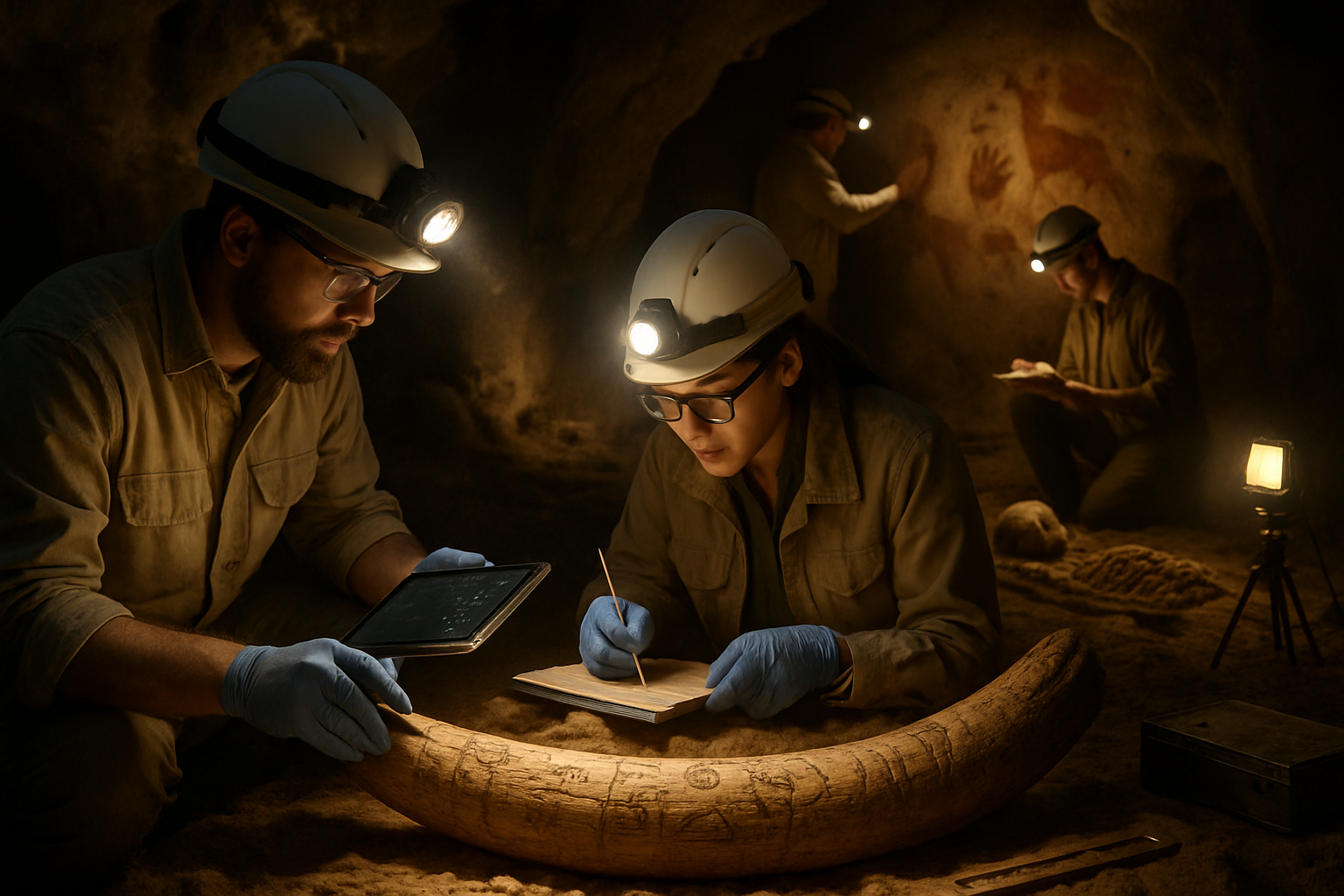
The most startling discovery comes from German archaeological sites, where researchers have identified what appears to be the world's oldest known symbolic communication system. Scientists examining artifacts from caves dating to approximately 45,000 years ago have discovered intricate patterns of lines, notches, dots, and crosses carved into mammoth tusks and other objects that suggest deliberate symbolic meaning.
Professor Christian Bentz from Saarland University, who led the research team, describes these markings as "an early alternative to writing" that fundamentally challenges our understanding of when humans first began recording thoughts and experiences. The discovery pushes back the timeline of symbolic communication by tens of thousands of years from the traditionally accepted proto-cuneiform scripts of ancient Mesopotamia, dated to around 5,000 years ago.
"The Stone Age sign sequences are an early alternative to writing. These patterns show deliberate symbolic meaning that predates anything we've seen before."
— Professor Christian Bentz, Saarland University
The artifacts were discovered in cave systems where early Homo sapiens lived just as they were beginning their expansion from Africa into Europe, a period when they first encountered established Neanderthal populations. While the precise meaning of these symbols remains mysterious, their systematic arrangement and recurring patterns suggest a sophisticated understanding of symbolic representation that challenges traditional narratives about the gradual development of human cognitive abilities.
Neanderthal-Human Social Dynamics Revealed
Complementing this discovery of early symbolic communication, new genetic research has unveiled sophisticated social patterns in prehistoric human interactions that occurred during the same general time period. Advanced X-chromosome DNA analysis conducted by an international team of Austrian, Swedish, and Singaporean researchers has revealed that Neanderthal males predominantly mated with modern human females during the crucial coexistence period between 45,000 and 28,000 years ago.
This research, led by Professor Lars Werdelin, challenges assumptions about random interbreeding between the two human species. The conspicuous absence of Neanderthal genes on X-chromosomes in modern human populations suggests these relationships followed specific social patterns rather than occurring through random encounters.
Perhaps most remarkably, the research suggests that Neanderthals may have possessed social qualities that made them attractive partners to early modern humans. Professor Werdelin's team proposes that Neanderthals may have been "more pleasant and generous" than their Homo sapiens contemporaries, possessing social characteristics that facilitated complex inter-group relationships.
Sophisticated Social Cognition in Prehistory
Both discoveries point to a common theme: early humans and their contemporaries possessed far more sophisticated cognitive and social capabilities than traditional evolutionary models suggested. The German cave symbols indicate advanced abstract thinking and symbolic representation, while the genetic evidence suggests complex social dynamics, mate selection preferences, and community acceptance of inter-group relationships.
These findings align with the broader pattern of archaeological discoveries throughout 2026, which have consistently revealed greater complexity in ancient human societies. From sophisticated fire control techniques discovered 350,000 years earlier than expected to evidence of advanced astronomical systems dating back 8,000 years, researchers are uncovering a picture of human development that emphasizes capabilities rather than limitations.
Advanced Archaeological Techniques Drive Discovery
The success of these investigations demonstrates the power of modern analytical techniques applied to historical materials. The German cave symbol study employed advanced chemical analysis of carving patterns, detailed stratigraphic analysis, and sophisticated dating methodologies to establish the age and intentionality of the markings.
Similarly, the Neanderthal-human interaction research utilized cutting-edge genetic sequencing, environmental reconstruction, and population modeling techniques that were unavailable to previous generations of researchers. These methodological advances are part of what scholars are calling the "2026 Archaeological Renaissance," characterized by international cooperation and the integration of traditional fieldwork with revolutionary analytical capabilities.
Implications for Human Evolution Theory
The convergence of these discoveries forces a fundamental reconsideration of human developmental timelines. The cave symbols suggest that symbolic thought and communication systems emerged much earlier than previously believed, while the genetic evidence indicates that social organization and cultural practices were sophisticated enough to support complex inter-group relationships with specific patterns and preferences.
Both findings challenge the traditional narrative of gradual human development from simple survival-focused behaviors to complex cultural practices. Instead, they suggest that advanced cognitive capabilities, symbolic thinking, and sophisticated social structures emerged much earlier in human history than conventional evolutionary models assumed.
Climate Change and Archaeological Urgency
These discoveries also highlight the urgent need for systematic archaeological preservation efforts. Many of the sites containing these ancient treasures face threats from climate change, development pressures, and natural deterioration. The German cave systems and the frozen deposits containing genetic materials require careful preservation to prevent the loss of invaluable historical information.
The international cooperation enabling these discoveries demonstrates the importance of collaborative research efforts that transcend national boundaries. Both research teams emphasize that major archaeological breakthroughs increasingly depend on interdisciplinary expertise, shared resources, and coordinated analysis that no single institution could accomplish independently.
Future Research Directions
Scientists involved in both discoveries emphasize that these findings represent the beginning rather than the conclusion of new research directions. The German cave symbols require extensive comparative analysis with similar markings from other European sites to understand the geographic distribution and cultural significance of these early symbolic systems.
Meanwhile, the genetic research methodology can be applied to investigating other aspects of prehistoric human behavior, including migration patterns, population dynamics, and cultural exchange during the crucial period when modern humans spread across Europe and Asia.
Both research teams are actively seeking additional funding and international partnerships to expand their investigations. The German cave research requires extensive excavation of additional sites to determine whether symbolic communication systems were widespread or limited to specific communities. The genetic research team plans to analyze DNA from additional ancient populations to understand the full scope of human-Neanderthal interactions across different regions and time periods.
Rewriting Human History
These February 2026 discoveries represent a watershed moment in understanding human development, suggesting that our species possessed remarkable cognitive and social capabilities much earlier than previously believed. The combination of symbolic communication systems from 45,000 years ago and sophisticated social dynamics during the same period paints a picture of early humans as intellectually and socially advanced beings rather than simple survival-focused creatures.
The research establishes a new foundation for understanding human development that emphasizes intellectual sophistication, cultural complexity, and social organization as fundamental characteristics of our species from its earliest European presence. Rather than viewing advanced capabilities as recent developments, these discoveries suggest that symbolic thinking and complex social relationships were integral to human success during our species' crucial expansion period.
As archaeological techniques continue to advance and international cooperation deepens, researchers anticipate additional discoveries that will further refine our understanding of early human capabilities. The pattern emerging from 2026's archaeological renaissance suggests that human intellectual and social sophistication has ancient roots, fundamentally changing how we understand our species' remarkable journey from African origins to global presence.