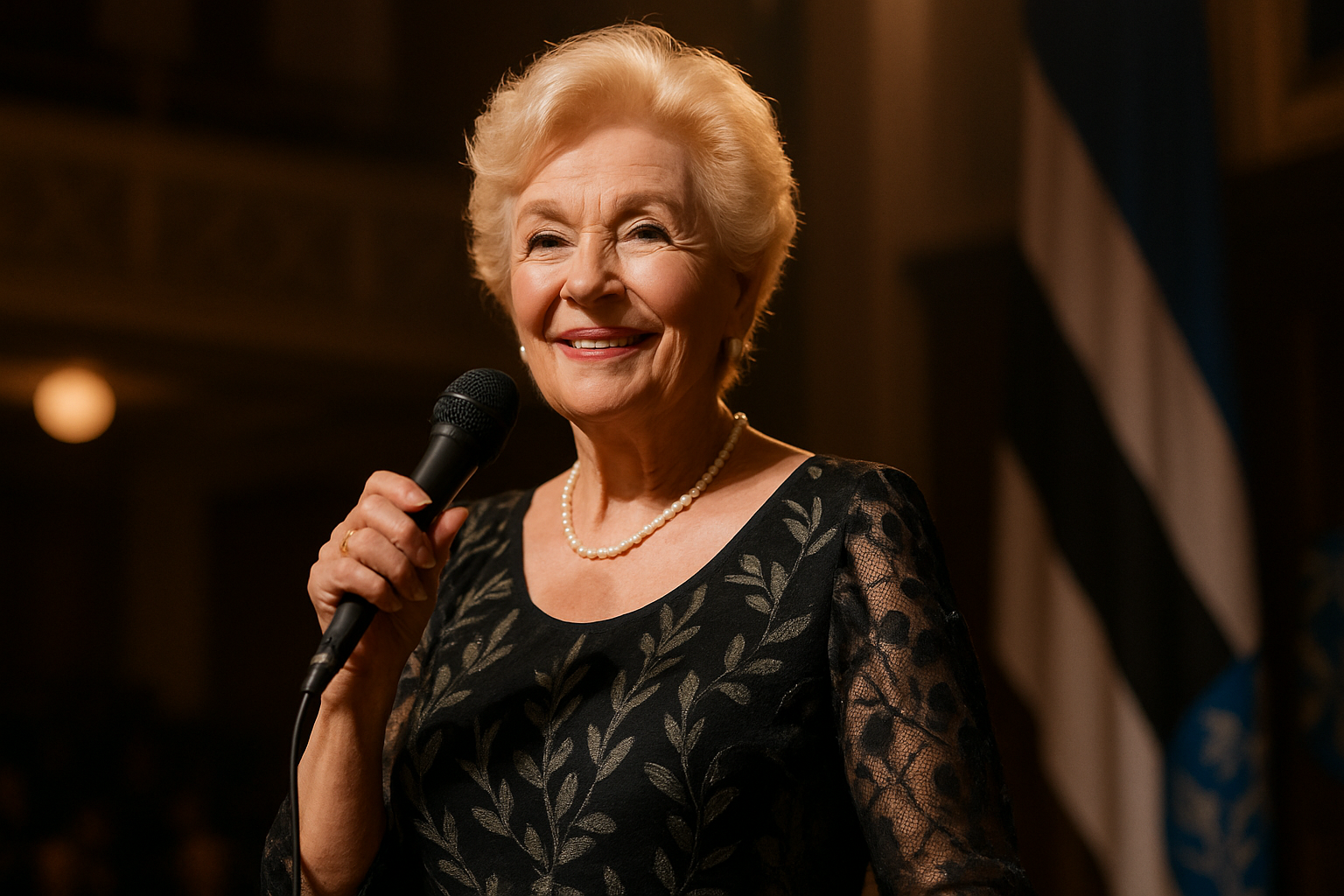
Anne Veski turns 70 today, marking seven decades of life for Estonia's most beloved pop star who spent decades filling concert halls from Tallinn to the Soviet heartland, yet remains virtually unknown in the English-speaking world.
In Estonia, Anne Veski is more than famous: she's part of the furniture, part of the weather, part of the national mood. Her voice has soundtracked generations of Estonian life, her performances have become cultural touchstones, and her influence extends far beyond music into the realm of social acceptance and LGBTQ+ advocacy. At 70, she remains a masterclass in performance and Estonia's biggest gay icon.
A Voice That Defined an Era
Veski's career began during the Soviet era, when the Baltic states were searching for cultural expression within the constraints of the communist system. She won what was arguably the Baltic's nearest thing to Eurovision, toured a vanished empire, and built her career on the radical idea that pop music should make people feel better. This philosophy would prove prescient, as her music became a source of joy and identity for millions across the Soviet Union.
Her success was not merely about entertainment; it was about representation. In a time when individual expression was often suppressed, Veski's flamboyant performances and unapologetic authenticity provided a beacon of hope for those who felt marginalized. Her concerts became safe spaces where audiences could experience freedom of expression, even if only for a few hours.
The Star the West Missed
Despite filling massive venues across Eastern Europe and the Soviet Union, Anne Veski's name draws blank stares in London, New York, or Los Angeles. This disconnect highlights the cultural isolation that existed during the Cold War era, where artistic talent on one side of the Iron Curtain remained largely invisible to the other side.
"Outside Estonia and its neighborhood, she's still a discovery waiting to happen."
— Estonian World
The reasons for this Western anonymity are complex. Language barriers, political divisions, and different music industry structures all played a role in keeping Soviet-era performers confined to their regional markets. Unlike some Eastern European artists who managed to break through to Western audiences, Veski's career peaked during a period when cultural exchange was minimal.
Cultural Icon and LGBTQ+ Trailblazer
Perhaps nowhere is Veski's impact more profound than in her role as an advocate for LGBTQ+ rights and acceptance. In a region where traditional values often clash with progressive ideals, she has consistently championed inclusivity and acceptance. Her flamboyant stage presence and unapologetic authenticity made her a natural icon for Estonia's LGBTQ+ community long before such advocacy was mainstream.
This aspect of her legacy connects her to the broader European cultural renaissance currently taking place. As documented in Eurovision 2026's "United by Queerness" exhibition in Vienna, there's a growing recognition of how entertainment figures have advanced social acceptance across Europe. Veski's decades-long advocacy predates many of these contemporary movements, making her a pioneer in using celebrity status for social progress.
The Enduring Appeal
What makes Anne Veski's story particularly compelling is her longevity and continued relevance. At 70, she remains active and engaged, her performances still drawing devoted audiences. This durability speaks to something deeper than mere nostalgia – it suggests an artist who has managed to evolve while maintaining her core identity.
Her career trajectory mirrors that of many Eastern European artists who came of age during the Soviet era. Like them, she navigated complex political landscapes, censorship, and economic upheaval. Unlike many, she emerged with her artistic integrity intact and her popularity undiminished.
A Missing Piece of Global Pop History
Veski's story illuminates a broader gap in how we understand global popular culture. The Western music industry's historical focus on English-language markets meant that entire musical traditions and their biggest stars remained invisible to international audiences. This created a distorted picture of 20th-century popular music that is only now being corrected.
The current cultural renaissance documented across Europe in February 2026 – from Estonia's Station Narva festival to the broader Eurovision cultural diplomacy initiatives – suggests a growing appetite for discovering these "missing" artists and cultural traditions. Veski's career provides a perfect case study of what the world missed during decades of cultural division.
Legacy and Influence
As Estonia celebrates its place in the European cultural community, figures like Anne Veski represent bridges between the Soviet past and the democratic present. Her career spans multiple political systems, artistic movements, and social changes, making her a living repository of Estonian cultural history.
Her influence extends beyond Estonia's borders, inspiring artists across the Baltic region and former Soviet states. The values she championed – authenticity, acceptance, and the power of music to heal – remain as relevant today as they were during her career's peak.
Today, as Anne Veski celebrates her 70th birthday, Estonia honors not just an entertainer, but a cultural ambassador who helped define what it means to be Estonian. Her story serves as a reminder that talent and influence don't always translate across linguistic or political boundaries, and that sometimes the most significant artists are those whose impact is felt most deeply within their own communities.
In a world increasingly interested in diverse voices and previously overlooked talents, Anne Veski's story suggests that some discoveries are worth waiting for, even if they come decades later than they should have.