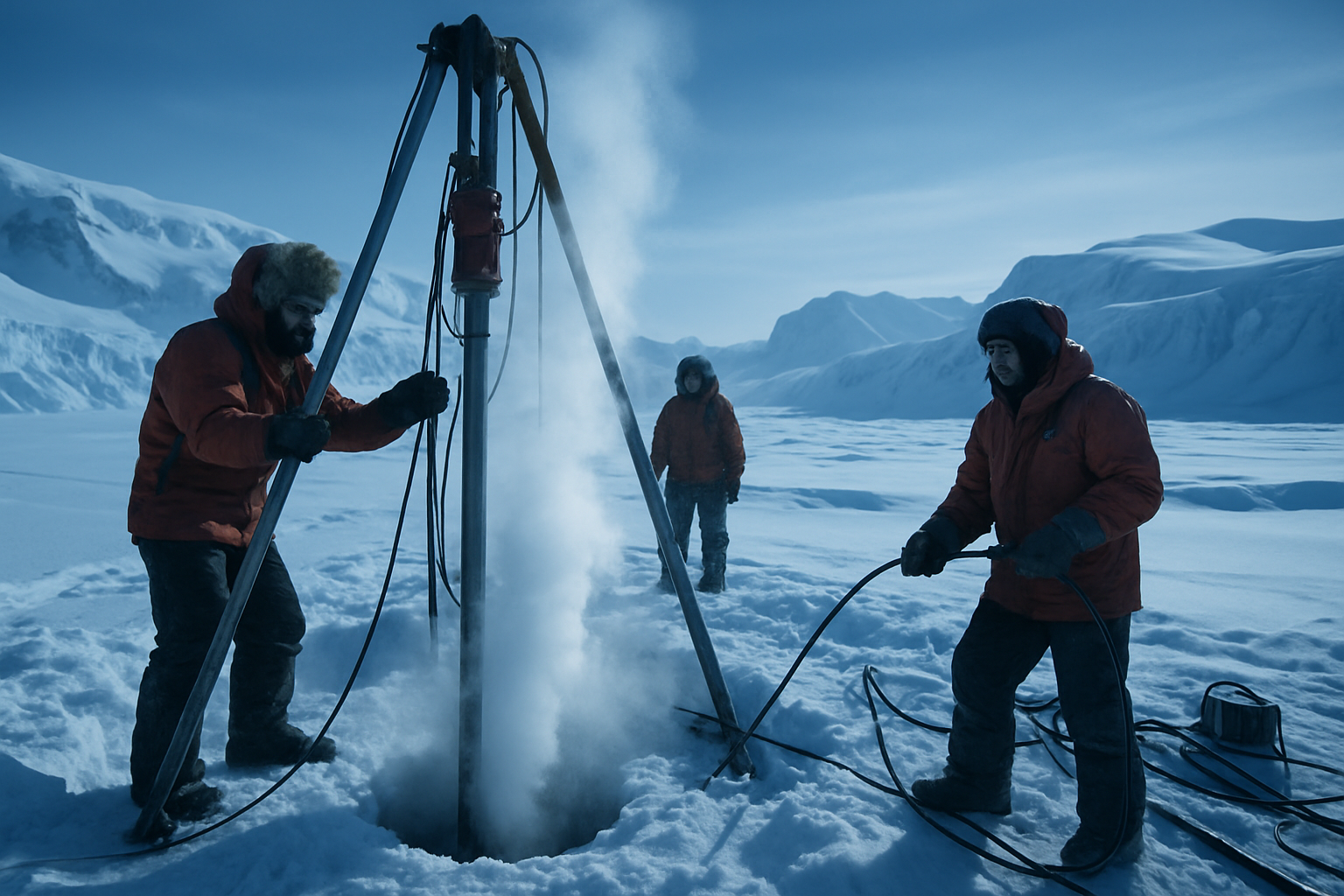
Scientists have successfully drilled 523 meters through Antarctic ice at Crary Ice Rise, extracting a remarkable 228-meter sediment core that preserves an extraordinary record of environmental changes spanning the past 23 million years, including evidence of ancient warm periods that could provide critical insights into how ice sheets respond to climate change.
The groundbreaking drilling operation took place on the edge of the West Antarctic Ice Sheet, at a remote location 700 kilometers from the nearest research stations. This unprecedented achievement represents one of the most significant advances in paleoclimate research in recent years, offering scientists invaluable data about Earth's climate history during a period when global temperatures have reached alarming new heights.
Unlocking Millions of Years of Climate Secrets
The extracted sediment core functions as a natural time machine, preserving detailed records of ancient climate conditions in its layers. Each stratum contains microscopic fossils, chemical signatures, and geological markers that tell the story of how the Antarctic ice sheet has responded to past climate variations over geological timescales.
The core's 23-million-year record encompasses multiple ice ages, interglacial periods, and crucially, ancient warm periods that serve as natural laboratories for understanding how ice sheets behave under elevated temperatures. This historical perspective is particularly valuable as scientists work to predict how the West Antarctic Ice Sheet and the massive Ross Ice Shelf might respond to current global warming trends.
"This discovery provides scientists with vital information about how the ice sheet and Ross Ice Shelf could react to global warming."
— Research Team Statement
Technological Marvel in Extreme Conditions
The drilling operation itself represents a remarkable feat of engineering and logistics. Working in one of Earth's most hostile environments, researchers had to transport sophisticated drilling equipment across hundreds of kilometers of Antarctic terrain, then operate it in temperatures that can plummet to -40°C with winds exceeding 200 kilometers per hour.
The 523-meter drilling depth required penetrating through multiple layers of ice accumulated over millennia. Each meter revealed different time periods, with the deepest sections containing the oldest climate records. The precision required to extract an intact 228-meter core without contamination demonstrates the advanced state of modern polar research technology.
Critical Context: Climate Emergency Accelerates
This research comes at a crucial moment in Earth's climate history. January 2026 was confirmed as the hottest month ever recorded, marking the 18th consecutive month of global temperatures exceeding 1.5°C above pre-industrial levels. This sustained warming has overridden natural climate variability, including La Niña cooling effects, demonstrating that human-induced climate change has fundamentally altered atmospheric systems.
The timing makes the Antarctic findings particularly urgent. As current global temperatures reach levels not seen in millions of years, the ancient climate records preserved in this sediment core provide essential baseline data for understanding how ice sheets respond to rapid warming. The West Antarctic Ice Sheet alone contains enough frozen water to raise global sea levels by several meters if it were to collapse.
International Antarctic Research Collaboration
The successful drilling operation builds upon decades of international cooperation in Antarctic research. The project connects to a broader network of climate monitoring initiatives across the continent, from Argentina's 122-year continuous Antarctic presence to Bulgaria's recent establishment of meteorological laboratories on Livingston Island.
This international framework, coordinated through the Scientific Committee on Antarctic Research (SCAR) and the Antarctic Treaty System, ensures that critical climate data is shared globally. The collaboration represents one of science's most successful examples of peaceful international cooperation, with nations working together to understand planetary systems that affect all humanity.
Ancient Warm Periods Hold Future Clues
Among the most significant aspects of this discovery are the preserved records of ancient warm periods. These natural experiments from Earth's past provide crucial insights into ice sheet dynamics during times of elevated global temperatures. By analyzing how the Antarctic ice responded to historical warming events, scientists can refine their models for predicting future changes.
The sediment layers contain evidence of periods when global temperatures were similar to or higher than current projections for the coming decades. This historical data reveals how quickly ice sheets can change, how they recover from warm periods, and what threshold temperatures might trigger irreversible melting processes.
Implications for Global Sea Level Rise
The research has profound implications for coastal communities worldwide. The West Antarctic Ice Sheet and Ross Ice Shelf system represents one of the most vulnerable components of the global ice system. Understanding their historical behavior provides essential information for predicting future sea level rise, which threatens hundreds of millions of people living in coastal areas.
The 23-million-year record allows scientists to examine ice sheet behavior over multiple climate cycles, providing a much longer perspective than previous research efforts. This extended timeline helps distinguish between short-term fluctuations and long-term trends, critical for developing accurate predictive models.
Advanced Analysis Techniques
The sediment core analysis employs cutting-edge laboratory techniques that can extract detailed information from tiny samples. Researchers use isotope analysis to determine ancient temperatures, examine microscopic marine organisms to understand ocean conditions, and study geological markers to track ice sheet extent and behavior.
These sophisticated analytical methods allow scientists to reconstruct not just what happened millions of years ago, but when changes occurred, how rapidly they took place, and what environmental conditions triggered them. This level of detail is essential for understanding the mechanisms that control ice sheet dynamics.
Connection to Current Climate Research
The Antarctic drilling project connects to a global network of climate research initiatives responding to accelerating environmental change. From the Netherlands' advanced polar monitoring systems to Romanian discoveries of ancient bacteria in ice caves, scientists worldwide are racing to understand Earth's changing climate systems.
This coordinated international effort reflects the urgency of the climate crisis. With global temperatures continuing to rise and environmental systems approaching critical thresholds, research projects like the Antarctic drilling provide essential data for informed decision-making about climate adaptation and mitigation strategies.
Future Research Directions
The successful extraction of the 228-meter sediment core opens new avenues for Antarctic climate research. Scientists will spend years analyzing the samples, with each layer potentially revealing new insights about past climate conditions and ice sheet behavior.
Future drilling projects may target other locations across Antarctica, building a comprehensive picture of how the entire continental ice system has responded to climate changes throughout Earth's history. This research network could provide the detailed understanding needed to predict how Antarctic ice will respond to continued global warming.
Global Significance
The breakthrough at Crary Ice Rise represents more than a technical achievement in polar research. It provides humanity with a crucial window into Earth's climate past, offering guidance for navigating an uncertain climate future. As global temperatures continue rising and ice sheets face unprecedented stress, this 23-million-year climate record serves as both a warning and a guide.
The project exemplifies international cooperation at its best, with scientists from multiple nations working together to generate knowledge that benefits all humanity. In an era of accelerating climate change, such collaborative research efforts provide hope that scientific understanding can inform effective responses to one of the greatest challenges facing our planet.