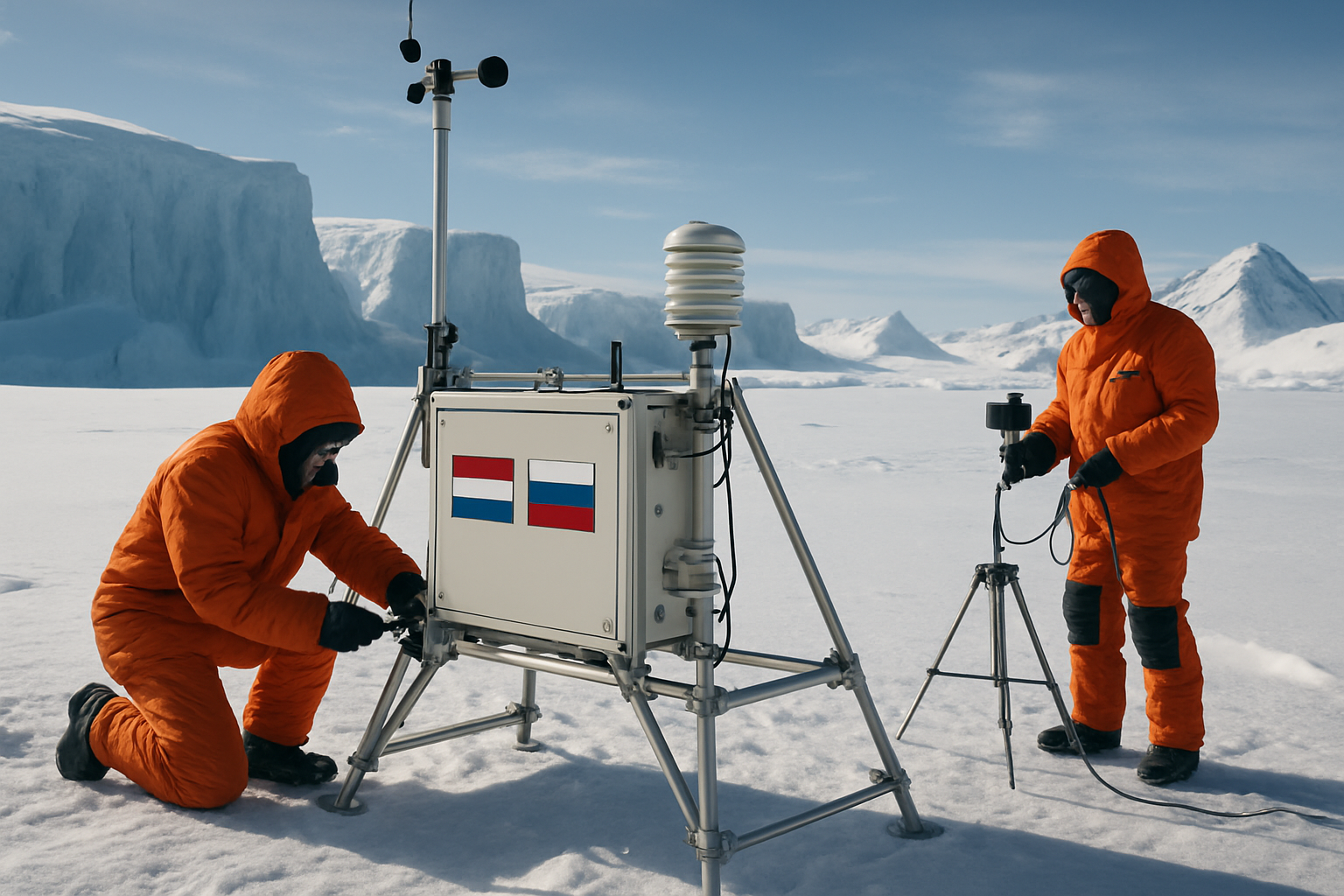
A convergence of cutting-edge technology and ancient discoveries is revolutionizing scientific understanding as Dutch researchers deploy advanced climate monitoring equipment in Antarctica while Russian scientists uncover millennia-old pathogens from frozen cave systems, creating unprecedented opportunities for climate research and medical breakthroughs.
The simultaneous developments represent the latest chapter in humanity's quest to understand Earth's most extreme environments and their hidden secrets. As global temperatures continue their unprecedented rise—with January 2026 marking the 18th consecutive month exceeding 1.5°C above pre-industrial levels—these research initiatives provide critical insights into both ancient climate patterns and contemporary climate change dynamics.
Dutch Innovation Transforms Antarctic Climate Monitoring
The Netherlands has successfully installed sophisticated new equipment across Antarctica's research stations, establishing what scientists describe as the most advanced polar climate monitoring network ever deployed. The Dutch equipment, designed specifically for Antarctica's extreme conditions, represents a significant technological leap in climate data collection capabilities.
"This equipment allows us to monitor climate variables with unprecedented precision and real-time data transmission," explained Dr. Sarah van der Berg, lead researcher with the Dutch Antarctic Program. "We're capturing atmospheric, ice sheet, and oceanic data that will fundamentally improve our understanding of how Antarctica influences global climate systems."
The new monitoring systems integrate advanced sensors capable of operating in temperatures below -70°C, wind speeds exceeding 200 km/h, and complete darkness during polar winter. The technology includes innovative power management systems utilizing both solar arrays and wind generation, ensuring continuous operation throughout Antarctica's extreme seasonal variations.
Russian Cave Discovery Reveals Ancient Microbial Secrets
Meanwhile, Russian researchers have made a startling discovery in ice caves, recovering ancient bacterial strains that challenge current understanding of microbial survival and antibiotic resistance. The research, building on previous Romanian discoveries of 5,000-year-old bacteria, reveals microorganisms that have survived in frozen conditions for millennia.
The Russian team, working in collaboration with international microbiologists, extracted samples from ice cave systems that have remained frozen for thousands of years. Initial analysis suggests these ancient microorganisms possess unique survival mechanisms that could provide insights into both prehistoric climate conditions and contemporary medical challenges.
"What we're discovering contradicts our fundamental assumptions about microbial survival in extreme environments," noted Dr. Elena Volkov, a microbiologist with the Russian Academy of Sciences. "These organisms have developed survival strategies that predate human civilization, yet they may hold keys to addressing modern medical challenges."
Climate Change Urgency Drives Research Innovation
Both research initiatives occur within the context of accelerating climate change, with Antarctica experiencing some of the most dramatic environmental transformations on Earth. The continent's ice sheets contain enough water to raise global sea levels by approximately 60 meters, making accurate monitoring critical for global climate prediction and adaptation planning.
The Dutch equipment deployment comes as climate scientists warn that Earth may be entering a climate phase potentially incompatible with human civilization. Recent research indicates that climate tipping points are approaching faster than previously anticipated, with Antarctic ice sheet stability representing one of the most critical factors in global climate stability.
The timing of these discoveries coincides with unprecedented global temperature records. Human-induced climate change has now overridden natural climate variability, including La Niña cooling effects that typically reduce global temperatures. This makes real-time Antarctic monitoring more crucial than ever for understanding how polar regions respond to and influence global climate patterns.
International Cooperation in Polar Research
The Dutch and Russian research initiatives exemplify the international cooperation essential for polar research success. Antarctica's extreme environment and remote location require collaborative efforts combining resources, expertise, and logistical capabilities from multiple nations.
This cooperation extends beyond individual research projects to encompass comprehensive scientific networks. The Scientific Committee on Antarctic Research (SCAR) coordinates international research efforts, ensuring that data collected by different nations contributes to global understanding of Antarctic systems and their worldwide implications.
Recent developments in Antarctic research include establishment of new research stations, deployment of autonomous monitoring systems, and expansion of year-round research capabilities. These advances provide unprecedented continuity in data collection, enabling scientists to monitor both rapid changes and long-term trends with greater accuracy.
Medical Implications of Ancient Microbe Discovery
The Russian cave discoveries carry significant medical implications, particularly as global healthcare systems face increasing challenges from antibiotic-resistant pathogens. The ancient microorganisms display complex relationships with modern pathogens, potentially offering new approaches to combating drug-resistant infections.
Research suggests these ancient bacteria developed survival mechanisms through millions of years of evolutionary pressure, creating biochemical pathways that modern medicine has not yet explored. While some ancient strains show resistance to contemporary antibiotics, others demonstrate antimicrobial properties that could be harnessed for therapeutic applications.
The medical research community views these discoveries within the broader context of the "Therapeutic Revolution of 2026," emphasizing prevention-first healthcare strategies and innovative approaches to persistent medical challenges. The ancient microorganisms may provide insights into developing new classes of antimicrobial compounds or understanding how microbial resistance evolves over geological timescales.
Technological Integration and Future Applications
The Dutch equipment represents significant advances in polar technology integration, combining traditional scientific instruments with artificial intelligence, satellite communication, and renewable energy systems. The technology demonstrates how modern scientific research increasingly relies on interdisciplinary approaches combining multiple technological capabilities.
Future applications of this technology extend beyond climate monitoring to include environmental protection, resource management, and even space exploration preparation. Antarctica serves as an analog for extraterrestrial environments, making technological developments in polar research relevant for future missions to Mars and other planetary bodies.
The integration of AI systems enables autonomous data analysis and real-time decision-making, reducing dependence on constant human oversight while maintaining scientific rigor. These systems can identify significant events, adjust monitoring parameters, and communicate priority data to research centers worldwide.
Global Climate Modeling and Prediction
Data from the new Dutch equipment will significantly improve global climate modeling capabilities, providing more accurate predictions of sea level rise, weather pattern changes, and regional climate impacts. Antarctica's role in global ocean circulation, atmospheric patterns, and ice sheet dynamics makes accurate monitoring essential for worldwide climate prediction.
The equipment enables scientists to track how Antarctic systems respond to global temperature increases, providing early warning indicators for potential tipping points or accelerated changes. This information proves crucial for international climate policy development and adaptation planning.
Climate models incorporating improved Antarctic data will provide better guidance for infrastructure planning, agricultural adaptation, and disaster preparedness. The economic implications of more accurate climate predictions extend across virtually every sector of human activity, from insurance and finance to urban planning and international development.
Challenges and Future Research Directions
Despite these advances, significant challenges remain in polar research. Logistics costs for Antarctic research continue to increase, extreme weather events disrupt research schedules, and climate change itself alters the research environment in unpredictable ways.
Future research priorities include expanding monitoring networks, developing more robust technologies for extreme environments, and enhancing international cooperation frameworks. Scientists emphasize the need for sustained long-term funding commitments to maintain the continuity essential for climate research.
The Russian microbial discoveries require extensive follow-up research to understand their medical potential and environmental implications. This research must balance scientific investigation with biosafety considerations, ensuring that ancient pathogens do not pose risks to contemporary ecosystems or human health.
Strategic Significance for Global Science
These developments represent more than individual research achievements; they exemplify how scientific investigation provides critical tools for understanding and addressing global challenges. The convergence of advanced technology deployment and ancient biological discoveries demonstrates the multi-faceted approach required for comprehensive scientific understanding.
The research initiatives occur during a critical period when environmental decisions made in 2026 could prove decisive for the trajectory of global environmental protection and human adaptation to climate change. The window for effective climate action continues to narrow, making sophisticated monitoring and research capabilities more essential than ever.
Success in these research endeavors depends on sustained international cooperation, enhanced coordination between different scientific disciplines, and continued financial commitments recognizing scientific research as essential infrastructure for human prosperity and planetary sustainability.
As Earth faces unprecedented environmental challenges, the Dutch and Russian research initiatives provide both hope and urgency—demonstrating humanity's capacity for scientific innovation while highlighting the critical importance of understanding our planet's complex systems before irreversible changes occur.