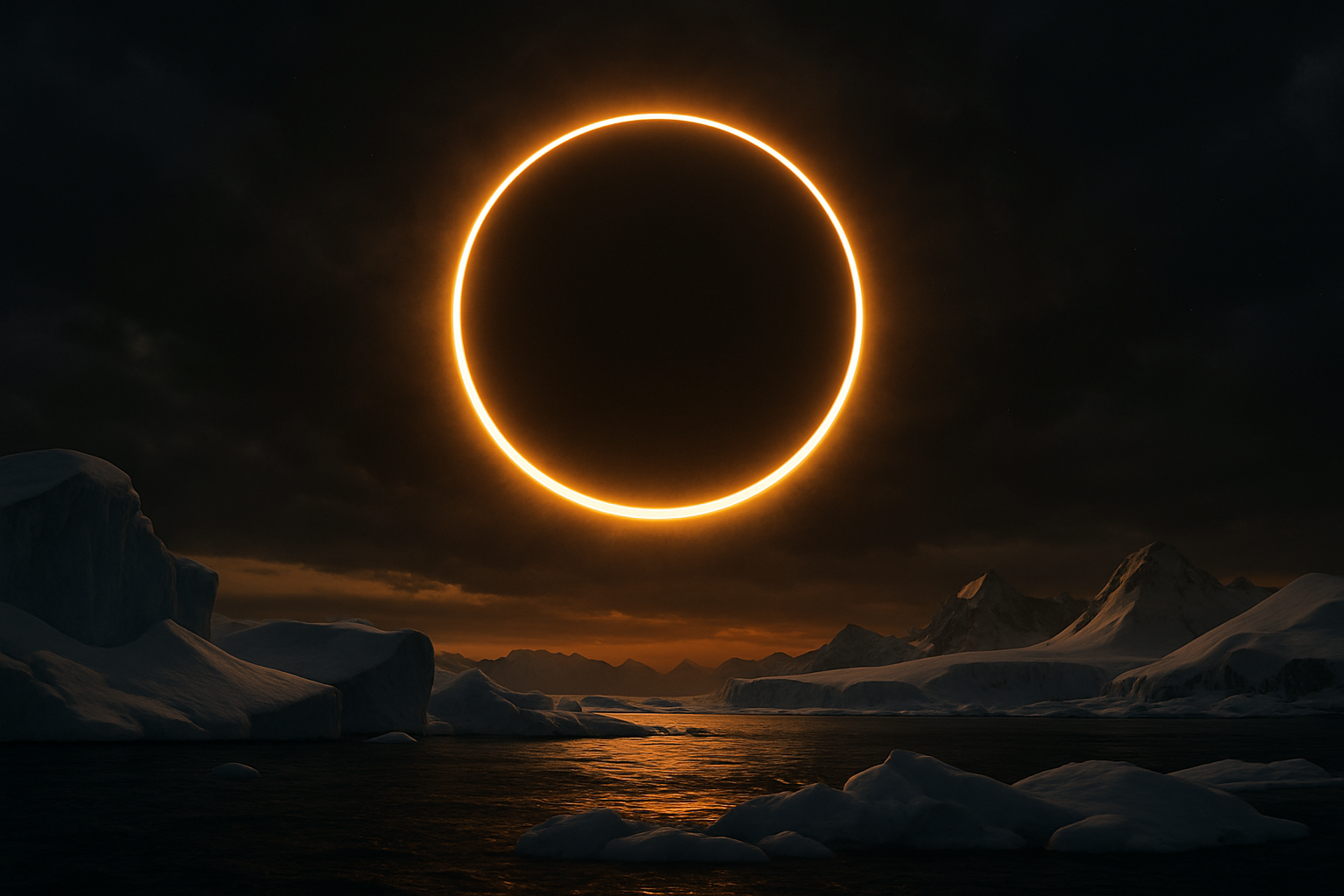
A rare celestial phenomenon will transform the sun into a spectacular "ring of fire" on February 17, 2026, as an annular solar eclipse follows an isolated trajectory over Antarctica, offering partial viewing opportunities across the extreme southern regions of America and Africa.
The annular solar eclipse, described by astronomers as a brief yet fascinating event, will create the dramatic visual effect known as the "ring of fire" when the moon passes directly between Earth and the sun, appearing smaller than the solar disk and leaving a brilliant golden ring visible around its edges.
Unique Antarctic Path Makes This Eclipse Exceptional
Unlike typical solar eclipses that traverse populated landmasses, this February 17 event follows an isolated trajectory primarily over Antarctica, making it one of the rarest eclipse experiences of the decade. The eclipse's path will sweep across the frozen continent, where only research stations and scientific expeditions will witness the full annular effect.
According to reports from Argentine news sources Perfil and La Gaceta, the eclipse's unique positioning means that while the complete "ring of fire" will be visible only over Antarctica, portions of the phenomenon can be observed as a partial eclipse from the southernmost regions of South America and Africa.
What Makes This an Annular Eclipse
An annular solar eclipse occurs when the moon's apparent diameter is smaller than the sun's, leaving the outer rim of the sun visible as a bright ring. This happens because the moon's elliptical orbit around Earth means its distance from our planet varies, and during this eclipse, the moon will be near its farthest point, appearing too small to completely cover the solar disk.
The term "ring of fire" aptly describes the spectacular visual effect created when the moon's silhouette is perfectly centered against the sun, surrounded by the brilliant solar corona forming a complete circle of light.
Global Context and Astronomical Significance
This eclipse arrives during what space experts are calling a "golden age" of astronomical observation. February 2026 has already proven to be a remarkable month for cosmic events, with previous discoveries including major black hole phenomena and advancing space exploration missions.
The timing of this eclipse is particularly significant as it occurs just days before the anticipated six-planet alignment scheduled for February 28, 2026, featuring Mercury, Venus, Mars, Jupiter, Saturn, and Uranus in a rare celestial formation visible globally.
Viewing Opportunities and Safety Precautions
While the full annular eclipse will be visible only from Antarctica, observers in southern Chile, Argentina, and parts of southern Africa will experience a partial solar eclipse. The degree of coverage will vary by location, with areas closer to Antarctica seeing a larger portion of the sun obscured by the moon.
Astronomers emphasize the critical importance of proper eye protection when viewing any solar eclipse. Direct observation of the sun without appropriate solar filters can cause permanent eye damage or blindness. Certified eclipse glasses or indirect viewing methods such as pinhole projectors are essential for safe observation.
Scientific Research Opportunities
Research stations across Antarctica are preparing to take advantage of this rare opportunity to study solar phenomena during the eclipse. The unique positioning allows scientists to observe the sun's corona and conduct atmospheric studies that would be difficult to perform under normal circumstances.
The eclipse also provides valuable data for understanding the Earth-moon-sun system dynamics and offers opportunities to test equipment and procedures that may be used for future astronomical observations and space missions.
Historical Context and Future Eclipses
Solar eclipses over Antarctica are exceptionally rare due to the continent's position and size relative to typical eclipse paths. The last significant eclipse visible from Antarctica occurred several years ago, making this February 17 event a once-in-a-generation opportunity for both scientific study and spectacular viewing.
The next comparable eclipse over Antarctica is not expected for many years, adding to the significance of this February event. For most observers, this will represent a unique chance to witness one of nature's most dramatic astronomical displays, even if only partially visible from populated areas.
International Collaboration and Coverage
Space agencies and astronomical organizations worldwide are coordinating efforts to document and study this eclipse. Digital streaming technology will allow global audiences to experience the "ring of fire" effect through high-quality broadcasts from Antarctic research stations and aircraft positioned along the eclipse path.
This technological coverage ensures that while the eclipse may be geographically isolated, its beauty and scientific value will be shared with astronomy enthusiasts and researchers around the world, continuing the tradition of international collaboration in space and astronomical observations that has marked early 2026.
The February 17 annular solar eclipse represents more than just a celestial spectacle; it symbolizes humanity's continued fascination with cosmic phenomena and our growing capability to study and share these remarkable events across the globe, even from the most remote corners of our planet.