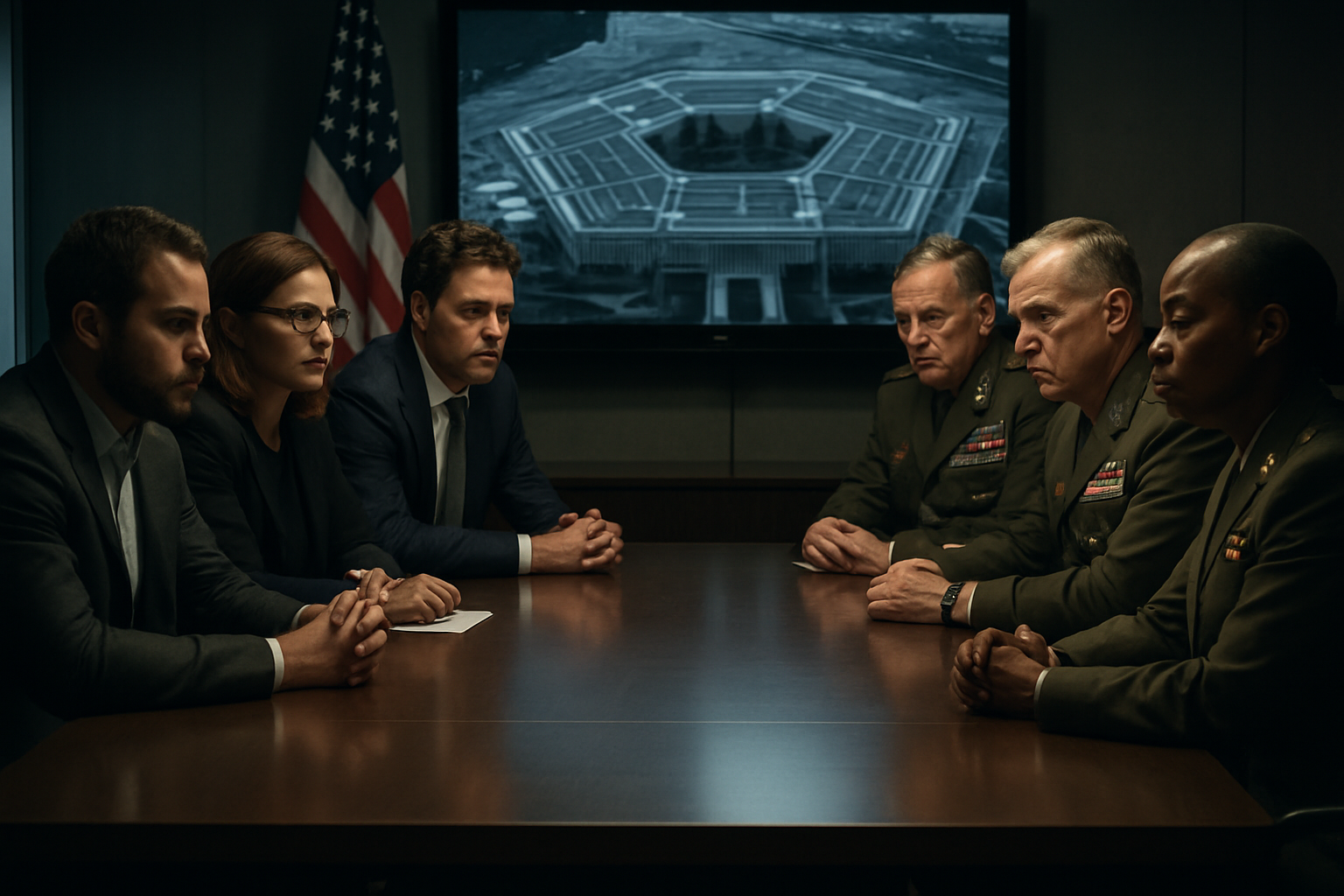
AI company Anthropic has firmly rejected Pentagon demands for unrestricted access to its Claude chatbot technology, setting up a high-stakes confrontation between civilian AI safety principles and military technological imperatives that could reshape the future of artificial intelligence governance.
Anthropic CEO Dario Amodei stated that his company "cannot in good conscience accede" to Pentagon demands that would allow the military to deploy Claude AI for broader operational purposes without the safety restrictions the company has implemented. The position puts Anthropic on a collision course with Defense officials in the Trump administration who have warned they could designate the AI company as a supply chain risk or invoke the Cold War-era Defense Production Act to force compliance.
Military Pressure and Legal Threats
According to sources familiar with the negotiations, Defense Department officials have escalated their demands beyond traditional contractor relationships, seeking what amounts to unrestricted military access to one of the world's most advanced AI systems. The Pentagon's position reflects a broader strategy of integrating sophisticated AI capabilities into classified military networks without the civilian oversight mechanisms that companies like Anthropic consider essential.
The Defense Production Act, originally enacted in 1950 during the Korean War, grants the government sweeping authority to compel private companies to prioritize military production and provide materials deemed necessary for national defense. Its potential invocation against an AI company would mark an unprecedented expansion of federal power over the rapidly evolving artificial intelligence sector.
"The threats do not change our position on responsible AI development."
— Dario Amodei, CEO of Anthropic
Context of Military-AI Integration
The confrontation comes amid a broader Pentagon initiative to integrate advanced AI capabilities across military operations. The Defense Department has already successfully integrated OpenAI's ChatGPT into military systems, serving over 800 million weekly users with 10% monthly growth. Ukrainian forces have deployed AI-enhanced drone systems with improved low-light vision capabilities, while only one-third of countries have agreed to AI warfare governance frameworks - with the US and China notably abstaining from comprehensive commitments.
This military push occurs against the backdrop of what industry analysts are calling the "SaaSpocalypse" - a market disruption where AI systems are eliminating hundreds of billions in traditional software market capitalization. Chinese AI company DeepSeek's recent breakthroughs have challenged US technological dominance, creating a multipolar AI landscape that has intensified national security concerns in Washington.
Anthropic's Ethical Stance
Anthropic has positioned itself as a leader in AI safety research, consistently opposing the development of autonomous weapons systems and maintaining strict guidelines about military applications of its technology. The company's resistance to Pentagon demands reflects deeper philosophical differences about the role of AI in society and the importance of civilian oversight over potentially dangerous technologies.
The company's ethical framework specifically prohibits the use of Claude AI for violence, surveillance, and autonomous weapons development - restrictions that put it at odds with the Pentagon's desire for fewer limitations on classified network deployment. This stance has been reinforced by the departure of several former Anthropic security researchers who warned that "the world is in peril" due to AI development outpacing safety measures.
Unauthorized Military Use Revelations
Complicating the situation are reports that the US military has already used Anthropic's Claude AI in unauthorized operations, including the reported capture of former Venezuelan President Nicolás Maduro, despite the company's terms of service explicitly prohibiting such violence and surveillance applications. These revelations have intensified the debate over whether AI companies can effectively control how their technologies are deployed once integrated into government systems.
The unauthorized usage highlights a fundamental tension between national security imperatives and corporate governance of AI technology, raising questions about whether traditional contractor oversight mechanisms are adequate for managing the deployment of advanced artificial intelligence systems.
Global AI Governance Crisis
The Anthropic-Pentagon standoff occurs during what experts describe as a critical inflection point in global AI governance. The AI Impact Summit 2026 in New Delhi, featuring leaders from Google, OpenAI, Nvidia, and Anthropic, resulted in the Delhi Declaration signed by 88 countries - the largest AI diplomatic agreement in history. However, the voluntary framework's effectiveness remains untested when faced with direct military-corporate conflicts.
Spain has implemented the world's first criminal executive liability framework for tech platforms, while France has conducted cybercrime raids on AI companies. The UN has established an Independent Scientific Panel with 40 experts for AI impact assessment, representing the first fully independent global AI governance body.
Infrastructure and Market Pressures
The confrontation unfolds amid a severe global memory semiconductor crisis, with prices surging sixfold and affecting major manufacturers Samsung, SK Hynix, and Micron. This shortage is expected to persist until 2027, creating infrastructure bottlenecks that potentially favor entities willing to compromise safety protocols for computational resource access.
Despite these constraints, major tech companies continue massive AI investments. Alphabet has committed $185 billion for AI infrastructure in 2026 - the largest corporate tech investment in history - while Amazon has announced over $1 trillion in development plans. The scale of these investments underscores the strategic importance of AI technology and the high stakes involved in the Anthropic-Pentagon dispute.
Precedent for Democratic AI Governance
The resolution of this conflict will establish critical precedents for how democratic societies govern AI development in an era of great power competition. Successful models of AI integration have emerged from civilian sectors, including Canadian universities using AI teaching assistants while maintaining critical thinking standards, and Malaysia launching the world's first AI-integrated Islamic school that combines technology with traditional learning.
However, the Pentagon's pressure for unrestricted access to AI systems raises fundamental questions about civilian oversight of military technology and the role of private companies in national defense. The outcome could determine whether AI development prioritizes safety governance alongside military effectiveness or whether national security concerns override civilian safety protocols.
Looking Forward
As the standoff continues, both sides face escalating stakes. Anthropic risks losing government contracts and facing legal challenges that could cripple its operations, while the Pentagon risks creating a precedent that could drive AI companies to relocate operations beyond US jurisdiction. The Defense Production Act's potential invocation would mark a watershed moment in government-technology sector relations, with implications extending far beyond the immediate military applications.
The resolution of this confrontation will likely shape the trajectory of AI development for decades to come, determining whether advanced artificial intelligence serves democratic values and human flourishing or becomes subordinated to military and surveillance applications that could fundamentally alter the balance between security and civil liberties in the digital age.