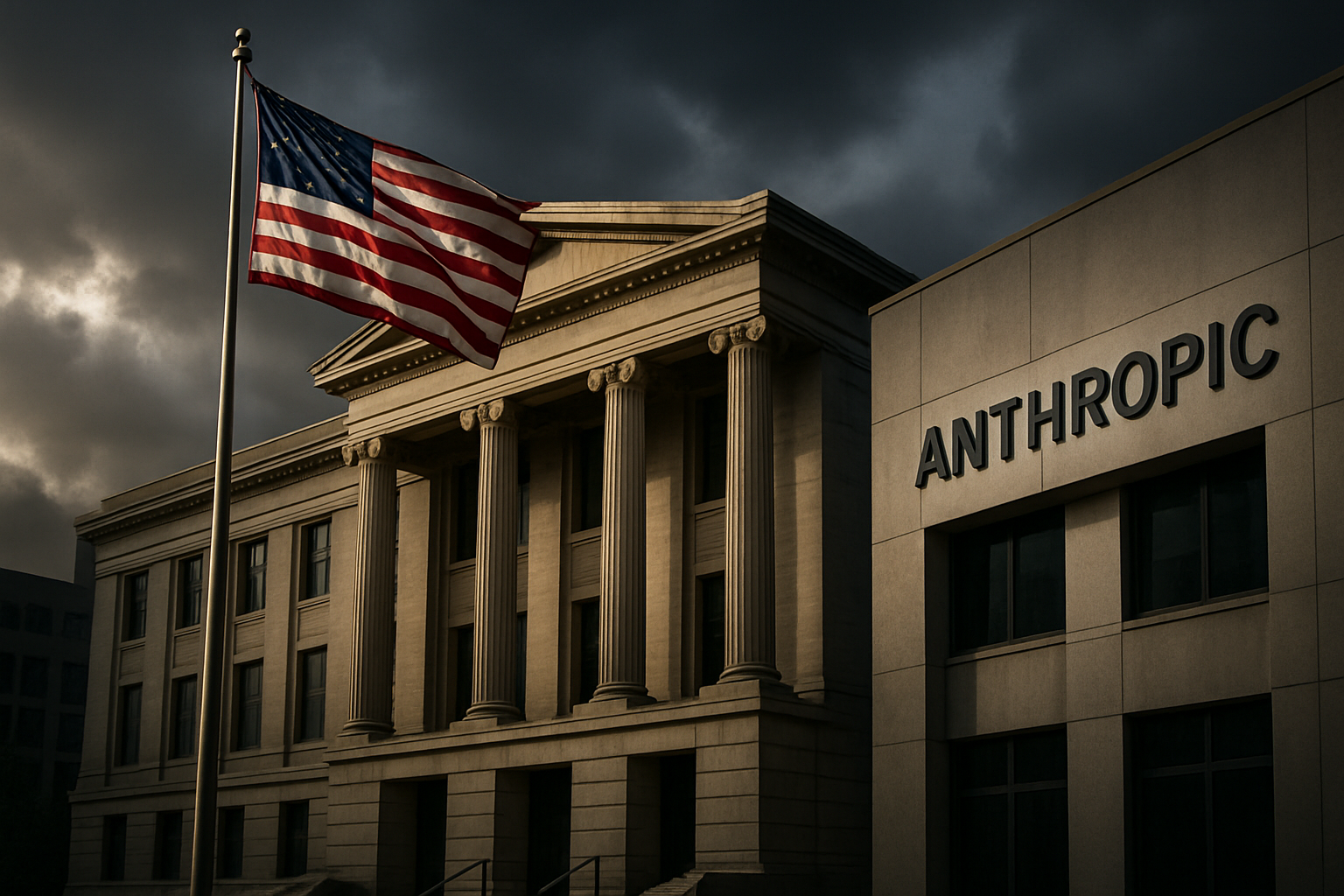
AI company Anthropic filed a federal lawsuit Monday seeking to block the Trump administration from enforcing its "supply chain risk" designation, escalating a high-stakes battle over military use of artificial intelligence that has emerged as a defining issue in AI governance.
The lawsuit, filed in federal court in California, represents the first major legal challenge by an AI company against government restrictions on military technology applications. Anthropic argues that the Pentagon's designation violates its constitutional rights to free speech and due process while undermining democratic oversight of AI systems.
Constitutional Challenge to Military AI Demands
The legal battle stems from Anthropic CEO Dario Amodei's rejection of Pentagon demands for unrestricted military access to the company's Claude AI models. The Defense Department sought removal of safety restrictions preventing mass surveillance and autonomous weapons applications, threatening to designate Anthropic as a "supply chain risk" if the company refused compliance.
"These actions are unprecedented and unlawful attempts to coerce a private company into abandoning its ethical principles," the lawsuit states.
— Anthropic Legal Filing
Amodei has consistently maintained that the company "cannot in good conscience accede" to deployment without safety restrictions, emphasizing that unrestricted AI capabilities could "undermine rather than defend democratic values."
Military AI Integration Divide
The dispute highlights a fundamental divide in the AI industry over military cooperation. While Anthropic maintains strict ethical restrictions, competitors OpenAI and Google have established comprehensive Pentagon partnerships without similar limitations.
OpenAI's ChatGPT now serves over 800 million weekly military users with 10% monthly growth, deployed across classified Defense Department networks through agreements that provide "layered protections" while maintaining military access. The company recently confirmed it does not control how the Pentagon uses its AI products in military operations.
This strategic difference has created competitive advantages for companies willing to work within military frameworks while disadvantaging those prioritizing safety protocols over unrestricted access.
Unauthorized Military Use Revealed
Court documents reveal that U.S. military forces previously used Claude AI in the operation to capture former Venezuelan President Nicolás Maduro, accessed through a partnership with Palantir Technologies despite terms of service explicitly prohibiting violence and surveillance applications.
The unauthorized usage highlights the Pentagon's position that contracted suppliers cannot dictate usage terms once AI systems are integrated into government networks, challenging traditional civilian oversight mechanisms.
Global Regulatory Context
The lawsuit emerges during an unprecedented period of AI governance development. Spain has implemented the world's first criminal executive liability framework for technology platforms, while France has conducted cybercrime raids on AI companies. The UN has established an Independent Scientific Panel of 40 experts for the first comprehensive global AI assessment.
This regulatory intensification reflects growing international concern about rapid AI deployment outpacing safety measures. Former Anthropic security researchers have resigned warning the "world is in peril" due to commercial and military pressures overwhelming safety considerations.
Infrastructure Constraints and Competition
The dispute unfolds against a backdrop of severe global infrastructure constraints. A memory semiconductor crisis has driven prices up sixfold, affecting Samsung, SK Hynix, and Micron operations until new facilities come online in 2027.
Despite these constraints, technology giants continue massive AI investments. Alphabet committed $185 billion to AI infrastructure in 2026, while Amazon's development plans exceed $1 trillion. The crisis potentially creates leverage for entities willing to compromise safety protocols for computational access.
International AI Governance Framework
The legal challenge coincides with the Delhi Declaration, signed by 88 countries representing the largest AI diplomatic agreement in history. The voluntary framework calls for "safe, reliable, robust" AI development, positioning developing nations as equal governance partners rather than passive technology recipients.
However, only one-third of countries have agreed to AI warfare governance frameworks, with the U.S. and China abstaining from comprehensive commitments on autonomous weapons systems.
Democratic Oversight at Stake
Legal experts view the case as a critical test of whether democratic institutions can maintain civilian oversight of military technology during intensifying global competition. The outcome will establish precedents for decades of AI governance, affecting the balance between innovation and safety, commercial interests and human welfare.
Successful civilian AI integration models demonstrate alternative approaches. Canadian universities have implemented AI teaching assistants while maintaining critical thinking standards, Malaysia operates the world's first AI-integrated Islamic school, and Singapore's WonderBot 2.0 shows successful heritage education applications.
Stakes for Democratic AI Governance
The lawsuit represents what analysts describe as a "civilizational choice point" determining whether AI serves democratic values and human flourishing or becomes a tool for surveillance and control beyond democratic accountability.
Resolution of the case will influence not only U.S. AI policy but international approaches to military AI applications. Success could establish frameworks for responsible AI deployment with civilian oversight, while failure may accelerate military solutions that bypass ethical considerations.
As the case proceeds through federal courts, it serves as a template for future conflicts between AI companies' ethical policies and national security imperatives, with implications extending far beyond the immediate parties to shape the trajectory of human-AI relationships for the remainder of the 21st century.