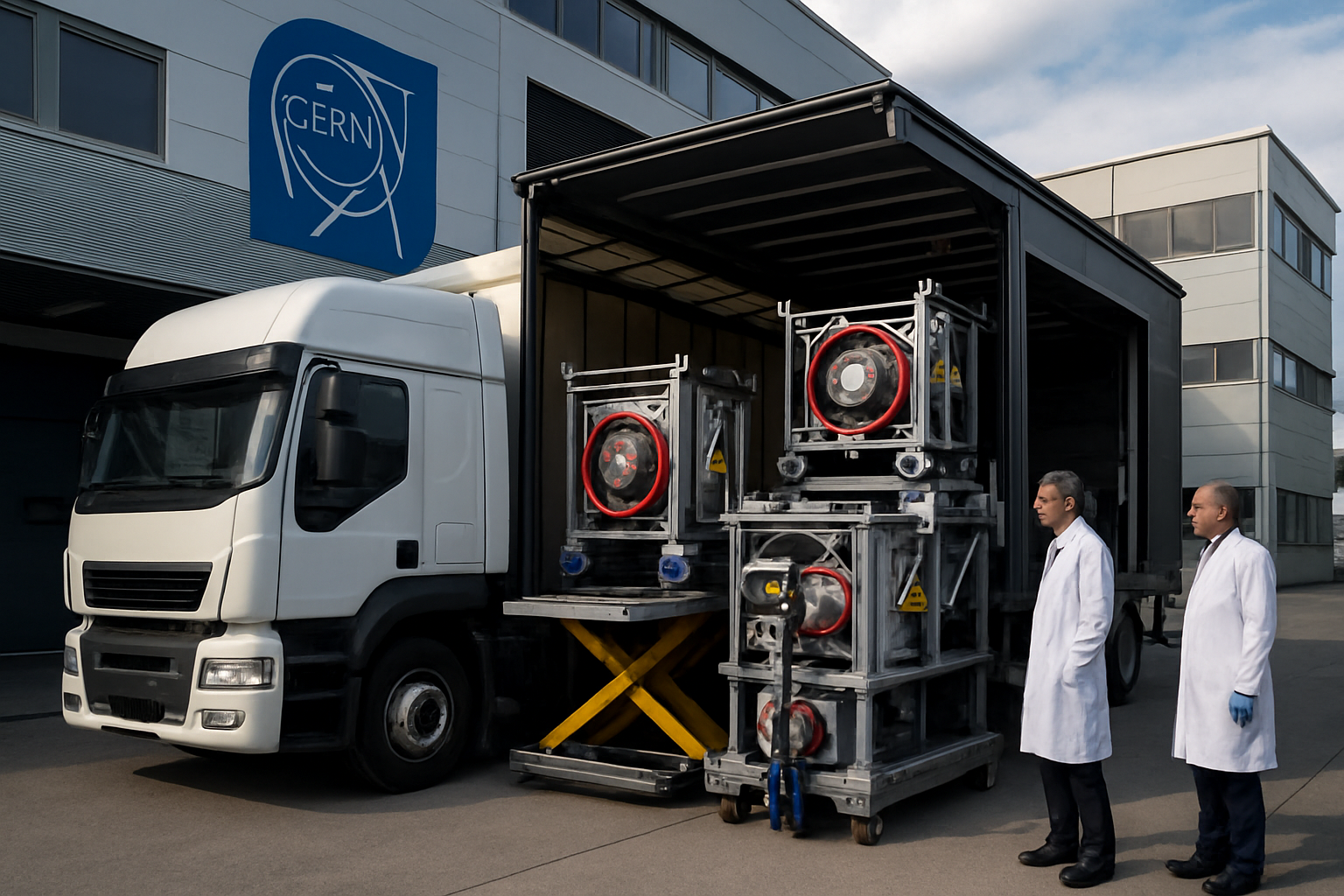
European scientists at CERN have achieved a historic breakthrough by successfully transporting antimatter via truck for the first time in history, marking a revolutionary milestone in fundamental physics research that could unlock one of the universe's most profound mysteries.
The groundbreaking achievement, completed on March 24, 2026, at the European Organization for Nuclear Research (CERN) facility near Geneva, Switzerland, represents decades of scientific advancement culminating in a world-first transportation of antimatter particles using conventional road transport. The feat required unprecedented precision engineering and safety protocols to contain the most volatile substance known to science.
Historic Achievement Decades in the Making
According to sources from Finnish and German media outlets, researchers faced the constant threat of annihilation - the complete destruction that occurs when antimatter particles contact regular matter. The successful test drive at CERN could represent "the first step toward solving one of the greatest puzzles in particle physics," as reported by German broadcaster Tagesschau.
The transportation involved specially designed magnetic containment systems that prevented the antimatter from touching any surface within the vehicle. Even microscopic contact between antimatter and regular matter results in their mutual annihilation, releasing enormous amounts of energy in accordance with Einstein's famous equation E=mc².
"Scientists had to fear antimatter explosion, annihilation," reported Finnish broadcaster YLE, highlighting the extreme precautions required for this unprecedented experiment. The achievement builds upon CERN's extensive experience with antimatter research, including previous work with the Large Hadron Collider that has already yielded significant particle physics discoveries.
The Science Behind Antimatter Transportation
Antimatter consists of particles identical to regular matter but with opposite electrical charges. When antimatter meets ordinary matter, both are instantly converted into pure energy - a process called annihilation that produces the most efficient energy release possible in the universe. This fundamental property makes antimatter both incredibly valuable for scientific research and extraordinarily dangerous to handle.
The CERN team developed sophisticated magnetic bottle technology that uses powerful electromagnetic fields to suspend antimatter particles in a complete vacuum, ensuring no contact with the container walls or surrounding air. The transportation system required continuous power supply, precise temperature control, and vibration dampening to maintain the magnetic containment throughout the journey.
Previous antimatter research was limited to stationary laboratory conditions within CERN's underground facilities. The ability to transport antimatter opens revolutionary possibilities for conducting experiments in different locations and sharing antimatter samples between research institutions worldwide.
Breakthrough Context and Global Significance
This achievement occurs within CERN's broader pattern of groundbreaking discoveries during 2026. Earlier this year, the facility's Large Hadron Collider identified the 80th known particle, designated "Xi-cc-plus," providing new insights into the strong nuclear force that binds atomic nuclei together.
The antimatter transportation breakthrough builds upon decades of international scientific cooperation at CERN, which operates as humanity's largest particle physics laboratory. The facility has previously produced world-changing discoveries including the Higgs boson particle and significant advances in our understanding of the fundamental structure of matter.
According to German media reports, this development could be "the first step toward solving one of particle physics' greatest riddles." The mystery centers on why the universe contains vastly more matter than antimatter, despite theoretical predictions that the Big Bang should have produced equal amounts of both.
Technical Challenges and Safety Protocols
The transportation required extraordinary safety measures due to antimatter's volatile nature. Research teams developed multiple redundant containment systems, emergency protocols, and real-time monitoring equipment to ensure the antimatter remained safely isolated throughout the journey.
The magnetic containment system operates at temperatures approaching absolute zero and requires ultra-high vacuum conditions. Any failure in power supply, magnetic field strength, or vacuum integrity could result in immediate annihilation. The transport vehicle incorporated backup power systems, shock absorption, and electromagnetic shielding to protect both the antimatter cargo and surrounding areas.
Scientists conducted extensive computer simulations and testing with smaller quantities before attempting the full transportation. The success demonstrates that controlled antimatter handling is possible outside dedicated laboratory environments, potentially revolutionizing how antimatter research is conducted globally.
Implications for Future Scientific Research
The successful antimatter transportation opens unprecedented possibilities for international collaboration in fundamental physics research. Previously, antimatter experiments were limited to locations where particles could be produced and immediately studied. Now, antimatter could potentially be shared between research institutions, enabling coordinated global investigations.
The breakthrough could accelerate research into antimatter's potential applications, including medical imaging, cancer treatment, and theoretical propulsion systems. Antimatter-based medical procedures could provide incredibly precise treatment options, while antimatter propulsion could theoretically enable interplanetary space travel.
More immediately, the transportation capability allows researchers to conduct antimatter experiments in different environments and facilities, potentially uncovering new properties or behaviors that weren't observable in standard laboratory conditions.
International Scientific Cooperation
CERN's success reflects the power of international scientific cooperation, involving researchers from dozens of countries working toward common goals in fundamental physics. The antimatter transportation project required expertise in particle physics, electromagnetic engineering, vacuum technology, safety systems, and transportation logistics.
The achievement demonstrates how sustained international cooperation and adequate funding for fundamental research can yield breakthrough discoveries with potential applications spanning multiple fields. CERN's model of collaborative scientific investigation has repeatedly produced world-changing discoveries that benefit all humanity.
Similar international cooperation frameworks exist in other areas of scientific research, including climate science, space exploration, and medical research. CERN's antimatter breakthrough provides another example of how global scientific collaboration can achieve results impossible for individual nations working alone.
Future Research Directions
The successful transportation represents just the beginning of new antimatter research possibilities. Scientists plan to investigate antimatter behavior under various transportation conditions, test longer-distance transport, and explore methods for maintaining larger quantities of antimatter outside traditional laboratory settings.
Future experiments could investigate fundamental questions about gravity's effect on antimatter, antimatter's interaction with magnetic fields during transport, and the stability of antimatter under varying environmental conditions. These investigations could provide crucial data for understanding the universe's matter-antimatter asymmetry.
The transportation capability may also enable development of standardized antimatter handling protocols, safety regulations, and international agreements governing antimatter research and transport. As the technology matures, it could facilitate global antimatter research networks comparable to those existing for other scientific disciplines.
Looking Toward the Future
CERN's antimatter transportation achievement represents a pivotal moment in fundamental physics research, demonstrating that even the most challenging scientific obstacles can be overcome through sustained international cooperation, adequate investment, and innovative engineering solutions.
The success builds upon CERN's legacy of transformative discoveries while pointing toward future breakthroughs that could reshape our understanding of the universe's fundamental nature. As antimatter research expands beyond individual laboratories to global collaborative networks, humanity edges closer to answering some of the most profound questions about existence, energy, and the cosmos itself.
This historic milestone in antimatter science occurs during what many researchers describe as a golden age of international scientific cooperation, demonstrating that human curiosity and collaboration can unlock even the universe's most closely guarded secrets. The successful transportation of antimatter by truck may well be remembered as the moment when theoretical physics took a giant leap toward practical application and deeper cosmic understanding.