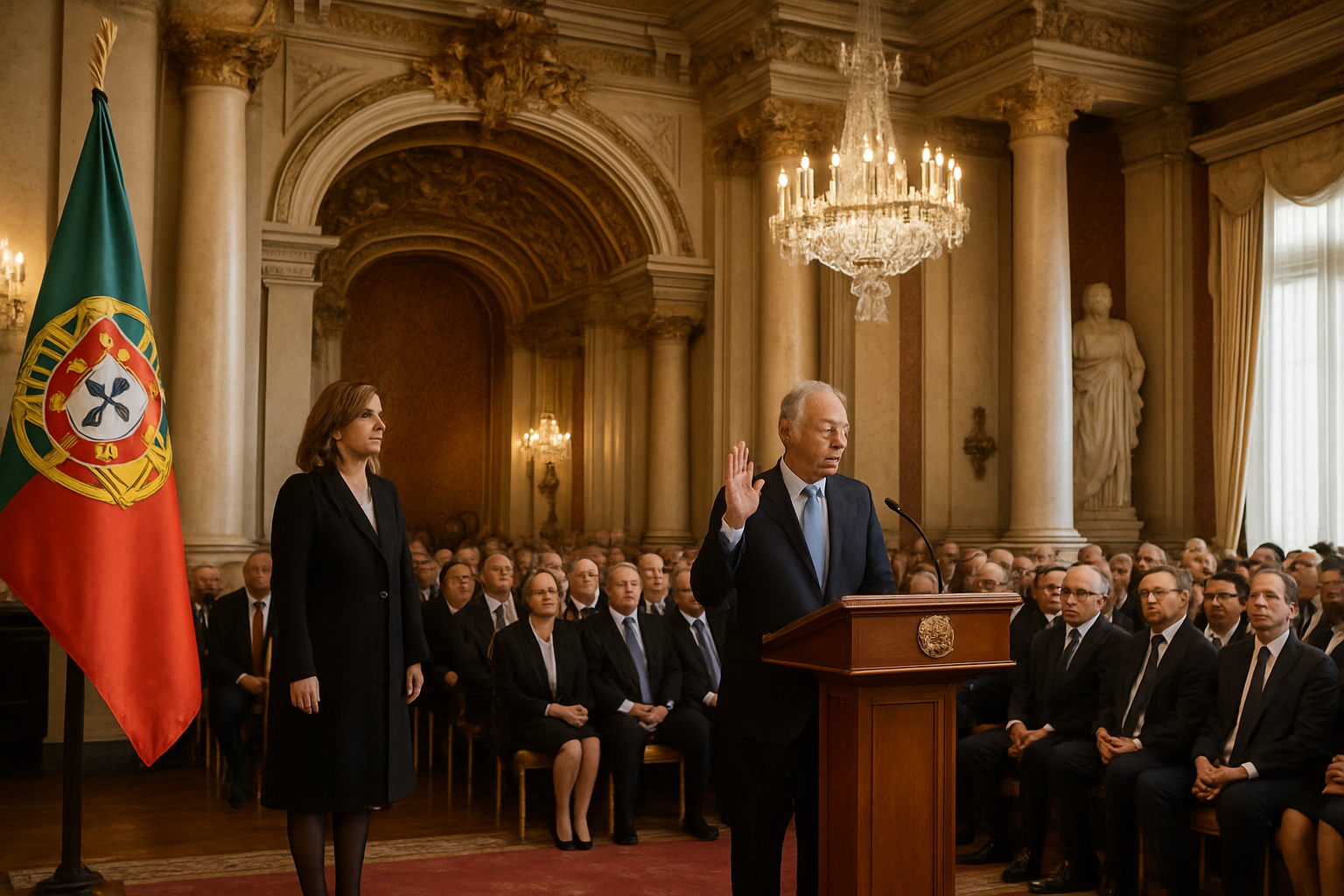
António José Seguro was officially inaugurated as Portugal's 21st President of the Republic on Monday in Lisbon, succeeding Marcelo Rebelo de Sousa after his commanding electoral victory in February's storm-disrupted election.
The Socialist leader's inauguration marks the culmination of an extraordinary political comeback, following his decisive 66.82% victory over far-right candidate André Ventura in February's presidential runoff – a triumph achieved despite unprecedented weather emergencies that prevented 36,000 voters from participating.
Seguro, originally from Penamacor where locals affectionately call him "Tozé," becomes the 21st president in Portugal's democratic history and ends a 20-year absence of left-wing leadership from the presidency. His victory represents the most comprehensive democratic endorsement in Portuguese constitutional history, surpassing even Mário Soares' previous record from 1991.
Historic Electoral Victory Amid Crisis
The February 8 presidential election proceeded during Portugal's largest peacetime rescue operation, with 26,500 emergency personnel deployed to respond to three consecutive Atlantic storms – Kristin, Leonardo, and Marta – that claimed 14 lives and left 167,000 residents without power. The election became a global template for maintaining democratic processes during climate emergencies.
Despite these extraordinary circumstances, Seguro achieved a geographic sweep unprecedented in modern Portuguese politics, winning all 18 districts and autonomous regions, 303 municipalities, and over 2,900 parishes. His victory margin of over 30 percentage points represents one of the largest in Portuguese democratic history.
The president-elect's campaign emphasized a distinct presidential style, promising he "will not speak about everything and nothing" – a contrast to his predecessor's more expansive public role. Seguro has indicated he may suspend his Socialist Party membership to emphasize his commitment to representing all Portuguese citizens.
International Recognition and Attendance
Monday's inauguration ceremony drew significant international attention, with Mozambique's President Daniel Chapo attending following an invitation from outgoing President Marcelo Rebelo de Sousa. The presence of African heads of state underscores Portugal's continued commitment to Lusophone relationships and international cooperation.
The ceremony marks not only a transition in Portuguese leadership but also a moment of reflection on democratic resilience. Seguro's election occurred during what international observers described as a critical test of climate-democracy intersection, as extreme weather increasingly disrupts electoral processes worldwide.
Political analyst David Santiago, editor of PÚBLICO's politics section, characterized the transition as moving from Rebelo de Sousa as the "president of affections" to Seguro as the "president of predictability," suggesting a shift toward a more measured presidential approach.
Massive Reconstruction Challenges
President Seguro inherits extraordinary reconstruction challenges following the devastating storm succession that coincided with his election. The Atlantic storms caused billions in agricultural and tourism damage, with infrastructure including the A1 highway viaduct near Coimbra collapsed due to Mondego River flooding.
The new president takes office as Portugal continues recovery efforts with international support, including €246 million in assistance from Sweden and Denmark, and EU Civil Protection Mechanism activation. The scale of reconstruction required provides an immediate test of Seguro's leadership capabilities and his administration's capacity for crisis management.
Climate adaptation has become a central challenge for the new presidency, with scientists warning that the extreme weather conditions experienced during the election period may become routine by the 2030s without significant climate action and infrastructure adaptation.
Political Realignment
Seguro's victory was achieved through an unprecedented broad coalition that united across traditional partisan lines to defend democratic values against the far-right challenge posed by Ventura's Chega party. This coalition included conservative voters who crossed party lines to support the Socialist candidate, demonstrating a rejection of extremist politics that exceeded many observers' expectations.
The president-elect has signaled his intention to work cooperatively with Prime Minister Luís Montenegro's government, emphasizing national unity over partisan division. This approach reflects his campaign promise that "the majority that elected me expires tonight," indicating his commitment to governing as president of all Portuguese citizens.
European and Global Context
Seguro's inauguration occurs during a period of significant democratic stress across Europe and globally. His overwhelming victory against far-right populism provides encouragement for moderate democratic forces facing similar challenges in other European countries.
The new president's approach to international relations will be closely watched, particularly given Portugal's role in European Union climate cooperation frameworks and its historical ties to Lusophone countries in Africa, Asia, and South America.
"This is a victory for democracy and moderation over extremism. The Portuguese people have spoken clearly about the kind of leadership they want."
— International Observer, Geneva Institute
Constitutional Powers and Expectations
As Portugal operates under a semi-presidential system, President Seguro's constitutional interpretation will be crucial for European democratic governance. His articulation of presidential powers following his commanding electoral mandate could provide a template for other semi-presidential systems during crisis periods.
The president-elect has indicated he will take a more restrained approach to public commentary compared to his predecessor, focusing on constitutional duties rather than daily political commentary. This shift reflects his promise to represent a different style of presidential leadership.
Constitutional experts note that Seguro's historic mandate provides him with significant moral authority, though the practical application of presidential powers within Portugal's democratic framework remains within established constitutional limits.
Looking Forward
President Seguro's inauguration represents not just a change in leadership but a potential inflection point for Portuguese democracy. His administration will be tested immediately by the massive reconstruction challenges inherited from the February storms, while also needing to address longer-term issues of climate adaptation, economic inequality, and European integration.
The new president's success will be measured not only by his ability to navigate these immediate challenges but by his capacity to fulfill his electoral promise of representing all Portuguese citizens while advancing the country's democratic values and international commitments.
As Portugal enters this new presidential term, the combination of domestic reconstruction needs, European leadership responsibilities, and global climate challenges will provide the ultimate test of Seguro's historic mandate and his vision for Portugal's future.