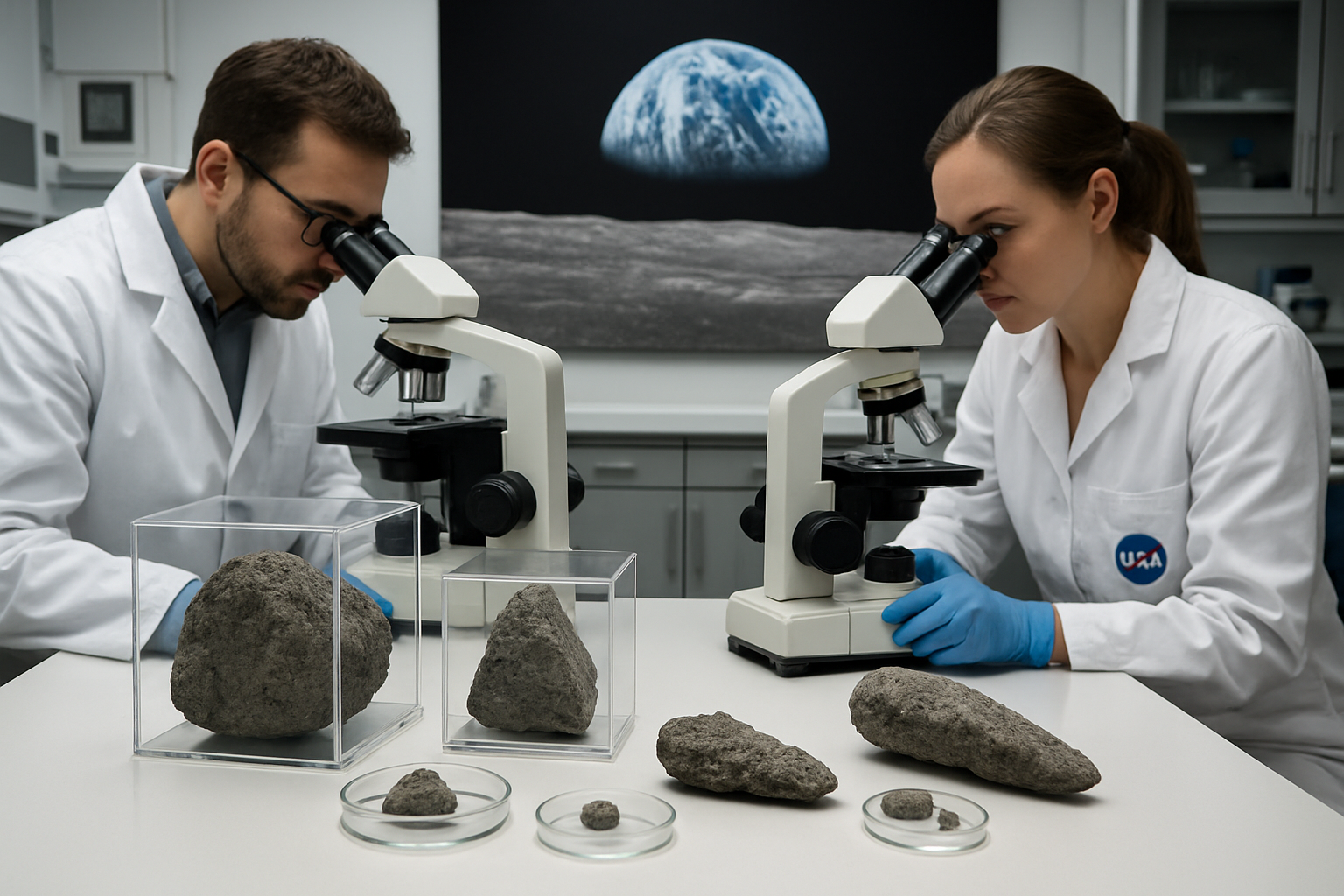
Lunar rocks collected by Apollo astronauts more than fifty years ago are delivering fresh revelations about the Moon's mysterious magnetic field, while unprecedented developments in space medicine highlight the growing challenges of human exploration beyond Earth's protective atmosphere.
Scientists analyzing decades-old Apollo samples have made significant breakthroughs in understanding the Moon's ancient magnetic field properties, settling long-standing debates about lunar magnetism that have puzzled researchers since the first rock samples returned to Earth in 1969. The findings represent a triumph of persistent scientific investigation, demonstrating how archived materials from historic missions continue yielding discoveries using modern analytical techniques.
Revolutionary Lunar Magnetic Field Discoveries
The latest analysis of Apollo lunar samples has provided definitive evidence about the Moon's magnetic field history, resolving debates that have persisted since the early days of lunar exploration. Using advanced spectroscopic analysis and sophisticated magnetic measurement techniques unavailable during the original Apollo era, researchers have been able to extract magnetic signatures preserved within the crystalline structure of lunar rocks for billions of years.
These findings suggest the Moon possessed a much stronger magnetic field in its early history than previously understood, with implications extending far beyond academic curiosity. Understanding lunar magnetism is crucial for future Artemis missions, which aim to establish sustainable human presence on the Moon by 2027. The magnetic field research directly informs habitat placement, equipment protection, and astronaut safety protocols for extended lunar operations.
"The Apollo samples continue to be scientific treasures that unlock secrets about our solar system's formation and evolution."
— NASA Lunar Science Team
Historic ISS Medical Emergency Revealed
In a parallel development highlighting the realities of human spaceflight, NASA astronaut Mike Fincke has publicly identified himself as the crew member who required the first-ever medical evacuation from the International Space Station. The unprecedented emergency occurred during the Crew-11 mission in early 2026, forcing mission cancellation and leaving the ISS operating with a reduced three-person crew.
Fincke's voluntary disclosure marks a watershed moment in space medicine transparency, as NASA typically maintains strict privacy protocols regarding astronaut health issues. The evacuation required unprecedented coordination between NASA, ESA, Roscosmos, and international ground control centers, representing the first real-world test of emergency medical protocols developed over decades of ISS operations.
The medical emergency's resolution using SpaceX Dragon spacecraft capabilities demonstrated the maturity of commercial crew systems for emergency scenarios, providing crucial validation for deep space missions where Earth return may be impossible. The incident occurred during what space industry analysts describe as the transition from "AI revolution to space economy golden age," with commercial space capabilities increasingly essential for human spaceflight operations.
Space Medicine Challenges for Deep Space Exploration
Fincke's medical evacuation underscores critical challenges facing extended human space missions, particularly as NASA prepares for Artemis lunar landings and eventual Mars exploration. Current ISS research programs focus intensively on long-duration spaceflight medical challenges, including Space-Associated Neuro-Ocular Syndrome (SANS), cardiovascular changes, bone density loss, and muscle atrophy.
The successful evacuation provides invaluable case study data for medical emergency management procedures that will inform protocols for Moon and Mars missions, where evacuation to Earth becomes impossible. Portuguese scientists leading breakthrough SANS research have identified visual acuity problems affecting astronauts during extended missions, representing a critical challenge for deep space exploration requiring medical solutions for lunar and Mars settlements.
Recent space medicine research aboard the ISS has included lung tissue cultivation studies under microgravity conditions, essential for understanding human tissue behavior in space environments. These investigations directly support future lunar base and Mars mission medical protocols, as extended space missions will require comprehensive understanding of human physiological adaptation to extraterrestrial environments.
International Space Cooperation Amid Growing Competition
Both the Apollo sample research and ISS medical evacuation demonstrate the strength of international space cooperation, even amid intensifying global space competition. The medical emergency showcased rapid coordination between NASA, ESA, and Roscosmos despite terrestrial tensions, followed by successful multinational crew rotation missions restoring full ISS capacity.
This cooperation occurs within a broader context of expanding global space capabilities. Pakistan has selected astronaut candidates for China's Tiangong space station mission scheduled for October-November 2026, while Thailand chairs UN space governance committees, reflecting the democratization of space capabilities among emerging nations.
The European Space Agency continues expanding capabilities through programs like the recently successful Crew-12 mission, which featured French astronaut Sophie Adenot becoming the first French woman to reach the ISS in 25 years. Her eight-month mission represents a record duration for European astronaut participation, focusing on research directly supporting future lunar and Mars exploration.
Technological Convergence and Future Implications
The convergence of historic lunar science with contemporary space medicine challenges illustrates how past achievements continue informing future exploration. Apollo-era samples analyzed with 21st-century techniques provide essential data for Artemis mission planning, while real-world medical emergencies validate systems crucial for deep space exploration.
NASA's ongoing Artemis II mission preparations, despite technical delays with hydrogen leak issues, represent humanity's return to deep space after a 50-year gap. The mission will send four astronauts, including Canadian Jeremy Hansen, on a 10-day lunar flyby using the powerful Space Launch System rocket and advanced Orion spacecraft.
Advanced AI integration is revolutionizing space operations, as demonstrated by NASA's successful fully AI-planned Mars rover missions in December 2025. These autonomous navigation capabilities enable real-time decision-making across cosmic distances, reducing dependence on Earth-based mission control and proving essential for future lunar and Mars operations.
Economic and Strategic Implications
These developments occur during unprecedented growth in the global space economy, with SpaceX preparing a June 2026 IPO potentially valuing the company over $1 trillion. The space industry's transition from experimental government programs to essential commercial infrastructure reflects broader economic transformation driven by satellite communications, space-based data processing, and eventual resource extraction capabilities.
The global memory crisis, with semiconductor prices increasing sixfold, has accelerated interest in space-based computing solutions. Companies are exploring extraterrestrial data centers that leverage continuous solar power and absence of atmospheric interference, representing potential convergence between space exploration and digital infrastructure development.
Space medicine research, validated through real-world emergencies like Fincke's evacuation, becomes increasingly valuable as space tourism and commercial spaceflight expand. Understanding and managing medical challenges in space environments will prove essential for the sustainable expansion of human presence beyond Earth.
Looking Toward a Spacefaring Future
The combination of breakthrough lunar science and advancing space medicine capabilities positions humanity for an unprecedented expansion of space presence. Apollo sample research continues yielding discoveries that inform contemporary mission planning, while medical challenges successfully managed aboard the ISS provide essential data for deep space exploration.
As NASA targets March 2026 for the Artemis II lunar flyby mission, these converging developments—from ancient magnetic field discoveries to modern medical protocols—represent essential building blocks for sustainable human space exploration. The successful resolution of the first ISS medical evacuation, combined with continuing scientific discoveries from Apollo-era materials, demonstrates both the challenges and opportunities defining humanity's spacefaring future.
The integration of international cooperation, commercial capabilities, and advancing medical knowledge establishes a foundation for the next phase of human space exploration, moving beyond brief visits to permanent settlements on the Moon and eventual missions to Mars. The lessons learned from both historic lunar samples and contemporary space medicine challenges will prove essential for humanity's transformation into a truly spacefaring civilization.