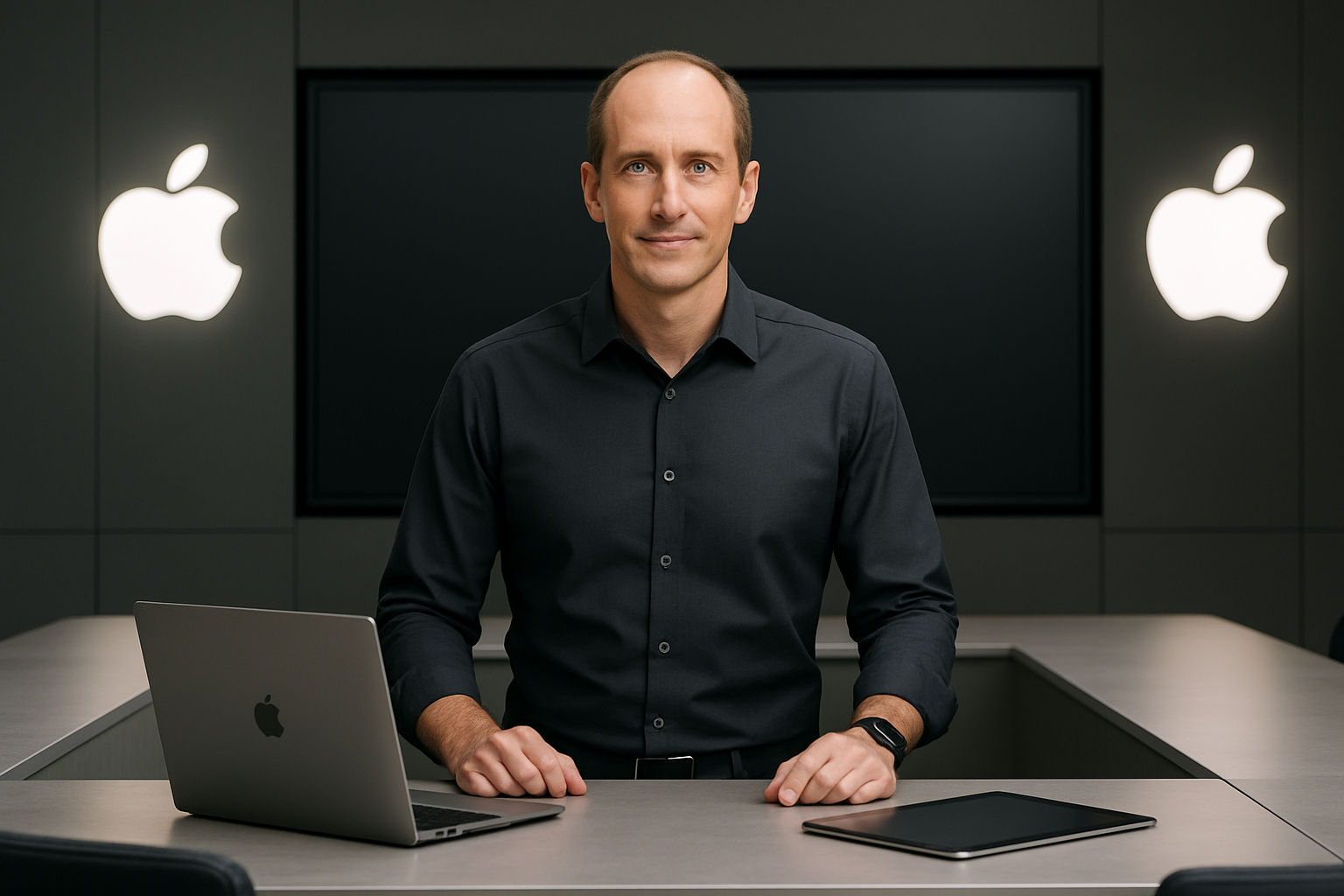
John Ternus has officially assumed leadership as Apple's CEO, replacing Tim Cook in a historic transition that marks the end of one of the most transformative eras in corporate history while beginning a new chapter fraught with artificial intelligence challenges that could define the company's next half-century.
The 50-year-old hardware engineering veteran, who brings 25 years of Apple experience since joining in 2001, faces immediate pressure to accelerate the company's AI integration efforts as Apple trails competitors who have invested tens of billions in artificial intelligence capabilities. Currently serving as vice president of hardware engineering, Ternus has overseen the development of much of Apple's signature technology, from AirPods to the revolutionary Apple Silicon transition and the recent MacBook redesigns.
The AI Competition Crisis
Apple's challenge in artificial intelligence represents perhaps the most pressing issue confronting Ternus as he takes the helm. The company has emerged as the second-worst performing stock among the "Magnificent Seven" technology giants since ChatGPT's launch in November 2022, highlighting investor concerns about Apple's ability to compete in the AI revolution.
While competitors like Google and Microsoft have committed over $185 billion and $1 trillion respectively to AI infrastructure development, Apple's privacy-first approach has created slower deployment compared to data-leveraging competitors. The company's Apple Intelligence framework, while maintaining distinctive privacy principles, must now demonstrate competitive capabilities in an era where AI functionality is transitioning from experimental features to essential business infrastructure.
"The roles people play are shifting fundamentally in this AI transformation. We must balance innovation acceleration with our core privacy values while ensuring we don't fall behind in capabilities that our users demand."
— Industry analyst on Apple's AI positioning
A Legacy of Operational Excellence
Ternus inherits a remarkable foundation built during Tim Cook's transformative 15-year tenure. Under Cook's leadership, Apple evolved from a $350 billion company in 2011 to a $3.5+ trillion technology empire, becoming the world's most valuable corporation serving 2.8 billion users globally. The iPhone alone generated over $1.5 trillion in revenue, establishing it as the most successful consumer product in history.
Cook's operational expertise transformed Apple from a computer company into an integrated ecosystem encompassing hardware, software, and services. The company achieved historic milestones as the first to reach $1 trillion (2018), $2 trillion (2020), and $3 trillion (2022) valuations, while building a services business that now operates at Fortune 500 scale with over $165 billion in cash reserves.
Engineering Leadership Returns
Ternus's appointment represents a return to Apple's tradition of engineering-focused leadership, following the path established by Steve Jobs and maintained by Cook. His mechanical engineering background and deep understanding of Apple's product development culture position him uniquely to navigate the complex challenges ahead.
As the architect behind Apple's successful Intel-to-Apple Silicon transition, Ternus demonstrated the technical vision and execution capabilities that defined some of Apple's most significant recent innovations. His leadership of the Mac development team and presentation of the iPhone Air redesign in autumn 2025 — the biggest iPhone transformation since 2017 — showcase his ability to balance innovation with Apple's distinctive design philosophy.
Critical Strategic Challenges
The new CEO faces a complex landscape of strategic challenges extending well beyond AI competition. Global supply chain pressures continue with memory chip prices experiencing a sixfold surge affecting Samsung, SK Hynix, and Micron operations, with shortages expected to persist until 2027 when new fabrication facilities come online.
Regulatory pressures are intensifying globally, with the European Union's Digital Markets Act forcing ecosystem modifications and Spain implementing the world's first criminal executive liability framework for technology platforms. Geopolitical tensions affecting Chinese manufacturing dependencies add another layer of complexity to Apple's operational environment.
Apple must also identify the next revolutionary product category while maintaining excellence in existing lines. The company's AR glasses project, codenamed "N50," represents a potential iPhone-scale transformation, but requires the same engineering precision and market timing that defined previous breakthrough successes.
The Innovation Imperative
Ternus emphasizes a "product-first philosophy" that prioritizes leveraging technology to create "amazing products" rather than deploying technology for its own sake. This approach contrasts with some competitors' massive AI spending without ensuring optimal user experiences, potentially representing a deliberate engineering-focused strategy during the industry transformation.
The company's vertical integration advantages become particularly valuable during the current semiconductor crisis, enabling more sophisticated supplier relationships and supply chain management than competitors dependent on external manufacturing partnerships. This operational expertise, honed during Ternus's quarter-century with the company, provides competitive advantages during global electronics supply disruptions.
Global Context and Timing
The leadership transition occurs during Apple's 50th anniversary year, adding symbolic significance to an already historic corporate succession. The timing during what industry experts characterize as a "civilizational choice point" in AI development amplifies the strategic importance of successful navigation through technological transformation.
International markets present both opportunities and challenges, with the company needing to balance global competitiveness with responsible development practices. The success of Ternus's leadership will influence not only Apple's trajectory but broader technology industry approaches to innovation, privacy protection, and democratic governance of AI systems.
Looking Forward
As Ternus assumes leadership of the world's most valuable company, his decisions will significantly influence technology industry standards and user experience expectations globally. The engineering expertise and institutional knowledge he brings, combined with Apple's distinctive approach to privacy and user-centric design, position the company to maintain leadership during unprecedented technological transformation.
The ultimate test will be whether Apple can adapt to the AI revolution while preserving the core values and innovation culture that enabled its extraordinary rise from near-bankruptcy in the 1990s to global technology dominance. Success will require balancing innovation acceleration with operational excellence, ensuring that technological advancement serves Apple's long-held principles of enhancing human capability rather than replacing human judgment and creativity.
The next chapter of Apple's story begins with Ternus at the helm, facing challenges that will determine whether the company can maintain its position as the world's most influential technology platform while navigating the most significant technological transformation since the internet's commercialization.