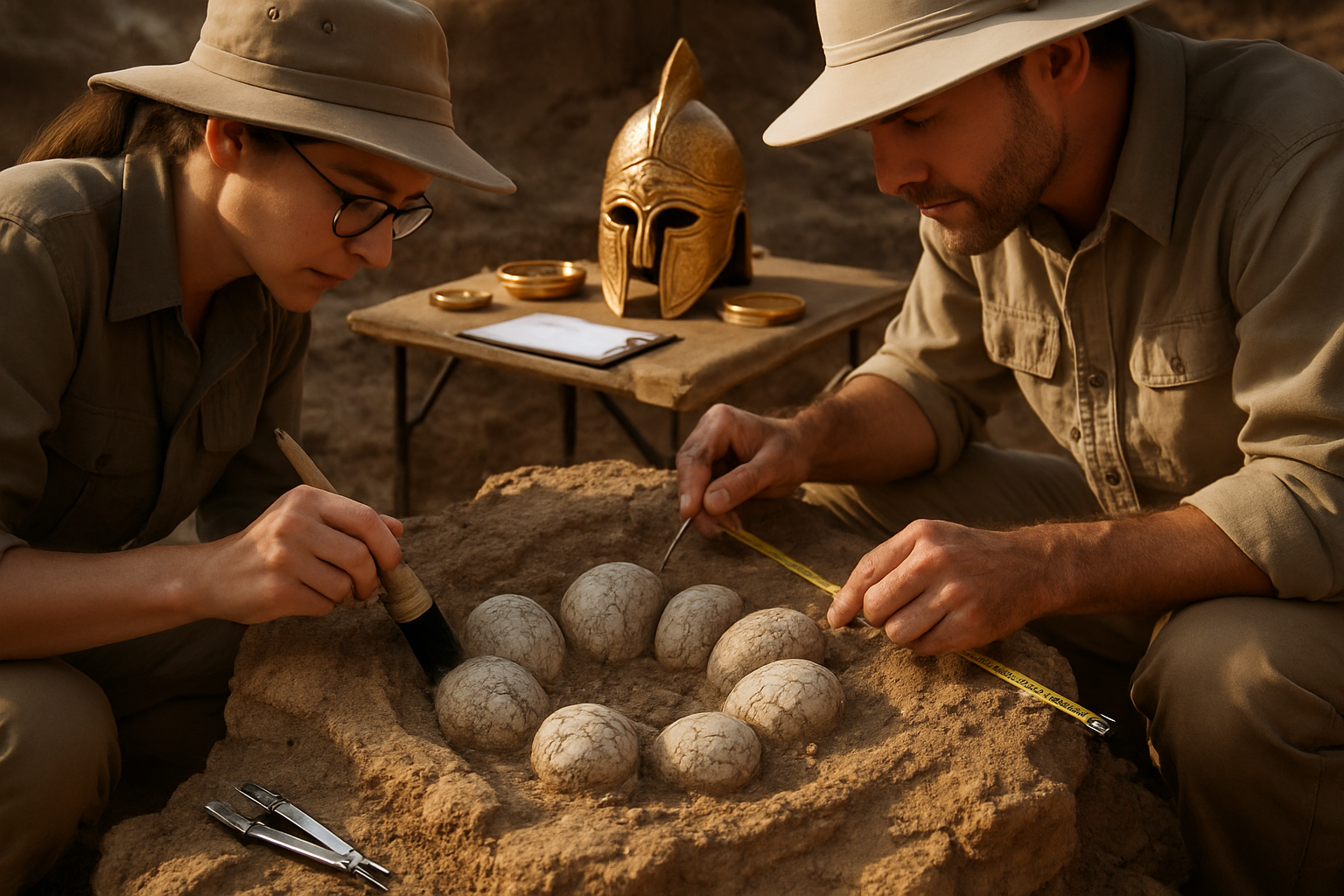
Two remarkable archaeological discoveries spanning prehistoric and ancient history have emerged this week, reinforcing 2026's unprecedented status as a renaissance year for historical research and cultural heritage recovery.
The Musée des dinosaures de Mèze in southern France announced the discovery of approximately 100 dinosaur eggs dating back 72 million years, potentially establishing one of the world's most significant nesting sites. Simultaneously, international law enforcement successfully recovered a stolen ancient Dacian golden helmet, representing a triumph in the fight against cultural heritage trafficking.
Prehistoric Discovery in Hérault: A Dinosaur Treasure Trove
The French discovery in the Hérault region represents a paleontological breakthrough of extraordinary proportions. The cache of approximately 100 fossilized eggs, embedded in Late Cretaceous sedimentary layers, provides unprecedented insights into dinosaur reproductive behavior during the twilight of the Mesozoic era.
Preliminary analysis suggests the eggs belonged to titanosaur sauropods, massive herbivorous dinosaurs that dominated Late Cretaceous landscapes across what is now southern Europe. The careful arrangement and preservation of the eggs indicate deliberate nesting behavior, contradicting earlier theories about random egg deposition and suggesting sophisticated maternal care strategies among these ancient giants.
"This discovery fundamentally alters our understanding of dinosaur social behavior during the Late Cretaceous period. The preservation quality and quantity of eggs suggests we're looking at evidence of complex nesting communities rather than isolated reproductive events."
— Dr. Marie Leclerc, Lead Paleontologist
The discovery occurs within France's rich geological context, where Cretaceous marine and terrestrial deposits have yielded numerous significant paleontological finds. The Hérault region's unique geological conditions—including rapid sediment burial and favorable mineralization processes—created ideal preservation circumstances that maintained the eggs' structural integrity across 72 million years.
Dacian Heritage Recovery: International Success Against Trafficking
In parallel developments, international heritage protection efforts achieved a significant victory with the recovery of a stolen ancient Dacian golden helmet, part of a collection that included three precious bracelets. The artifacts were originally stolen from a Dutch museum where they were exhibited on loan from Romania, representing a sophisticated international cultural trafficking operation.
The recovery involved coordinated efforts between Romanian cultural authorities, Dutch law enforcement, and international art crime specialists. The Dacian artifacts, dating to approximately 2,000 years ago, represent some of the finest examples of ancient Thracian goldwork, demonstrating the sophisticated metallurgical techniques of pre-Roman Dacia.
These golden artifacts showcase the remarkable artistic and technical achievements of the Dacian civilization, which flourished in the Carpathian region before Roman conquest in 106 CE. The intricate craftsmanship, including detailed relief work and sophisticated alloying techniques, demonstrates the advanced state of Dacian metallurgy and artistic expression.
2026 Archaeological Renaissance Context
Both discoveries occur within the documented "2026 Archaeological Renaissance," a period characterized by unprecedented international cooperation, technological advancement, and remarkable global discoveries. This year has witnessed extraordinary finds spanning from 16,000-year-old human-dog companionship evidence to sophisticated ancient Chinese astronomical systems, fundamentally challenging traditional models of human and natural development.
The convergence of advanced analytical techniques with traditional archaeological expertise has enabled breakthroughs impossible for previous generations. Ground-penetrating radar, sophisticated chemical analysis, DNA sequencing, environmental reconstruction, and digital documentation methods are revolutionizing our ability to extract information from archaeological sites and artifacts.

Methodological Advances and International Cooperation
The French dinosaur discovery exemplifies modern paleontological approaches, utilizing advanced geological analysis, careful excavation techniques, and sophisticated dating methods. Digital documentation creates permanent records accessible to researchers worldwide while protecting original specimens from environmental damage and handling stress.
Similarly, the Dacian artifact recovery demonstrates the power of international cooperation in cultural heritage protection. The successful operation required coordination across multiple jurisdictions, specialized knowledge of ancient metallurgy and art history, and persistent investigative work spanning several years.
These successes occur amid growing urgency for archaeological preservation. Climate change threatens sites worldwide, with January 2026 marking the 18th consecutive month of global temperatures exceeding 1.5°C above pre-industrial levels. Archaeological sites face unprecedented threats from extreme weather, rising seas, and environmental degradation, making systematic documentation and preservation efforts critically important.
Scientific and Cultural Implications
The dinosaur egg discovery contributes to fundamental questions about Late Cretaceous ecosystems and the evolutionary pressures that shaped dinosaur behavior during their final epoch. Evidence of communal nesting suggests complex social structures that may have provided survival advantages during the environmental stresses preceding the end-Cretaceous extinction event.
The Dacian artifact recovery highlights ongoing challenges in cultural heritage protection and the importance of international cooperation in combating trafficking networks. The successful operation provides a template for future recovery efforts while demonstrating that patient, coordinated international work can achieve remarkable results in restoring cultural patrimony to its rightful custodians.
"These discoveries represent two aspects of our mission to understand and preserve the past: uncovering new knowledge about Earth's ancient life and protecting the cultural treasures that illuminate human civilization."
— Professor Elena Vasquez, International Archaeological Council
Future Research Directions
The French discovery opens numerous research avenues, including detailed analysis of eggshell composition, embryological development studies, and comprehensive environmental reconstruction of Late Cretaceous nesting habitats. Advanced imaging techniques may reveal previously invisible details about embryo development and potentially preserved organic materials.
The recovered Dacian artifacts will undergo comprehensive conservation analysis, providing insights into ancient goldworking techniques, trade networks, and cultural practices. Scientific examination may reveal information about gold sources, manufacturing methods, and the symbolic significance of the decorative elements.
Both discoveries benefit from the 2026 emphasis on interdisciplinary approaches, combining traditional archaeological and paleontological methods with cutting-edge analytical techniques. This convergence of expertise enables research questions and analytical capabilities that transcend individual disciplinary boundaries.
Economic and Educational Impact
These discoveries generate substantial benefits beyond pure scientific knowledge. The French dinosaur site will likely become a significant paleontological tourism destination, contributing to regional economic development while providing educational opportunities for students and public visitors. Museum exhibitions, educational programs, and academic partnerships extend the impact far beyond the immediate discovery location.
The Dacian artifact recovery strengthens Romania's cultural heritage tourism potential while demonstrating successful international cooperation in heritage protection. The returned artifacts will likely feature in major museum exhibitions, educational programs, and cultural diplomacy initiatives that enhance Romania's international cultural standing.
Both discoveries contribute to growing recognition that archaeological and paleontological research represents strategic infrastructure equivalent to transportation, communication, and healthcare systems. Cultural heritage and scientific discovery provide community identity, educational resources, and economic benefits that extend across generations.
Preservation and Access Balance
Modern archaeological practice increasingly emphasizes balancing scientific research with public access and heritage protection. Digital documentation, virtual reality reconstruction, and advanced imaging create opportunities for global access to discoveries while protecting fragile original materials from damage through excessive handling or environmental exposure.
The French discovery will be studied using non-invasive methods wherever possible, with physical excavation carefully planned to maximize scientific information while preserving site integrity for future research using even more advanced techniques. Similarly, the recovered Dacian artifacts will undergo conservation treatment ensuring long-term preservation while enabling scientific study and public display.
Global Archaeological Renaissance Continues
These April discoveries reinforce 2026's emergence as a watershed year for archaeological and paleontological research. The combination of international cooperation, technological advancement, and systematic preservation efforts is producing remarkable results despite resource constraints and geopolitical challenges.
The pattern suggests that investment in systematic archaeological research, international cooperation frameworks, and preservation technologies generates extraordinary returns in scientific knowledge, cultural understanding, and community development. The success stories from 2026 provide practical templates for addressing the complex challenges of heritage preservation and scientific discovery in the 21st century.
As climate change and development pressures threaten archaeological sites worldwide, the urgency for documentation and preservation has never been greater. The French and Romanian discoveries demonstrate that remarkable treasures remain hidden across the globe, requiring continued investment in research, international cooperation, and preservation technologies to unlock the secrets of our planet's deep past and human heritage.