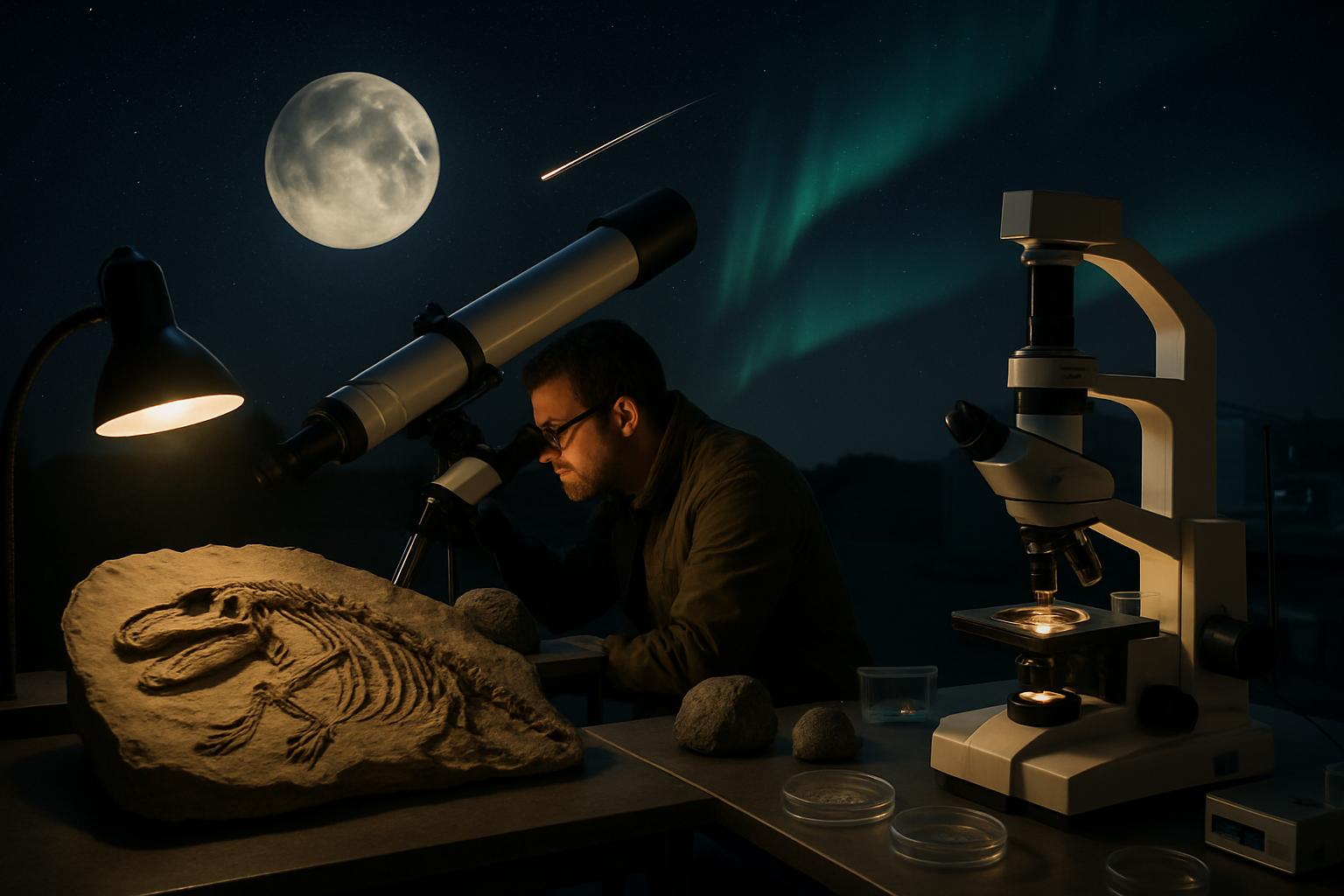
April 2026 has witnessed a remarkable convergence of scientific breakthroughs spanning space exploration, paleontology, and astronomy, reinforcing what researchers worldwide are calling the "2026 Scientific Renaissance" - a period of unprecedented discovery acceleration through international cooperation.
Three major developments this month exemplify the extraordinary momentum building across multiple scientific disciplines: Czech researchers have identified new lunar water accumulation mechanisms crucial for future Moon settlements, Australian paleontologists have solved a 120-year-old mystery with the discovery of a giant echidna fossil, and Azerbaijan astronomers are tracking spectacular meteor shower activity visible across the region.
Lunar Water Discovery Transforms Moon Settlement Plans
Czech scientists have made a groundbreaking contribution to lunar exploration by identifying previously unknown mechanisms for water accumulation on the Moon's surface. According to research published this week, new studies suggest optimal locations for ice deposits and detail how water has accumulated over geological epochs in permanently shadowed regions near the lunar poles.
The research, particularly significant for NASA's Artemis program, builds on previous discoveries that confirmed ice accumulation at the Moon's poles has been ongoing for at least 1.5 billion years. These "cold traps" in deep, permanently shadowed craters maintain temperatures of minus 160°C, gradually collecting water ice that could provide drinking water, oxygen, and hydrogen rocket fuel for future lunar settlements.
"For future Artemis missions, this represents a fundamental shift in our understanding of lunar resources. We now have a much clearer picture of where to establish sustainable lunar bases."
— Dr. Pavel Kotas, Czech Space Research Institute
The timing could not be more critical, as NASA's Artemis II mission achieved historic success this month, returning humanity to deep space exploration after a 54-year gap. The mission's success, combined with these new lunar water discoveries, establishes the foundation for permanent human presence on the Moon by 2030.
120-Year-Old Giant Echidna Mystery Solved
In Melbourne, paleontologist Tim Ziegler has achieved what colleagues are calling a "fossil detective story for the ages." While examining unidentified specimens in a drawer at Melbourne Museum in 2021, Ziegler identified remains of a giant echidna species that had been gathering dust for over a century since its original discovery.
The fossil, significantly larger than modern echidnas, represents a crucial piece in understanding Australia's prehistoric megafauna. Advanced analytical techniques unavailable during the early 20th century have now confirmed the specimen's significance, revealing details about ancient ecosystems and evolutionary pathways that led to today's unique Australian wildlife.
This discovery exemplifies the "renaissance of rediscovery" characterizing 2026 scientific research, where modern analytical methods are unlocking secrets from historical collections. Similar breakthroughs have occurred worldwide, including the authentication of previously dismissed Rembrandt paintings and the reanalysis of Apollo moon rock samples yielding new insights about lunar magnetic fields.
Azerbaijan Meteor Showers Captivate Global Astronomers
Azerbaijan's scientific community is documenting the "π-Puppid" meteor shower, with peak activity expected between April 22-24. The celestial display, visible across the region, represents part of a remarkable astronomical year that has included total lunar eclipses, planetary alignments, and groundbreaking space telescope discoveries.
The meteor shower observations contribute to an unprecedented period of astronomical collaboration, with citizen scientists and professional researchers coordinating observations across multiple time zones. Modern smartphone technology, recently NASA-certified for space photography, enables widespread documentation of these celestial phenomena.
This astronomical activity occurs during what experts term the "golden age of space observation," characterized by the convergence of advanced detection systems, artificial intelligence analysis, and global cooperation networks enabling real-time sharing of cosmic discoveries.
International Cooperation Drives Discovery Acceleration
The April 2026 breakthroughs exemplify the power of international scientific collaboration. Czech lunar research benefits from decades of space cooperation through European Space Agency partnerships. Australian paleontological advances leverage global expertise in advanced imaging and chemical analysis. Azerbaijan's astronomical observations connect to worldwide networks tracking cosmic phenomena.
This cooperation model has proven remarkably resilient, with bilateral partnerships and regional networks continuing to drive innovation despite traditional multilateral funding challenges. Scientists emphasize that the diversity of discoveries - from lunar water to ancient fossils to meteor showers - demonstrates the distributed nature of modern scientific advancement transcending individual national capabilities.
Technology Integration Revolutionizes Research
Each breakthrough showcases sophisticated integration of cutting-edge technology with traditional scientific methods. Lunar water research utilizes spectroscopic analysis and satellite data processing. Paleontological investigations employ DNA analysis, isotope studies, and advanced imaging techniques. Astronomical observations benefit from AI-powered pattern recognition and sophisticated weather satellite forecasting.
The convergence represents a fundamental shift in scientific methodology, where artificial intelligence enhances rather than replaces traditional scholarly inquiry. Research teams worldwide are achieving unprecedented insights by applying modern analytical techniques to both new discoveries and historical specimens preserved for decades or centuries.
Climate Urgency Accelerates Research Pace
The April 2026 discoveries occur against a backdrop of environmental urgency, with January 2026 marking the 18th consecutive month of global temperatures exceeding 1.5°C above pre-industrial levels. This climate pressure is driving accelerated research across multiple disciplines, as scientists race to understand planetary systems and preserve threatened research sites.
Lunar exploration gains additional significance as humanity seeks backup plans for critical resources and expanded living space. Paleontological research becomes increasingly urgent as fossil sites face environmental threats requiring systematic documentation before potential loss. Astronomical observations provide crucial data for understanding planetary formation and potential habitable worlds.
Economic and Strategic Implications
The scientific breakthroughs carry substantial economic implications across sectors. Lunar water discoveries support the emerging space economy, projected to exceed $1 trillion by 2030. Advanced paleontological techniques boost archaeological tourism while revealing insights applicable to modern material science. Enhanced astronomical capabilities position nations as leaders in planetary defense and space exploration.
Countries investing in fundamental scientific research are positioning themselves as high-value market leaders while contributing to humanity's collective knowledge base. The prevention-focused approaches demonstrated in 2026 research show superior cost-effectiveness compared to reactive crisis management models.
Looking Forward: The Renaissance Continues
April 2026's discoveries establish foundations for continued breakthroughs across multiple scientific frontiers. Lunar water findings inform imminent space colonization efforts. Paleontological advances reveal ancient adaptation strategies relevant for understanding climate change responses. Astronomical observations expand the search for potentially habitable worlds throughout the cosmos.
The convergence of scientific excellence with environmental urgency, space exploration capabilities, and unprecedented international cooperation frameworks suggests 2026 represents a watershed year for human knowledge advancement. As research teams worldwide build upon these April discoveries, the scientific renaissance shows every sign of accelerating, promising even more transformative insights in the months ahead.
"We're witnessing a remarkable period where cosmic discoveries, ancient revelations, and cutting-edge technology converge to expand human understanding at an unprecedented pace. This is what science looks like when global cooperation meets urgent necessity."
— Dr. Sarah Mitchell, International Science Cooperation Council