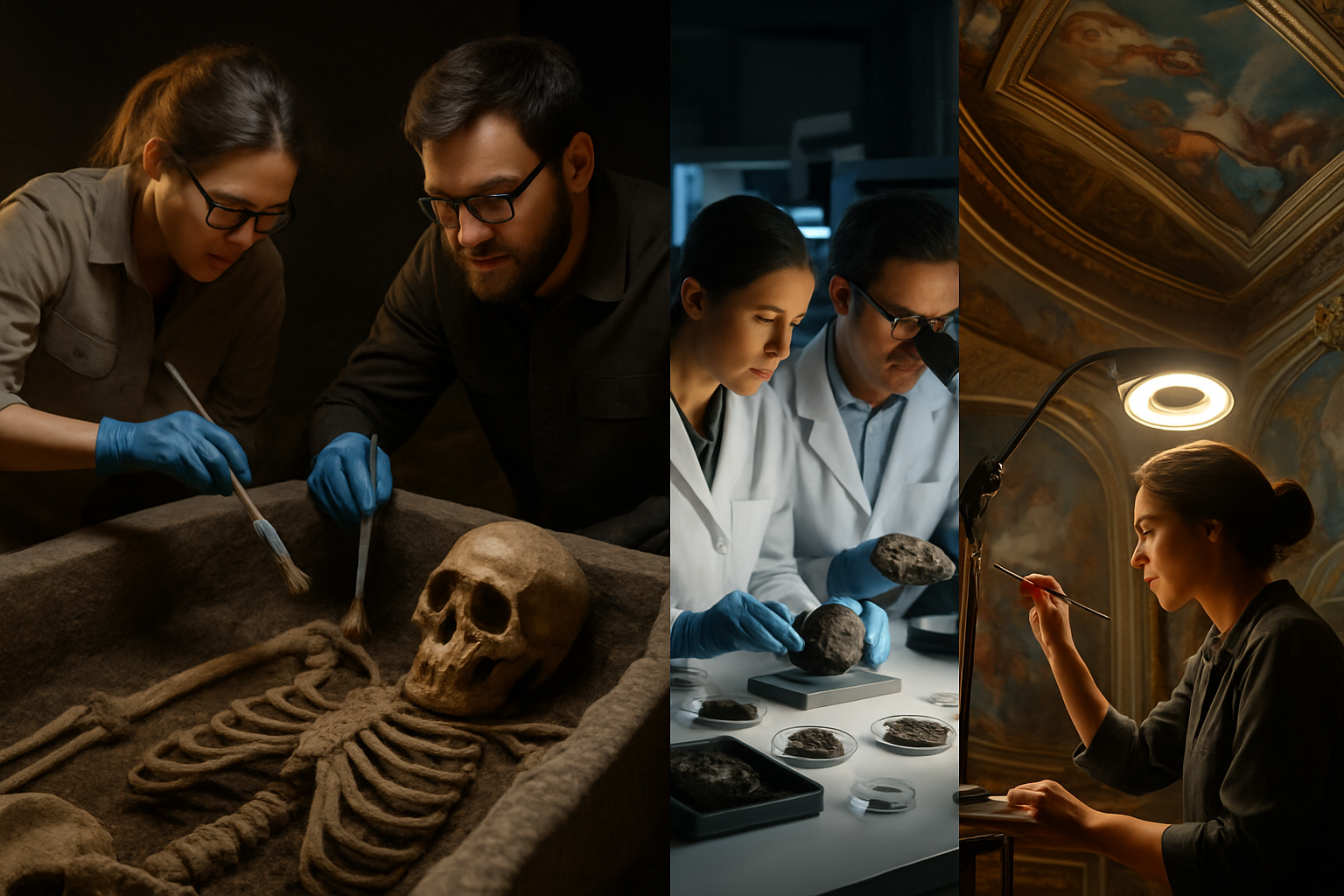
A remarkable convergence of archaeological and historical discoveries across three nations has provided unprecedented insights into past civilizations, from medieval Finnish royalty to potential ancient life on Mars, marking February 2026 as a pivotal moment in our understanding of history.
Finland: Unveiling the Only Royal Remains on Finnish Soil
In a historic moment for Finnish archaeology, researchers at the University of Turku have opened the sarcophagus of Kaarina Maununtytär, the only member of royalty ever buried on Finnish soil. Using cutting-edge bioarchaeological methods, the team is conducting comprehensive analysis to reveal new information about the queen's appearance, health, and background.
The opening of this medieval sarcophagus represents a watershed moment in Finnish historical research. Kaarina Maununtytär, whose remains have lain undisturbed for centuries, offers researchers an unprecedented opportunity to understand medieval royal life in the Nordic region through advanced scientific techniques unavailable to previous generations of archaeologists.
"This discovery allows us to apply modern bioarchaeological methods to answer questions that have remained unanswered for hundreds of years," explained Dr. Päivi Onkamo, leading the research team. "We can now examine DNA, isotope analysis, and skeletal pathology to create a comprehensive picture of medieval royal life."
Czech Republic: Martian Meteorite Reveals Ancient Water Secrets
Simultaneously, Czech researchers have made groundbreaking discoveries about Mars' ancient past through analysis of the mysterious meteorite nicknamed "Black Beauty" (Černá kráska). The meteorite, which traveled from Mars to Earth, contains significantly more water than previously assumed, according to a new study based on advanced neutron scanning methodology.
This discovery strengthens theories that Mars was a much wetter planet in ancient times and potentially a place where simple life could have emerged. The neutron scanning technique revealed water signatures that traditional analysis methods had missed, suggesting that our understanding of Martian hydrology may need fundamental revision.
"The implications are profound," noted Dr. Pavel Kotas, lead researcher on the project. "If Mars contained this much water, the possibilities for ancient microbial life become much more realistic. This meteorite is essentially a time capsule from ancient Mars."
Monaco: Hidden Renaissance Masterpieces Emerge from Palace Ceilings
Perhaps the most visually stunning discovery comes from Monaco's Prince's Palace, where remarkable Renaissance frescoes hidden for centuries beneath palace ceilings are being unveiled to international scholars. What began as routine decorative maintenance in 2013 evolved into an extraordinary archaeological discovery when restoration teams uncovered a complete ensemble of late Renaissance frescoes.
These monumental visual allegories of Grimaldi family history from the 16th century onwards were previously unknown and hidden from view for generations. The works compose a comprehensive narrative of one of Europe's oldest ruling dynasties, preserved in pristine condition by their concealment.
The revelation will culminate in a three-day international conference from March 19-21, 2026, marking the completion of a decade-long restoration project. Art historians from around the world are expected to attend, as these frescoes may fundamentally alter understanding of Renaissance artistic patronage and palace decoration.
"These frescoes represent an unbroken link to Renaissance artistic tradition," said Dr. Marie-Claire Gibello, lead art historian on the project. "They provide insights not just into artistic technique, but into how powerful families commissioned art to legitimize their rule and preserve their legacy."
— Dr. Marie-Claire Gibello, Art Historian
Broader Implications for Historical Understanding
These three discoveries, occurring simultaneously across Europe, represent different facets of the archaeological renaissance currently transforming historical research. The Finnish royal analysis demonstrates how modern scientific techniques can extract information from ancient remains that previous generations of researchers could never access.
The Czech meteorite research shows how space archaeology—the study of extraterrestrial materials—can provide insights into planetary history and the potential for life beyond Earth. Meanwhile, the Monaco frescoes remind us that significant historical artifacts may still lie hidden in plain sight, waiting for the right moment of discovery.
Advanced Technologies Revolutionizing Archaeology
Each discovery showcases the crucial role of advanced technology in modern archaeological research. The Finnish team employs sophisticated DNA analysis, isotope studies, and digital imaging to create comprehensive portraits of medieval life. Czech researchers utilize neutron scanning techniques that can detect water signatures invisible to conventional analysis.
In Monaco, restoration specialists use advanced imaging technology, chemical analysis, and digital documentation to reveal and preserve artworks that have survived centuries of concealment. These technological approaches represent the cutting edge of archaeological methodology.
International Cooperation in Historical Research
The simultaneous nature of these discoveries across three nations demonstrates the increasingly international character of archaeological research. Modern archaeology requires collaboration between specialists in multiple fields—from biochemistry to art history, from planetary science to medieval studies.
This collaborative approach reflects broader trends in 21st-century archaeology, where the most significant discoveries often result from interdisciplinary teams bringing diverse expertise to complex historical questions.
Looking Forward: The Future of Archaeological Discovery
These February 2026 discoveries suggest that we may be entering a golden age of archaeological research, where advanced scientific techniques are revealing previously hidden aspects of human and planetary history. The combination of sophisticated technology, international cooperation, and systematic research approaches is producing unprecedented insights into the past.
The implications extend beyond academic research. These discoveries help us understand human adaptation, artistic expression, and our place in the cosmos. They provide concrete evidence of how past civilizations lived, created, and understood their world—knowledge that remains relevant for contemporary challenges.
As researchers continue their analysis of these remarkable finds, the international archaeological community awaits further revelations that may fundamentally alter our understanding of medieval Europe, ancient Mars, and Renaissance artistic achievement.