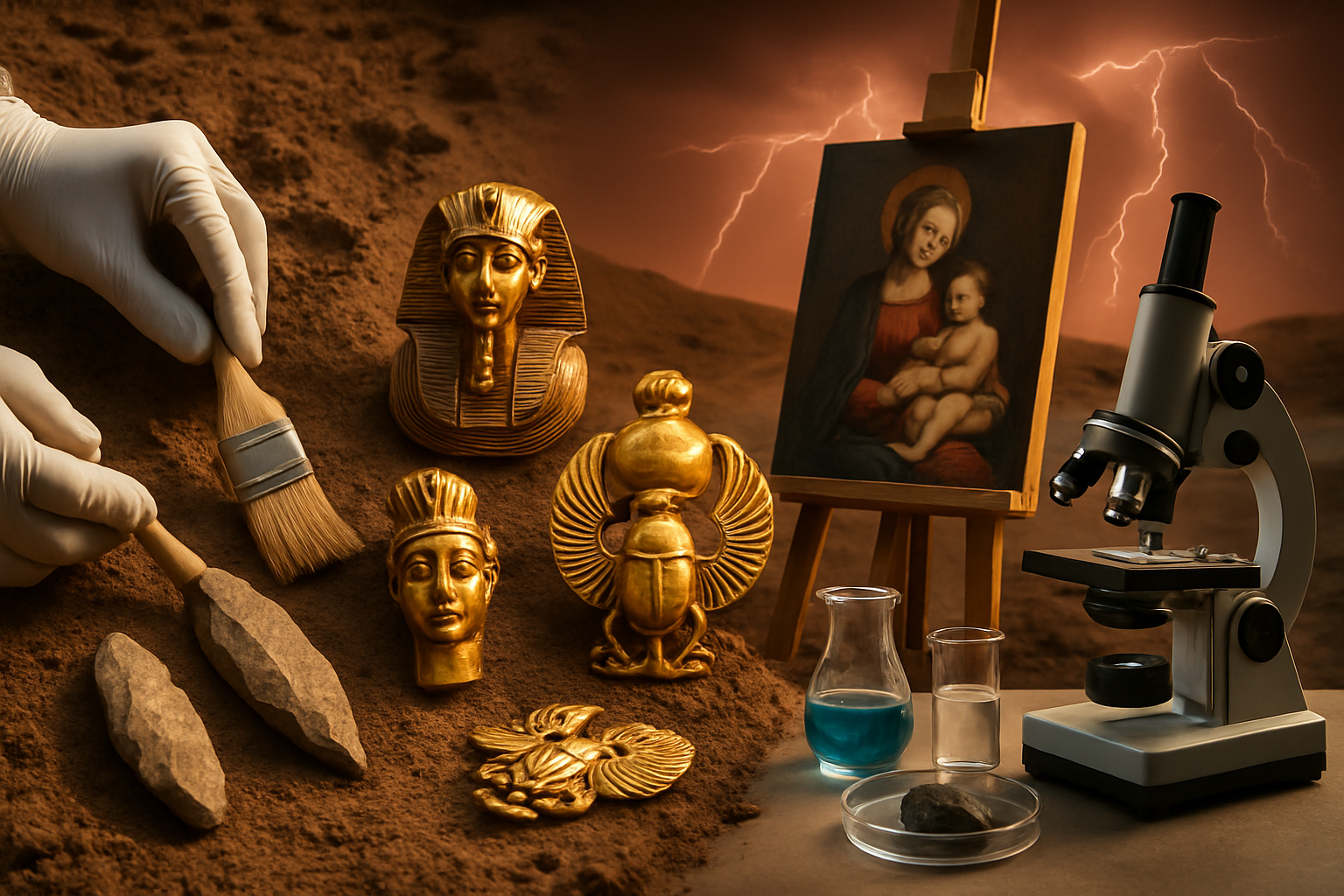
March 2026 continues the extraordinary archaeological and scientific renaissance that has defined this year, with four groundbreaking discoveries spanning from prehistoric South Africa to the red planet Mars, challenging long-held theories about human evolution and planetary phenomena.
The convergence of ancient human innovation and cutting-edge space research exemplifies how 2026 has become a watershed year for scientific discovery. From microscopic stone tools that predate major archaeological transitions to electromagnetic signals detected across the solar system, researchers are rewriting textbooks across multiple scientific disciplines.
Redefining the Stone Age Transition
Austrian researchers have fundamentally challenged the accepted understanding of human technological development in South Africa with their analysis of minute stone tools from archaeological sites dating to the late Stone Age transition. The discovery, published this week, reveals that what was long considered an abrupt shift in human technology was actually a gradual transformation spanning thousands of years.
For decades, archaeologists believed the transition to the late Paleolithic period in South Africa represented a sudden technological breakthrough. However, detailed analysis of microscopic stone implements suggests early humans underwent a slow, methodical evolution in their tool-making capabilities rather than experiencing a dramatic leap forward.
"These tiny tools tell the story of careful, incremental innovation rather than revolutionary change. Early humans were experimenting and refining their techniques over millennia, not experiencing sudden breakthroughs."
— Lead researcher, Austrian archaeological team
The findings add to a growing body of evidence from 2026's archaeological renaissance that consistently reveals greater sophistication in early human societies than previously understood. Similar discoveries this year have included evidence of fire control 350,000 years earlier than expected, complex astronomical systems dating back 8,000 years, and sophisticated ancient drilling machines in Egypt from 5,000 years ago.
Lightning Storms on the Red Planet
While archaeologists rewrite human history on Earth, Czech scientists have made an equally groundbreaking discovery about our planetary neighbor. For the first time, researchers have documented what appears to be lightning-like electrical discharges in the Martian atmosphere, detected through electromagnetic signals captured by NASA's MAVEN spacecraft.
The Czech research team, analyzing years of data from the Mars Atmosphere and Volatile Evolution mission, identified distinctive electromagnetic signatures consistent with electrical discharges similar to Earth's lightning. These "whistler waves" - electromagnetic signals created during electrical events - provide the first concrete evidence that Mars experiences electrical storms despite its thin atmosphere.
The discovery challenges conventional understanding of planetary atmospheric physics. Mars' atmosphere is less than 1% as dense as Earth's, leading scientists to question whether electrical storms were possible. The Czech findings suggest that even in such rarefied conditions, atmospheric electrical activity can occur under specific circumstances.
Renaissance Art Authentication Breakthrough
Meanwhile, in the art world, technological advances are revealing hidden masterpieces. Amsterdam's Rijksmuseum has authenticated a previously dismissed Rembrandt painting through advanced scientific analysis unavailable just decades ago.
The work, titled "Vision of Zechariah in the Temple" and dated to 1633, had been rejected by scholars in 1960 due to conservative attribution practices of the mid-20th century. However, modern techniques including X-ray fluorescence spectroscopy, infrared reflectography, and dendrochronological analysis have confirmed its authenticity.
The painting depicts the biblical scene of the priest Zechariah receiving a divine vision in the Temple of Jerusalem. Analysis revealed characteristic Rembrandt materials, including expensive ultramarine blue and vermillion pigments, while canvas weave patterns and ground layer composition supported the attribution.
"This represents a renaissance of rediscovery. Advanced analytical techniques are allowing us to reconsider works dismissed by earlier generations of scholars."
— Rijksmuseum conservation scientist
Egyptian Treasures in London's Spotlight
The month's discoveries culminate with the opening of a major Egyptian archaeological exhibition in London. "Ramses and the Pharaohs' Gold" at Battersea Power Station showcases more than 180 artifacts, including the golden mask of King Amenemope, ruler of Egypt's Twenty-First Dynasty.
The exhibition represents the culmination of decades of Egyptian archaeological work, featuring treasures that demonstrate the sophisticated craftsmanship and cultural achievements of ancient Egyptian civilization. The golden mask of King Amenemope, in particular, exemplifies the technical mastery of ancient Egyptian metallurgy and artistic design.
These artifacts provide crucial context for understanding the broader archaeological renaissance of 2026. The Egyptian discoveries, combined with similar finds worldwide, paint a picture of ancient civilizations far more sophisticated and interconnected than previously believed.
The Technology Revolution Enabling Discovery
What unifies these diverse discoveries is the technological revolution enabling them. Advanced chemical analysis reveals microscopic details in ancient stone tools, space-based instruments detect electromagnetic phenomena across planetary distances, and sophisticated imaging techniques peer beneath centuries of paint and varnish.
The archaeological community has embraced what researchers term "convergence methodology" - combining traditional excavation and analysis techniques with cutting-edge technology including DNA analysis, isotope studies, advanced imaging, and environmental reconstruction.
This technological integration extends to space science, where missions like MAVEN continue analyzing data years after initial collection, revealing new phenomena through improved analytical techniques. The Czech team's identification of Martian lightning demonstrates how reanalyzing existing data with new methods can yield breakthrough discoveries.
International Cooperation Drives Innovation
Perhaps most significantly, these discoveries exemplify the international cooperation that has characterized 2026's scientific renaissance. Austrian researchers collaborate with South African archaeologists, Czech scientists analyze American spacecraft data, Dutch museums work with international conservation experts, and Egyptian artifacts travel to London for global audiences.
This collaborative approach transcends traditional academic boundaries, with archaeologists, planetary scientists, art historians, and conservation specialists sharing methodologies and insights. The result is a comprehensive understanding of human achievement that spans from our earliest tool-making ancestors to our current exploration of neighboring planets.
Climate Urgency Driving Preservation
Underlying these discoveries is an urgent recognition that both archaeological sites and scientific opportunities face environmental threats. Climate change affects ancient sites worldwide, while limited spacecraft missions make data analysis increasingly precious.
January 2026 marked the 18th consecutive month exceeding 1.5°C above pre-industrial levels, adding urgency to archaeological preservation efforts. Many sites containing ancient treasures face threats from climate change, development, and natural deterioration, necessitating systematic documentation and international cooperation.
Economic and Cultural Impact
These discoveries generate significant economic and cultural benefits beyond their scientific value. Archaeological tourism boosts local economies, while major exhibitions like the Egyptian show in London attract international visitors and media attention.
The authentication of previously dismissed artworks demonstrates the financial stakes involved in art historical research. A confirmed Rembrandt painting carries enormous monetary value while contributing to our understanding of artistic development during the Dutch Golden Age.
Similarly, space discoveries about Mars contribute to long-term planning for human exploration, while archaeological findings inform our understanding of human adaptation and innovation throughout history.
Future Implications
As 2026 continues, these discoveries establish new standards for interdisciplinary research combining traditional scholarly methods with advanced technology. The success across varied contexts - from prehistoric South Africa to modern Mars exploration - provides templates for future scientific investigation.
The gradual Stone Age transition revealed in South Africa suggests human technological development followed more complex patterns than simple linear progression. This understanding could inform how we approach contemporary technological challenges and social adaptation.
The detection of electrical activity on Mars adds to growing evidence that planetary atmospheres exhibit more dynamic behavior than previously understood. This research contributes to the search for potentially habitable worlds around other stars and informs planning for future Mars exploration missions.
Meanwhile, the art authentication breakthrough demonstrates how technological advances can recover lost cultural treasures, with implications for museums and private collections worldwide. Many previously dismissed works may deserve reconsideration using modern analytical techniques.
Looking Ahead
March 2026's discoveries represent just the latest chapter in what researchers are calling an unprecedented year for scientific breakthrough. The combination of advanced technology, international cooperation, and urgent preservation needs has created ideal conditions for transformative discoveries.
From the careful analysis of microscopic stone tools to the detection of electromagnetic signals across the solar system, researchers are demonstrating that significant discoveries remain possible when traditional methods meet modern technology. The question is not whether more breakthroughs await, but rather what new understanding of our world and universe these discoveries will reveal.
As we move forward in 2026, the archaeological and scientific renaissance continues to challenge our assumptions about human capability, planetary phenomena, and the interconnected nature of discovery across space and time. Each finding builds upon previous knowledge while opening new questions for future investigation, ensuring that our understanding of both ancient achievements and cosmic phenomena will continue evolving throughout this remarkable year.