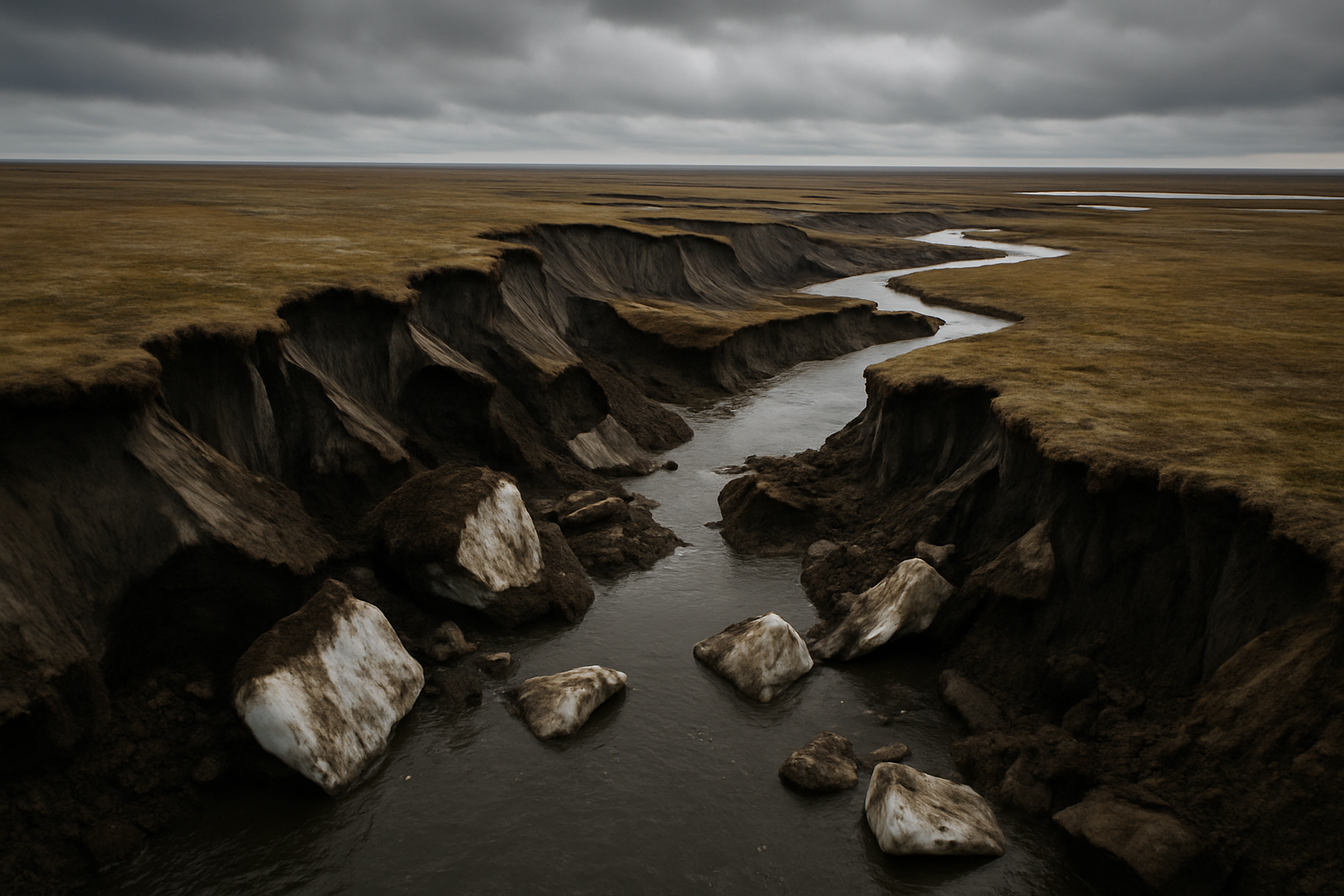
Arctic permafrost is collapsing along Canada's northern coastlines at unprecedented rates while Chinese scientists warn that a developing El Niño could trigger a global energy crisis, creating a dangerous convergence of climate impacts during what may be the 24th consecutive month of extreme global warming.
On the remote Yukon island of Herschel Island-Qikiqtaruk, dramatic permafrost slumps are reshaping the Arctic landscape as thawing ice-rich soil creates massive coastal depressions. The phenomenon represents a visible manifestation of how rapidly changing climate conditions are transforming polar regions, offering a stark preview of environmental changes that could become routine within the decade.
Meanwhile, Chinese government scientists have issued urgent warnings that the anticipated El Niño weather pattern could severely disrupt global energy systems, potentially worsening price volatility already triggered by Middle Eastern conflicts. The climate phenomenon, which occurs every two to seven years, threatens to force hydropower stations across multiple regions to reduce output or shut down entirely due to extreme weather conditions.
Permafrost Collapse Accelerating Arctic Transformation
The permafrost degradation documented along Canada's Yukon coast represents more than isolated environmental damage—it signals fundamental changes to Arctic systems that have remained stable for millennia. These permafrost slumps, where ice-rich ground collapses as it thaws, are creating increasingly unstable coastal conditions that threaten traditional ways of life across the circumpolar north.
According to extensive climate data analysis spanning recent months, Arctic regions are experiencing warming at rates far exceeding global averages. This accelerated warming is triggering feedback mechanisms that could amplify climate change impacts worldwide, including the release of previously frozen carbon stores and disruption of ocean circulation patterns.
The transformation visible at Herschel Island-Qikiqtaruk exemplifies broader Arctic changes documented across multiple research initiatives. Finnish meteorologist Dr. Matti Huutonen has reported the earliest tick season on record extending into northern Oulu regions typically unaffected until summer, while Greenland's Nuuk ski resort was forced to shut down completely due to the warmest January temperatures in recorded history.
El Niño Energy Crisis Predictions
Chinese scientists' warnings about El Niño impacts on global energy systems come as international meteorologists predict a 50-60% probability of El Niño development during the July-September period. This timing could prove catastrophic, as the phenomenon would occur during a period of already unprecedented global warming.
The anticipated El Niño effects include severe disruptions to hydroelectric power generation through both drought conditions that reduce reservoir levels and extreme precipitation events that force facility shutdowns for safety reasons. These impacts could force greater reliance on fossil fuel alternatives at precisely the moment when energy security has become a critical geopolitical concern due to Middle Eastern conflicts.
"The convergence of El Niño with current warming trends could create energy supply disruptions beyond what we've previously modeled," explained climate researchers tracking global weather patterns. The phenomenon's ability to dramatically alter precipitation patterns worldwide makes hydropower systems particularly vulnerable, especially in regions where they constitute primary electricity sources.
Global Climate Milestone: Record-Breaking Temperature Streak
The permafrost and energy crisis warnings emerge during what climate scientists describe as the longest sustained period of extreme global warming in recorded history. January 2026 marked the hottest month ever recorded, extending a temperature streak that has consistently exceeded critical thresholds for nearly two years.
This sustained warming has fundamentally altered atmospheric systems, overriding natural climate variability including La Niña cooling effects that historically provided temporary relief from temperature increases. The result is what researchers term a "climate volatility paradox"—sustained global warming that simultaneously enables record heat and devastating regional weather extremes through disrupted atmospheric circulation patterns.
"We're witnessing changes to fundamental Earth systems that have remained stable throughout human civilization. The speed and scale of these changes represents uncharted territory for climate science."
— Dr. Matti Huutonen, Finnish Meteorological Institute
The temperature records reflect human-induced climate change that has completely overwhelmed natural cooling mechanisms, creating compound environmental effects that traditional climate adaptation strategies struggle to address. Arctic sea ice loss equivalent to the area of Vienna occurs annually, while polar circulation patterns show structural instability unprecedented in observational records.
Ecosystem and Infrastructure Impacts
Beyond energy concerns, the converging climate impacts threaten ecosystems across multiple continents. Colombian authorities are grappling with invasive species management as changing conditions allow new organisms to establish in previously unsuitable environments. These biological invasions represent another dimension of environmental pressure as traditional ecological relationships become unstable.
Infrastructure systems designed for historical climate conditions are repeatedly failing as extreme weather events exceed operational parameters. Emergency response systems worldwide report operating at or beyond capacity limits, with traditional mutual aid mechanisms proving inadequate when multiple regions face simultaneous disasters rather than sequential emergencies.
The economic implications extend far beyond immediate energy costs. Agricultural systems face mounting losses as extreme weather destroys crops and disrupts supply chains during critical growing seasons. Tourism industries experience extended cancellations due to infrastructure damage, while mental health services report increased demand related to climate anxiety and repeated trauma from environmental disasters.
International Cooperation Under Strain
The simultaneity of climate challenges is testing international cooperation mechanisms designed for sequential rather than concurrent global emergencies. The European Union's Civil Protection mechanism has been repeatedly activated, with a €246 million response to Sweden-Denmark assistance representing the largest coordinated European weather response on record—yet proving insufficient for the scale and simultaneity of current challenges.
Environmental challenges increasingly transcend political boundaries as atmospheric systems and ocean currents transport climate effects globally, making unilateral adaptation efforts insufficient. Success in addressing these converging crises requires unprecedented international cooperation, enhanced multi-sector coordination, and sustained financial commitments recognizing environmental protection as essential infrastructure rather than regulatory burden.
Technology and Traditional Knowledge Integration
Successful climate adaptation strategies emerging globally demonstrate the need for sophisticated integration of cutting-edge technology with traditional ecological knowledge and community-based management systems. Estonia's combination of agricultural wisdom with advanced climate monitoring, Australia's integration of Indigenous fire management with modern meteorological forecasting, and Finland's "transformative adaptation" approaches provide templates for scaling adaptation efforts worldwide.
Advanced monitoring systems including satellite imagery, environmental DNA sampling, and AI-powered analysis can provide rapid threat response capabilities, but require community engagement and local expertise to achieve maximum effectiveness. This technology-tradition synthesis represents a fundamental evolution in environmental protection methodology toward comprehensive frameworks that combine scientific rigor with cultural sensitivity and community ownership.
Critical Decision Point for Global Climate Action
Climate scientists describe April 2026 as a potential watershed moment in global climate preparedness, forcing a critical choice between reactive crisis management and transformative infrastructure adaptation. The current conditions offer a preview of what could become routine by the 2030s without comprehensive climate adaptation investment.
The environmental action window is narrowing rapidly as ecological systems approach critical thresholds that could trigger irreversible changes affecting global food security, climate stability, and human settlements. Additional weather systems developing in Atlantic and Pacific regions suggest these crisis conditions may persist for weeks or months, potentially establishing a "new normal" of extreme weather frequency and intensity that permanently challenges traditional frameworks.
Tools, knowledge, and cooperation frameworks exist for comprehensive environmental protection, but success depends on unprecedented speed of coordination and sustained international cooperation with political commitment to environmental protection as essential infrastructure for human prosperity and planetary sustainability.
Future Implications and Strategic Response
The question confronting global policymakers is no longer whether transformative climate action is needed, but whether humanity can organize and implement solutions rapidly enough to maintain planetary habitability during Earth's most environmentally challenging period in recorded history.
The convergence of Arctic permafrost collapse, energy system vulnerabilities, and extreme weather events underscores the urgent need for coordinated international action. Current initiatives across multiple nations demonstrate remarkable human adaptive capacity and innovation in species protection, renewable energy deployment, and community-based environmental stewardship.
However, the choices made in coming months could prove decisive for climate resilience strategies affecting generations. The integration of immediate crisis response with long-term resilience building provides a practical framework for coordinated international efforts during what researchers unanimously describe as a decisive decade for climate action.
As permafrost continues to thaw across Arctic regions and energy systems face unprecedented strain from climate volatility, the international community confronts a critical moment that will determine humanity's capacity to maintain environmental stability while adapting to permanent changes in Earth's climate systems.