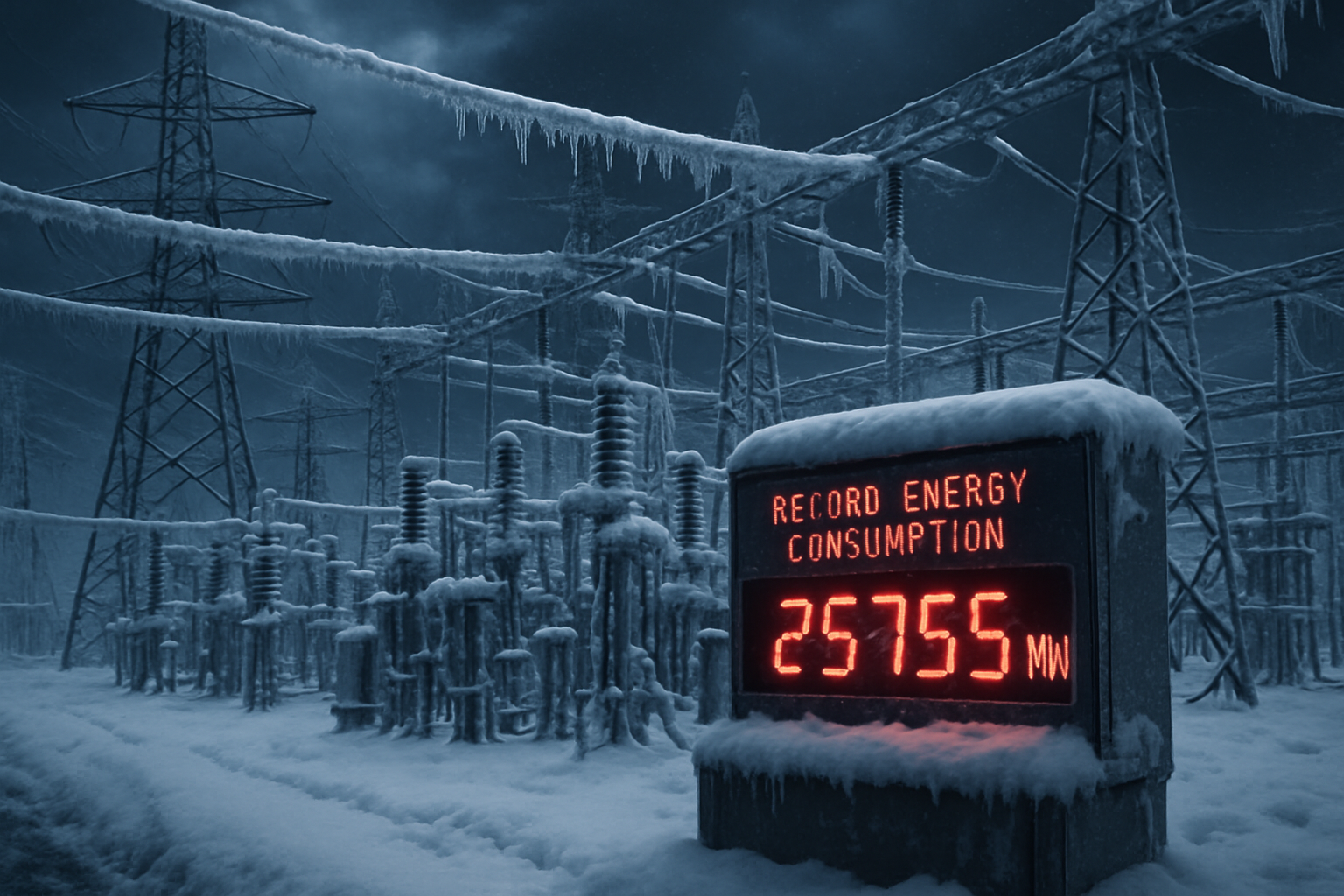
Arctic conditions sweeping across Northern Europe and parts of North America are pushing electricity grids to their breaking points, with multiple nations recording unprecedented energy consumption levels while grappling with cascading infrastructure failures that threaten millions of people during the harshest winter in decades.
Estonia set a new national electricity consumption record on Thursday morning, with grid operator Elering recording demand at 1,723 megawatts as temperatures plummeted and heating systems worked overtime to maintain livable conditions. The Baltic nation has been experiencing its coldest winter in 25 years, part of a broader European crisis that has already claimed over 140 lives across the Northern Hemisphere since late January.
Infrastructure Under Siege
The energy crisis extends far beyond simple supply and demand imbalances. In Cuba, a substation failure in Holguín triggered a cascading blackout across four eastern provinces on February 4, cutting power to 3.4 million people including Santiago de Cuba, the country's second-largest city. The collapse comes as Cuba's oil reserves have dwindled to an estimated 15-20 days of supply, with Venezuelan crude supplies cut to zero following the recent political upheaval in Caracas.
Meanwhile, Guatemala is bracing for temperatures that could descend to 0°C or below in western regions, according to the National Institute of Seismology, Volcanology, Meteorology and Hydrology (Insivumeh). This unprecedented cold wave is part of a larger weather pattern affecting Central America, with frost warnings extending across multiple countries.
"We are witnessing the convergence of extreme weather events, aging infrastructure, and geopolitical tensions creating a perfect storm for energy system failures."
— European Energy Security Analyst
European Grid Struggles
The situation in Europe reveals the fragility of energy systems under extreme stress. Historical context shows this crisis building over weeks, with Poland recording historic electricity demand of 27.7 gigawatts and production peaking at 29.8 gigawatts during earlier cold snaps in February. Finland faced electricity prices spiking to 250 euros per day, forcing business closures as heating costs became prohibitive.
Estonia's new record consumption comes just days after the country opened continental Europe's largest battery storage facility at Kiisa, Harju County, with capacity to serve 90,000 households. However, even this significant infrastructure investment appears insufficient to buffer against the extreme demand spikes caused by sustained Arctic conditions.
Global Energy Market Volatility
The energy crisis has sent shockwaves through global markets, with natural gas prices surging 24% in Europe and a staggering 78% in the United States over the past month. These price increases reflect not only immediate supply constraints but also concerns about infrastructure resilience and geopolitical stability affecting energy supplies.
The timing of the crisis is particularly problematic as European nations grapple with reduced Russian energy imports while simultaneously facing criticism from EU auditors about critical materials shortages. China currently controls 60% of global production and 90% of refining capacity for lithium, cobalt, and rare earth elements essential for renewable energy infrastructure.
Climate Paradox Amid Record Heat
Paradoxically, these extreme cold events are occurring during what has been confirmed as January 2026 being the hottest month in global recorded history—the 18th consecutive month exceeding 1.5°C above pre-industrial levels. This apparent contradiction demonstrates the increasing volatility and unpredictability of global weather systems as climate change accelerates.
The Northern Hemisphere has experienced unprecedented extreme weather patterns, from Arctic conditions in Europe to devastating storms in Spain and Portugal. Storm Leonardo has forced the evacuation of thousands in Andalusia, while countries like Latvia recorded their coldest January ever at -8.7°C, 5.7 degrees below the 1991-2020 average.
Infrastructure Adaptation Challenges
The current crisis highlights critical gaps in energy infrastructure adaptation to extreme weather events. In Finland, traditional ice roads across the Archipelago Sea could not be established despite severe cold because equipment has deteriorated over 20 years of disuse, representing the end of traditional Baltic winter transport methods.
Transportation systems have also suffered extensively, with Berlin Brandenburg Airport suspending all takeoffs due to black ice conditions and Poland's railway system experiencing complete paralysis in the Lower Silesia region, where trains became literally frozen to tracks in Głogów.
Emergency Response Measures
Governments across the affected regions have activated emergency protocols. Sweden and Denmark announced a €246 million assistance package for energy infrastructure support, while emergency warming centers have been opened across multiple countries. Poland has deployed fighter jets as a precautionary measure, and various nations have suspended educational activities to conserve energy and ensure public safety.
The crisis has also exposed vulnerabilities in newer energy technologies. While Austria achieved 88% renewable electricity production in 2024, the current extreme weather demonstrates that renewable systems require robust backup infrastructure to maintain grid stability during unprecedented demand spikes.
Long-term Implications
This energy crisis serves as a stark reminder of the challenges facing the global transition to sustainable energy systems. The simultaneous pressures of extreme weather, aging infrastructure, geopolitical tensions, and supply chain vulnerabilities create a complex web of risks that require coordinated international responses.
As governments work to restore normal service, the events of February 2026 will likely accelerate discussions about energy security, infrastructure resilience, and the need for more robust emergency preparedness systems capable of handling the increasing frequency and intensity of extreme weather events in our changing climate.